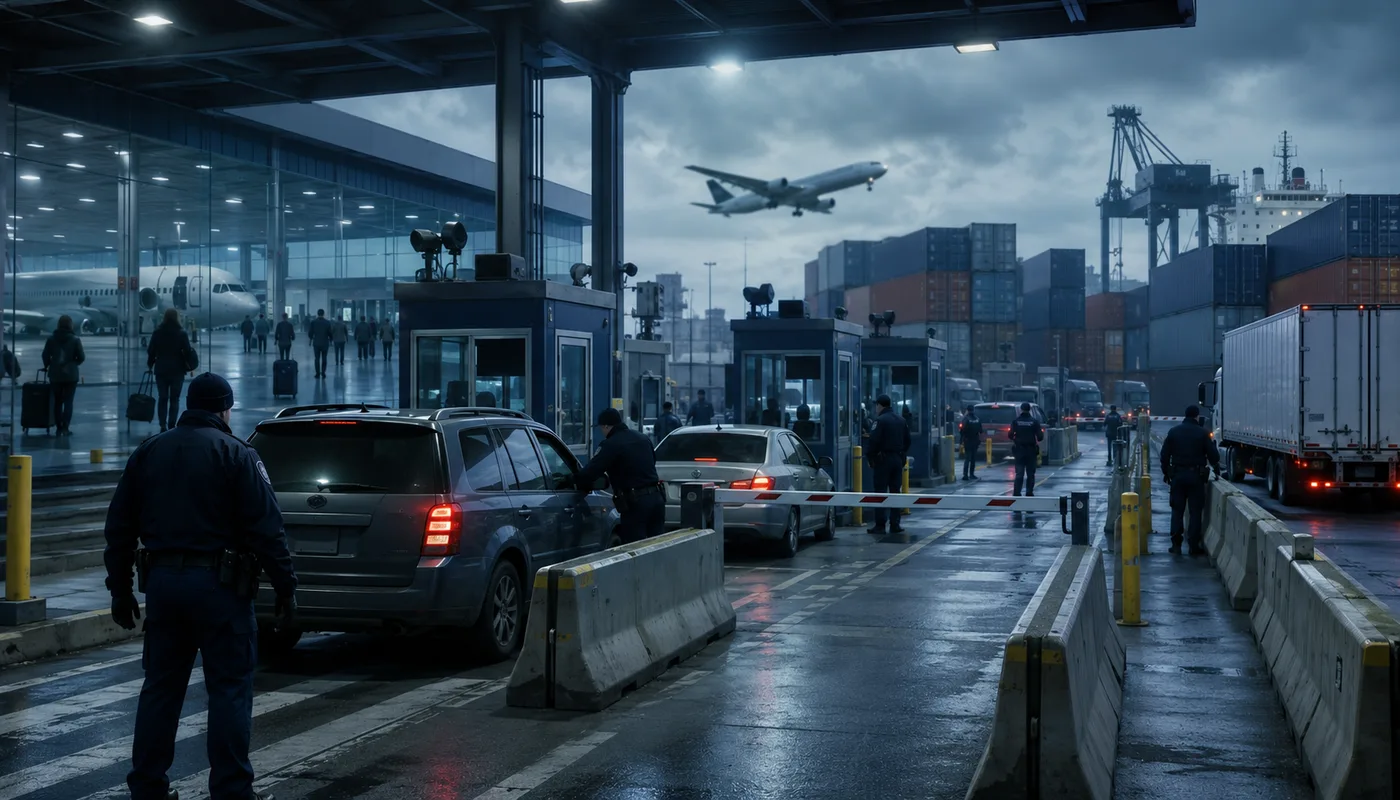
United States Customs and Border Protection Is Bigger Than the Border Debate
United States Customs and Border Protection is the DHS agency at the center of a paradox: fewer border crossings, wider border power.
Key takeaways
United States Customs and Border Protection is a border operating system, not just a patrol force.
- CBP is broader than Border Patrol; it also includes Field Operations, Air and Marine Operations, and the Office of Trade inside one DHS component.
- CBP’s FY 2026 request lists $23.0 billion, 69,874 positions, and 67,964 full-time equivalents in DHS budget documents.
- CBP reported 8,943 southwest Border Patrol apprehensions in April 2026 and said Border Patrol again made zero releases into the United States on May 15, 2026.
- CBP affects online shopping because duty-free de minimis treatment for shipments valued at $800 or less was suspended globally effective August 29, 2025 under CBP guidance.
- CBP says more than 90% of interdicted fentanyl is stopped at ports of entry, primarily in vehicles driven by U.S. citizens on its fentanyl initiative page.
United States Customs and Border Protection is not simply the uniform at the fence. It is the checkpoint where migration, customs, drugs, travel data, and tariffs collide. That matters now because the visible border story has narrowed while CBP’s practical reach has widened. The latest public border numbers point to unusually low southwest Border Patrol apprehensions in April 2026, but the agency is also enforcing tariff changes, screening travelers, seizing narcotics, and policing cargo through its public statistics hub. The useful way to read CBP news is to separate four gates: people, goods, data, and money. Most political arguments flatten those gates into one slogan. That misses the real story.
What is United States Customs and Border Protection?
United States Customs and Border Protection is the DHS agency responsible for securing U.S. borders while facilitating lawful travel and trade according to CBP’s official overview.
CBP was created on March 1, 2003, when customs, immigration inspection, Border Patrol, and agriculture inspection functions moved into the new Department of Homeland Security under CBP’s history page. Border Patrol works between ports of entry. CBP officers in Field Operations work at airports, seaports, and land crossings. Air and Marine Operations covers air and maritime interdiction. The Office of Trade handles customs enforcement, tariff collection, and supply-chain rules under CBP’s organization page.
The myth correction is simple: Border Patrol is part of CBP; it is not CBP itself.
Why is CBP trending in U.S. law and government now?
CBP is trending because immigration enforcement, tariff policy, fentanyl interdiction, and traveler screening are converging inside one agency.
The headline is the border. The operating story is broader. CBP said April 2026 southwest Border Patrol apprehensions were 8,943, 94% lower than the Biden-administration monthly average cited by the agency in its May 15 release. That comparison is politically loaded, but the direction is clear: fewer unlawful crossings do not make CBP less powerful.
CBP is also enforcing a larger customs burden. Its e-commerce guidance says duty-free treatment for shipments valued at or under $800 from all countries was suspended effective August 29, 2025 under the de minimis update. A December 2025 Federal Register notice proposed making five years of social-media information a mandatory ESTA data element for Visa Waiver Program travelers in the I-94 and ESTA notice. Border law is now platform law.
How big is CBP in 2026?
CBP’s FY 2026 request treats the agency as a 69,874-position, $23.0 billion border-and-trade machine in DHS budget materials.
CBP officers and agents operate at 328 ports of entry across the United States according to CBP’s ports-of-entry page. That footprint explains the tension. CBP must move lawful travelers and goods quickly while stopping unlawful entries, contraband, pests, and fraud accurately. Speed helps travel and commerce. Scrutiny protects security and revenue. The agency is judged, fairly or not, on both at once.
What changed at the border as of June 3, 2026?
The latest CBP/DHS public release says April 2026 southwest Border Patrol apprehensions were 8,943 and Border Patrol again made zero releases into the United States in the May 15, 2026 announcement.
As of June 3, 2026, final FY 2026 border totals are not available because the fiscal year runs from October 1, 2025, through September 30, 2026 under CBP’s nationwide encounters page. April data can show direction, but it is not a full-year verdict.
CBP also reported 463 pounds of fentanyl seized in April 2026, with heroin seizures up 73% and methamphetamine seizures up 63% from March 2026 in the same release. The friction: seizure numbers measure what CBP finds, not the total amount trafficked.
Why does CBP matter beyond immigration?
CBP matters beyond immigration because it is also America’s customs collector, cargo screener, agriculture firewall, drug-interdiction force, and travel-screening gatekeeper according to CBP’s mission overview.
The trade role became harder to ignore after the 2025 de minimis shift. CBP guidance says duty-free de minimis treatment is suspended for low-value shipments from all countries, effective August 29, 2025 under its e-commerce FAQ. That makes CBP relevant to importers, marketplaces, customs brokers, and consumers who never think about border policy.
The drug role is also misread. CBP says more than 90% of interdicted fentanyl is stopped at ports of entry, where cartels primarily use vehicles driven by U.S. citizens on CBP’s fentanyl page. That does not erase illegal crossings. It does correct the myth that fentanyl is mainly a desert-crossing story.
How should readers interpret CBP news without getting misled?
CBP news is clearest when read through four gates: people, goods, data, and money.
People means encounters, admissibility, asylum processing, removals, and releases. Goods means cargo inspections, agriculture controls, and de minimis entries. Data means ESTA, biometrics, traveler records, watchlists, and risk scoring. Money means duties, tariffs, fees, penalties, and customs fraud.
This four-gate test prevents lazy readings. A falling encounter number does not prove every border risk is falling. A rising seizure number does not prove trafficking is rising. A faster airport lane does not mean lighter vetting. The right question is narrower: which gate moved, who benefits, and who pays the cost?
FAQ
The FAQ answers the common CBP search intents behind the keyword.
What is United States Customs and Border Protection?
United States Customs and Border Protection is the DHS agency that controls U.S. border entry, customs, cargo, tariffs, agriculture inspections, and travel screening according to CBP.
Is CBP the same as Border Patrol?
CBP is not the same as Border Patrol; U.S. Border Patrol is one component of CBP, alongside the Office of Field Operations, Air and Marine Operations, and the Office of Trade under CBP’s organization page.
What changed at the U.S. border in April 2026?
CBP reported 8,943 southwest Border Patrol apprehensions in April 2026 and said Border Patrol again made zero releases into the United States in its May 15, 2026 release.
Why does CBP affect online shopping?
CBP affects online shopping because it enforces customs entries, tariffs, and the 2025 suspension of duty-free de minimis treatment for shipments valued at $800 or less under CBP guidance.
Sources
Sources are listed in the same order they support the analysis.
- About CBP — U.S. Customs and Border Protection, unknown.
- Leadership & Organization — U.S. Customs and Border Protection, 2026-03-24.
- U.S. Customs and Border Protection FY 2026 Congressional Budget Justification — Department of Homeland Security, 2025-06-13.
- Trump administration delivers a full year of zero releases at the border — U.S. Customs and Border Protection, 2026-05-15.
- E-Commerce Frequently Asked Questions — U.S. Customs and Border Protection, unknown.
- Frontline Against Fentanyl — U.S. Customs and Border Protection, unknown.
- Stats and Summaries — U.S. Customs and Border Protection, 2026-03-20.
- History — U.S. Customs and Border Protection, unknown.
- Agency Information Collection Activities: Revision, Arrival and Departure Record and ESTA — Federal Register, 2025-12-10.
- At Ports of Entry — U.S. Customs and Border Protection, 2025-07-11.
- Nationwide Encounters — U.S. Customs and Border Protection, unknown.