New Zealand’s Debt Crossroads: Why Fiscal Discipline Has Become a Political Flashpoint
New Zealand’s government debt trajectory remains a central law-and‑government issue as fiscal deficits persist and sovereign credit outlooks turn negative.
Key takeaways
- New Zealand’s net core Crown debt is forecast to peak at about 46.1% of GDP in 2027/28 before declining under current forecasts, up from around 41.8% in 2024/25. (The Treasury New Zealand)
- The 2026 Budget projects operating deficits continuing through 2026/27 with a return to surplus under a narrow fiscal measure (OBEGALx) by 2028/29. (The Treasury New Zealand)
- The government’s bond issuance programme is set at NZ$34 billion for 2026/27, with reductions planned across subsequent years. (New Zealand Debt Management)
- Credit rating agencies Fitch and Moody’s have moved New Zealand’s outlook to “negative”, citing fiscal trajectory concerns. (investingLive)
- Political criticism has sharpened: opposition voices argue the budget fails to address living cost stresses, while supporters stress fiscal discipline. (Reuters)
Defining New Zealand’s debt reality in 2026
New Zealand’s government debt — the total amount the government owes through bonds and other borrowings — is now a focal point of fiscal and political debate. Government forecasting in the 2026 Budget Economic and Fiscal Update expects net core Crown debt (the debt the government holds after accounting for financial assets) to rise and then gradually fall as a share of gross domestic product (GDP), peaking at about 46.1% of GDP around 2027/28. (The Treasury New Zealand)
That ratio is a key measure of fiscal sustainability used by international analysts and credit agencies. It compares the government’s indebtedness to the size of the economy, giving context beyond raw dollar figures. New Zealand’s debt is currently moderate compared with some advanced economies, but the trend has drawn scrutiny because deficits have persisted since the pandemic. (NZ 2026 Budget)
Policymakers and markets are paying close attention because the country is in a delicate phase: it is committed to consolidating debt while also funding critical services and coping with global shocks such as energy price volatility and geopolitical uncertainty.
How much debt is New Zealand carrying — and how did it get here?
New Zealand finances itself through borrowing when government revenue does not cover expenditures. After the COVID-19 pandemic, deficits widened as the state supported households and businesses, pushing debt levels higher relative to GDP. By the mid‑2020s, debt metrics were still elevated:
- Net core Crown debt was around 41.8% of GDP in 2024/25, according to official financial statements. (The Treasury New Zealand)
- Debt has increased through successive budget cycles as expenditures on health, welfare and infrastructure outpaced revenues. (The Treasury New Zealand)
The 2026 Budget — introduced by the Finance Minister — forecasts that debt as a share of GDP will soon crest near 46.1% before trending lower as fiscal consolidation takes hold. (The Treasury New Zealand)
Deficit vs surplus: the engine of the debt trajectory
A key reason debt has increased is ongoing fiscal deficits — when the government spends more than it collects in revenue. The operating balance before gains and losses excluding ACC (OBEGALx), a standard measure of New Zealand’s underlying fiscal position, has shown deficits in recent years and is forecast to remain so through 2026/27. (The Treasury New Zealand)
The Treasury projects a return to surplus on this measure by 2028/29, assuming economic growth and prudent spending. This surplus is what will eventually stop debt from growing faster than the economy. (The Treasury New Zealand)
Bond issuance and debt management in practice
Another barometer of debt is how much government borrows in the bond market. The New Zealand Government Bond (NZGB) programme — the planned issuance of government bonds — is a key tool in funding the deficit and refinancing existing obligations.
For the 2026/27 year, the bond programme is set at NZ$34 billion, with net issuance declining across the forecast period. (New Zealand Debt Management)
This downward revision (a reduction of NZ$6 billion compared with previous forecasts) signals a tentative shift toward fiscal restraint, albeit in the context of ongoing deficits. (New Zealand Debt Management)
In practical terms, a smaller issuance programme can help reduce upward pressure on interest rates and borrowing costs, but it also tightens fiscal space at a time when many New Zealanders feel cost‑of‑living pressures.
Credit rating agencies: why the outlook matters
Sovereign credit ratings influence how costly it is for a nation to borrow. In March and April 2026, two major credit agencies — Fitch Ratings and Moody’s — revised New Zealand’s long‑term credit outlook from stable to negative, citing concerns about the persistent deficits and the slower trajectory toward a balanced budget. (investingLive)
A negative outlook isn’t a downgrade per se, but it warns that a downgrade could occur if fiscal performance weakens further. Markets watch this closely because a downgrade can raise borrowing costs, affecting everything from bond yields to interest rates for households and businesses.
Politics, policy, and public debate
Debt is also a political flashpoint as New Zealand heads toward the 2026 general election. Opposition voices, including spokespeople from the Labour Party, argue the government’s budget fails to address rising living costs and leaves households exposed to economic pressures. (Reuters)
Supporters of the government’s approach counter that fiscal discipline is necessary to put debt on a sustainable path and avoid burdening future generations. Critics on social platforms argue that too much emphasis on squeezing debt could weaken economic growth or restrict essential services.
This tension — between discipline and support, between short‑term relief and long‑term sustainability — lies at the heart of the debt debate in New Zealand today.
A framework for understanding debt debates: the “three arcs”
To parse competing claims on debt, consider the “three arcs” framework:
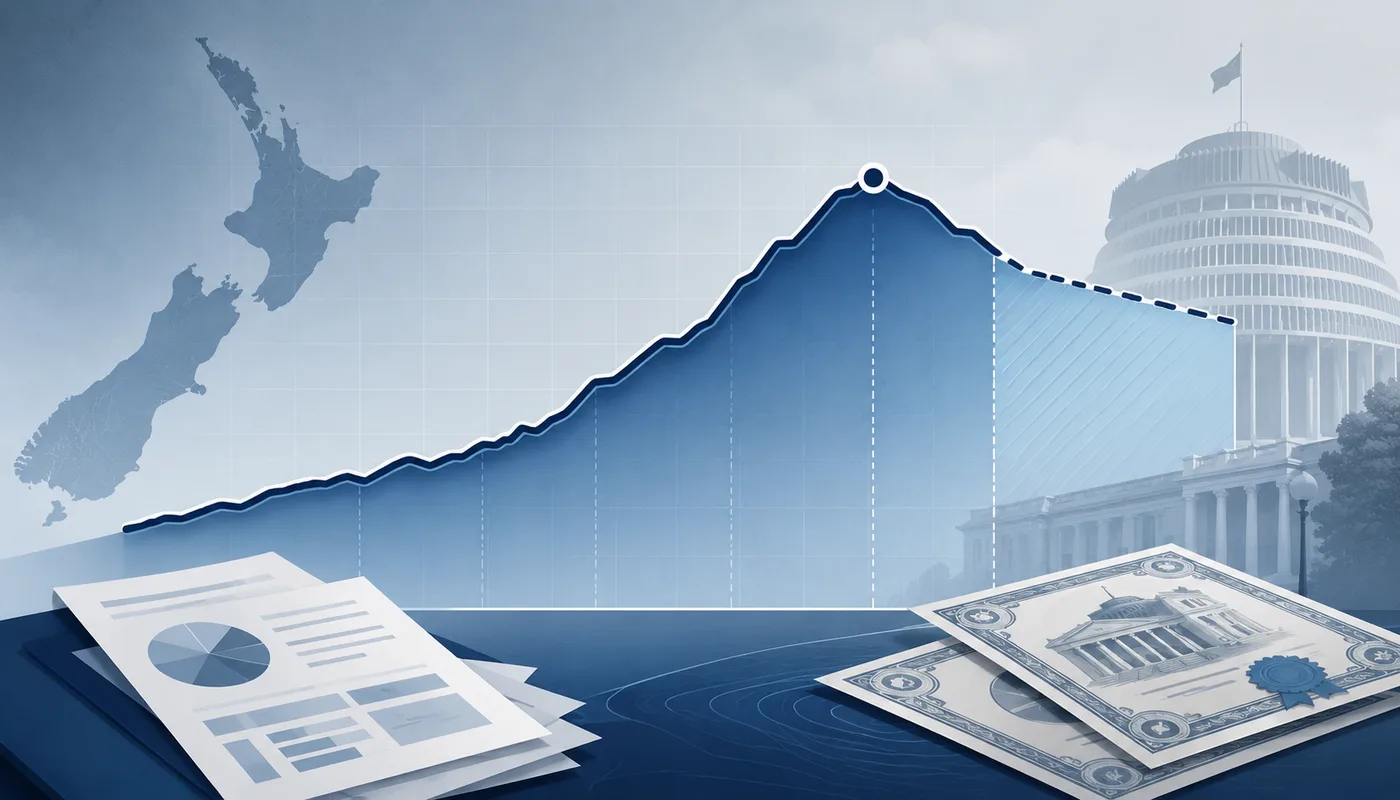
- Fiscal trajectory arc: how debt as a share of GDP evolves over time. A rising arc signals growing risk; a flattening or declining arc suggests fiscal consolidation. New Zealand’s current arc is expected to peak then bend downward under official forecasts. (The Treasury New Zealand)
- Market confidence arc: reflected in credit ratings and bond yields. A negative rating outlook reveals market unease about fiscal discipline. (investingLive)
- Socioeconomic arc: how debt policy translates to lived reality — services, taxes, cost pressures. This arc often divides policymakers and voters.
Juxtaposing these arcs highlights trade‑offs: tightening too fast might dampen growth and services, while lax discipline risks credit market reactions.
What’s at stake for New Zealanders
Debt isn’t just a number; it affects policy choices that impact daily life:
- Interest rates are influenced by fiscal and monetary settings, affecting mortgages and business loans.
- Public services may face trade‑offs if spending is squeezed to reduce deficits.
- Economic resilience matters in the face of external shocks like global energy price shifts.
New Zealand’s relatively moderate debt level gives it room to manoeuvre compared with some advanced economies, but the combination of persistent deficits, credit outlook warnings, and political debate ensures debt will remain a live policy issue well into 2026 and beyond.
FAQ
What is New Zealand’s current government debt level?
Net core Crown debt is forecast to peak around 46.1% of GDP under the 2026 Budget forecasts, with the government aiming to reduce debt as a share of the economy over the medium term. (The Treasury New Zealand)
Why did credit rating agencies change New Zealand’s outlook?
Credit rating agencies including Fitch and Moody’s revised New Zealand’s sovereign outlook to negative due to concerns about persistent deficits and a delayed return to surplus. (investingLive)
Sources
- New Zealand Treasury, “Budget Economic and Fiscal Update 2026”, May 20, 2026.
- New Zealand Debt Management, “New Zealand Government Bond Programme Update - BEFU 2026”, May 28, 2026.
- InvestingLive, “New Zealand outlook cut to negative by Fitch as debt concerns mount”, March 22, 2026.
- Reuters, “New Zealand Labour says budget fails to address rising living costs”, May 29, 2026.