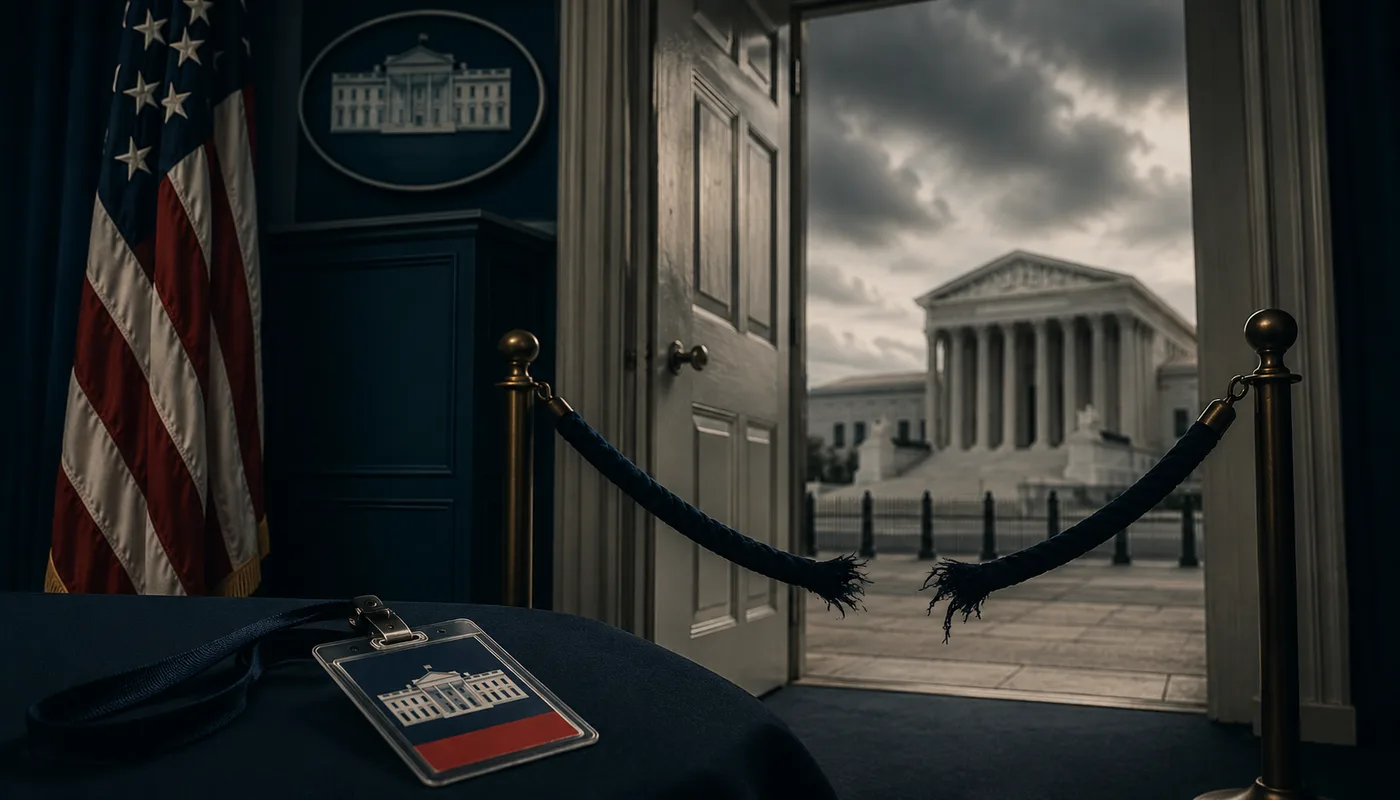
AP’s White House Access Fight Turns a Map Label Into a Press-Freedom Test
AP’s White House access fight turns a naming dispute into a test of viewpoint-based press exclusion.
Key takeaways
AP’s access dispute is a First Amendment fight about government retaliation, not a newsroom style footnote.
- AP became a law-and-government trend after the White House limited the outlet’s access following its decision to keep using “Gulf of Mexico” while acknowledging “Gulf of America.” Reuters reported the lawsuit on Feb. 22, 2025.
- Executive Order 14172 made “Gulf of America” federal terminology for U.S. agencies, but AP’s guidance said other countries and international bodies did not have to recognize the change. Federal Register, AP style guidance.
- AP won a district-court preliminary injunction on April 8, 2025; a D.C. Circuit panel stayed much of that relief on June 6; the full court denied en banc reconsideration on July 22. D.D.C. order, AP News, D.C. Circuit order.
- The practical test is the Room Rule: access claims weaken as the setting moves from general credentials to restricted presidential workspaces.
AP is The Associated Press, and in this trend the keyword points to its White House access case, not Advanced Placement exams or generic news alerts. The fight began after President Donald Trump’s Executive Order 14172 directed federal naming changes, including “Gulf of America,” and AP chose to keep “Gulf of Mexico” for a global audience while acknowledging the U.S. designation. Federal Register, AP style guidance.
AP is not trending because of style trivia. It is trending because a map label became a pressure point: can government access be conditioned on a publisher adopting official language? The district court counted 1,355 White House-access reporters, a press pool of one or two percent, and long-standing AP pool seats. D.D.C. order. The cleaner test is simple: who opened the room, why was access denied, and was the reason viewpoint-based?
Why is AP trending in United States law and government?
AP is trending because an official naming order collided with AP’s editorial independence and then moved into federal court.
Executive Order 14172 was signed on Jan. 20, 2025 and published in the Federal Register on Jan. 31; the Interior Department said on Jan. 24 that “Gulf of America” and “Mount McKinley” were effective immediately for federal use. Federal Register, Interior Department.
AP’s newsroom rule split the difference: use “Gulf of Mexico” because the name had long international use, while acknowledging the Trump administration’s U.S. designation. AP said it would use “Mount McKinley” because that mountain lies solely inside the United States. AP style guidance.
AP sued senior Trump aides on Feb. 21, 2025, saying its reporters were excluded from spaces including the Oval Office and Air Force One because AP would not adopt the new Gulf name. Reuters. The myth to kill: this is not about whether AP deserves a royal seat. It is about whether access can be used to punish editorial wording.
What did the courts actually decide?
The courts treated AP’s claim as strong at the district-court level but narrower once restricted presidential spaces reached the appeals court.
On April 8, 2025, U.S. District Judge Trevor N. McFadden granted AP a preliminary injunction and said the government need not open press spaces to everyone, but cannot exclude a journalist from opened spaces because of viewpoint. D.D.C. order.
That distinction is the hinge. The order did not require the White House to admit all journalists, or any set number of journalists, to every presidential event. It said AP could not be treated worse than comparable outlets because of its editorial position when similar access was otherwise available. D.D.C. order.
On June 6, 2025, a divided D.C. Circuit panel stayed much of the lower-court relief, and AP News reported that the panel gave the president wide latitude over spaces such as the Oval Office and Air Force One. AP News. On July 22, the full D.C. Circuit denied AP’s emergency request for rehearing en banc. D.C. Circuit order.
How should readers judge the AP case without getting lost in legal jargon?
The Room Rule is the simplest way to read the AP case: identify the room, the rule-maker, and the reason for exclusion.
The room matters because White House access is not one thing. The district court described a 49-seat Brady Briefing Room shared by 65 outlets, an East Room that can hold up to 180 journalists, a 21-member in-house pool, and an Air Force One pool of 13 journalists. D.D.C. order.
The rule-maker matters because access rules mix journalism practice, security, logistics, and presidential control. Reuters reported that the administration later removed wire services, including AP and Reuters, from permanent pool slots while still permitting sporadic participation. Reuters.
The reason matters most. A security limit is different from a viewpoint penalty. A private interview is different from a pooled event. The AP case sits in the hardest middle: the president has real control over intimate workspaces, while the press has a real claim against punishment for disfavored wording.
What changed as of June 3, 2026?
As of June 3, 2026, the AP dispute has shifted from a Gulf label fight into a reusable template for future White House access disputes.
Reuters reported that the D.C. Circuit heard the merits appeal on Nov. 24, 2025, with the Justice Department arguing that Oval Office and similar access decisions fall within presidential discretion. Reuters. CourtListener’s public appellate docket listed the case as argued on Nov. 24, 2025 and last updated on May 22, 2026. CourtListener.
The useful reading is institutional pattern recognition. Future administrations will notice which category wins: security discretion, presidential invitation, neutral pool management, or viewpoint retaliation. The more a space looks like an opened press forum, the weaker the argument for excluding a disfavored outlet. The more it looks like a private presidential interaction, the stronger the discretion argument becomes.
That is the tradeoff. Press access cannot become a voucher for approved language. Presidential access also cannot become a free-for-all that ignores space, safety, and event control. The AP fight matters because it forces courts to draw that line in public.
FAQ
The FAQ below defines the AP trend as a White House access dispute over viewpoint-based press exclusion.
What does AP mean in this trend?
AP means The Associated Press in this trend; the dispute concerns its White House access after its Gulf naming guidance. AP style guidance.
Why did the White House restrict AP access?
The White House restricted AP after AP kept using Gulf of Mexico while acknowledging Gulf of America, and AP challenged the move as First Amendment retaliation. Reuters.
Did AP win the case?
AP won a district-court preliminary injunction on April 8, 2025, but the D.C. Circuit stayed much of that relief on June 6 and denied en banc reconsideration on July 22, 2025. D.D.C. order, D.C. Circuit order.
What is the bigger legal issue?
The bigger legal issue is whether an administration can exclude a news outlet from opened press spaces because of editorial viewpoint while retaining control over security, logistics, and private presidential access. D.D.C. order.
Sources
The sources below are the official records, court materials, and wire reports used for the legal timeline and access facts.
- Federal Register: Restoring Names That Honor American Greatness (2025-01-31)
- U.S. Department of the Interior: Interior Department Advances Restoration of Historic Names Honoring American Greatness (2025-01-24)
- Associated Press: The AP establishes style guidance on the Gulf of Mexico and Mount McKinley (2025-01-23)
- Reuters: AP sues Trump aides for restricting access over Gulf of Mexico name (2025-02-22)
- U.S. District Court via Justia: Associated Press v. Budowich Document 46 (2025-04-08)
- AP News: Appeals court hands AP an incremental loss in its attempt to regain access (2025-06-06)
- U.S. Court of Appeals for the D.C. Circuit via CourtListener: July 22 en banc order (2025-07-22)
- Reuters: Justice Department defends Trump ban on Associated Press Oval Office access (2025-11-24)
- CourtListener: Associated Press v. Taylor Budowich appellate docket (unknown)