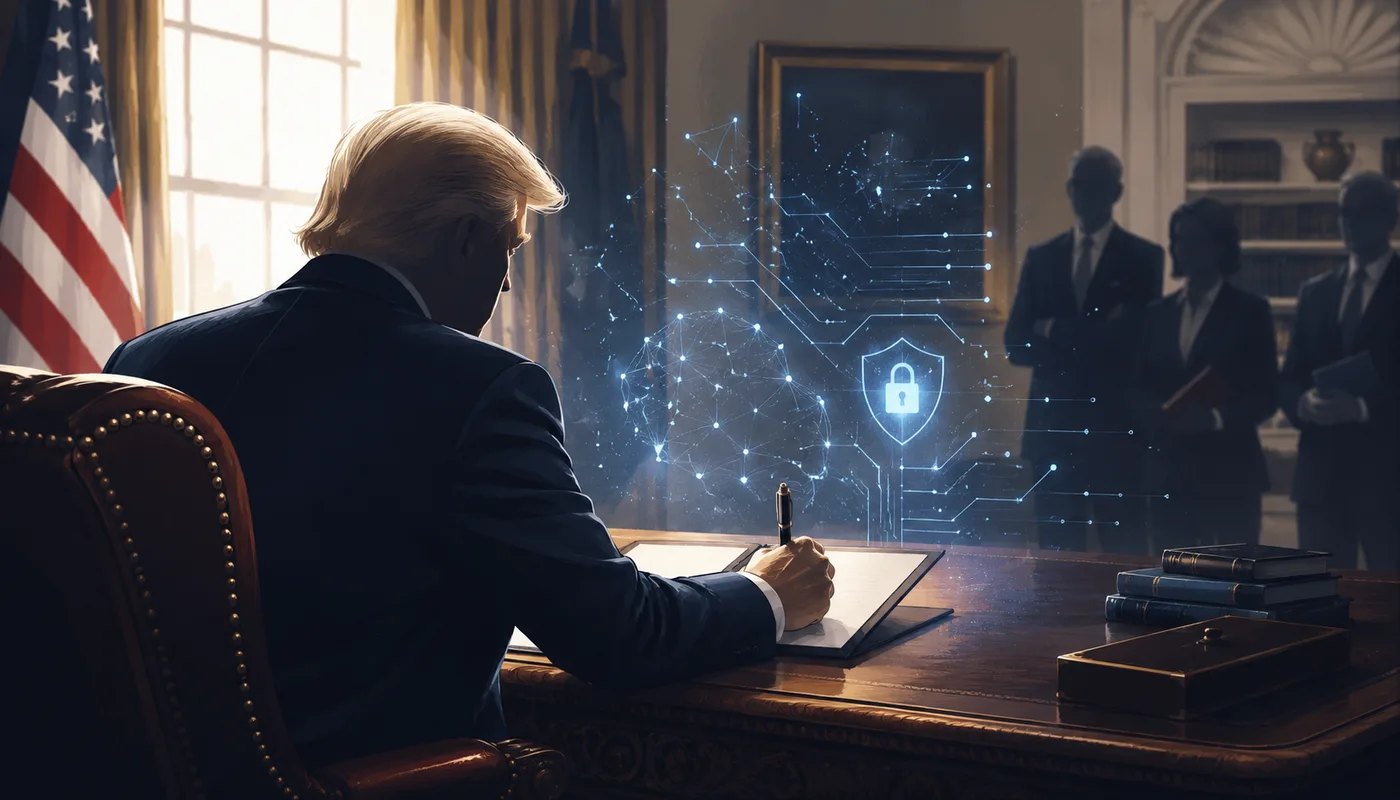
Trump AI Executive Order: Voluntary Review but Skepticism on Enforcement
President Trump’s June 2, 2026 trump ai executive order directs a voluntary 30‑day pre‑release review for advanced AI models and federal cybersecurity actions but stops short of mandatory regulation.
Key takeaways
- The June 2, 2026 executive order titled Promoting Advanced Artificial Intelligence Innovation and Security directs federal agencies to create a voluntary framework for early access to advanced AI models up to 30 days before public release. (The White House)
- Participation in pre‑release review and cybersecurity benchmarking for “covered frontier models” is voluntary — not mandatory — and the order bars mandatory licensing or preclearance requirements. (The White House)
- The order was scaled back from earlier drafts that proposed longer review windows (up to 90 days) after pushback from tech leaders and business groups concerned about competitiveness. (Business Insider)
- Federal actions include establishing an “AI cybersecurity clearinghouse” and prioritizing cyber defenses for national security and critical infrastructure. (The White House)
- The policy reflects a pivot from Trump’s prior deregulatory stance and contrasts with the Biden AI regulatory framework rescinded earlier in his term. (The White House)
What the Trump AI executive order actually does
The trump ai executive order signed on June 2, 2026 creates a federal policy that encourages voluntary engagement between AI developers and government agencies on advanced AI systems before those systems are widely deployed. (The White House)
Unlike mandatory regulatory schemes under consideration in 2023–25, this order does not create new licensing requirements, permits, or legally enforceable pre‑release approvals for artificial intelligence models. (The White House) Instead, it directs agencies — including Homeland Security, Defense, Treasury, and Commerce — to coordinate early access, cyber threat evaluations, and vulnerability remediation plans for the most powerful AI systems. (The White House)
This directive defines “covered frontier models” as the most advanced, high‑impact artificial intelligence systems that may pose heightened cybersecurity or national security concerns. These systems would be offered voluntarily to the federal government for evaluation up to 30 days before a public launch. (The White House)
The order also establishes an “AI cybersecurity clearinghouse,” intended to collect and share identified vulnerabilities across government and industry to protect critical infrastructure such as banks, hospitals, and utilities. (The White House)
Why voluntary matters — and why critics are skeptical
Voluntary is the watchword of this executive order. The text explicitly states nothing in the order should be construed as permitting mandatory government licensing, preclearance, or permitting for AI development or distribution. (The White House) That’s a marked departure from earlier discussion within the administration about a stricter review or licensing regime. (Business Insider)
Tech industry leaders, including executives from major AI labs, are widely reported to have lobbied to reduce review time and keep the framework voluntary. One widely cited report notes calls from figures like Elon Musk and Mark Zuckerberg helped trim the review window from 90 to 30 days. (Tech Times)
Critics argue this may be too weak. Civil liberties and consumer groups contend that voluntary review lacks enforceability and might allow powerful AI models to reach markets without meaningful scrutiny. Some policy analysts note ambiguity in how “covered frontier models” are defined and which entities would participate. (MarketWatch)
Proponents, however, call this an incremental step toward structured public‑private collaboration that avoids stifling innovation in a globally competitive AI marketplace. (Axios)
How this differs from earlier Trump AI actions
This June 2026 executive order represents a policy shift from President Trump’s earlier AI approaches. In January 2025, he signed an AI policy framework order aimed at removing barriers to U.S. leadership and rescinding some Biden-era AI regulatory actions. (Wikipedia)
Earlier orders also focused on preventing state AI regulations from fracturing the market and on preempting conflicting state laws — a push the administration articulated throughout 2025. (Reddit)
In contrast, the June order directly engages with the cybersecurity dimensions of advanced models and seeks collaboration with AI developers rather than relying solely on market forces. (The White House)
What changed from May’s postponed signing
A planned May 21, 2026 signing of a broader AI executive order was canceled a few hours before the ceremony after President Trump said he “didn’t like what I was seeing” and feared overly restrictive language could weaken U.S. competitiveness in the AI race against China. (CBS News)
At that time, some drafts included longer voluntary review periods and potentially tighter engagement conditions that industry stakeholders pushed back on. The finalized June 2 order trimmed these provisions, streamlined voluntary participation, and emphasized non‑burdensome oversight. (Business Insider)
National security, competitiveness, and AI policy framing
The executive order’s balancing act reflects broader tensions in U.S. policy: safeguarding national security and critical infrastructure while preserving industry competitiveness. The White House’s fact sheet frames the order as promoting AI innovation and cybersecurity without stalling technological progress. (The White House)
This aligns with broader geopolitical competition with China over AI dominance. Trump’s public comments echo concern that heavy regulation could hamper U.S. firms and cede ground to foreign competitors. (CBS News)
However, civil liberties advocates argue that without enforcement mechanisms, voluntary review may not meaningfully mitigate risks posed by extremely capable AI systems. Debate continues in Congress about whether statutory authority and mandatory frameworks should complement executive action. (MarketWatch)
FAQ
What does the Trump AI executive order do?
It establishes a voluntary 30‑day pre‑release review for advanced AI models and directs federal cybersecurity efforts without creating mandatory licensing or government approval.
Is participation in the review mandatory?
No. The executive order explicitly states the 30‑day review for AI models is voluntary and does not authorize mandatory licensing, preclearance, or permitting.
Why was the signing of the order delayed in May?
President Trump delayed the earlier version of the executive order over concerns it might weaken U.S. competitiveness in AI against China and due to industry objections to proposed provisions.
Sources
- The White House, “Fact Sheet: President Donald J. Trump Promotes Advanced Artificial Intelligence Innovation and Security – The White House”, 2026‑06‑02 (The White House)
- Reuters, “Trump administration to ask US AI firms to voluntarily submit models for cybersecurity tests”, 2026‑06‑02 (Reuters)
- Axios, “Trump dodges AI rules for now with latest executive order”, 2026‑06‑02 (Axios)
- JURIST, “Trump signs executive order calling for government access to frontier AI models”, 2026‑06‑02 (jurist.org)