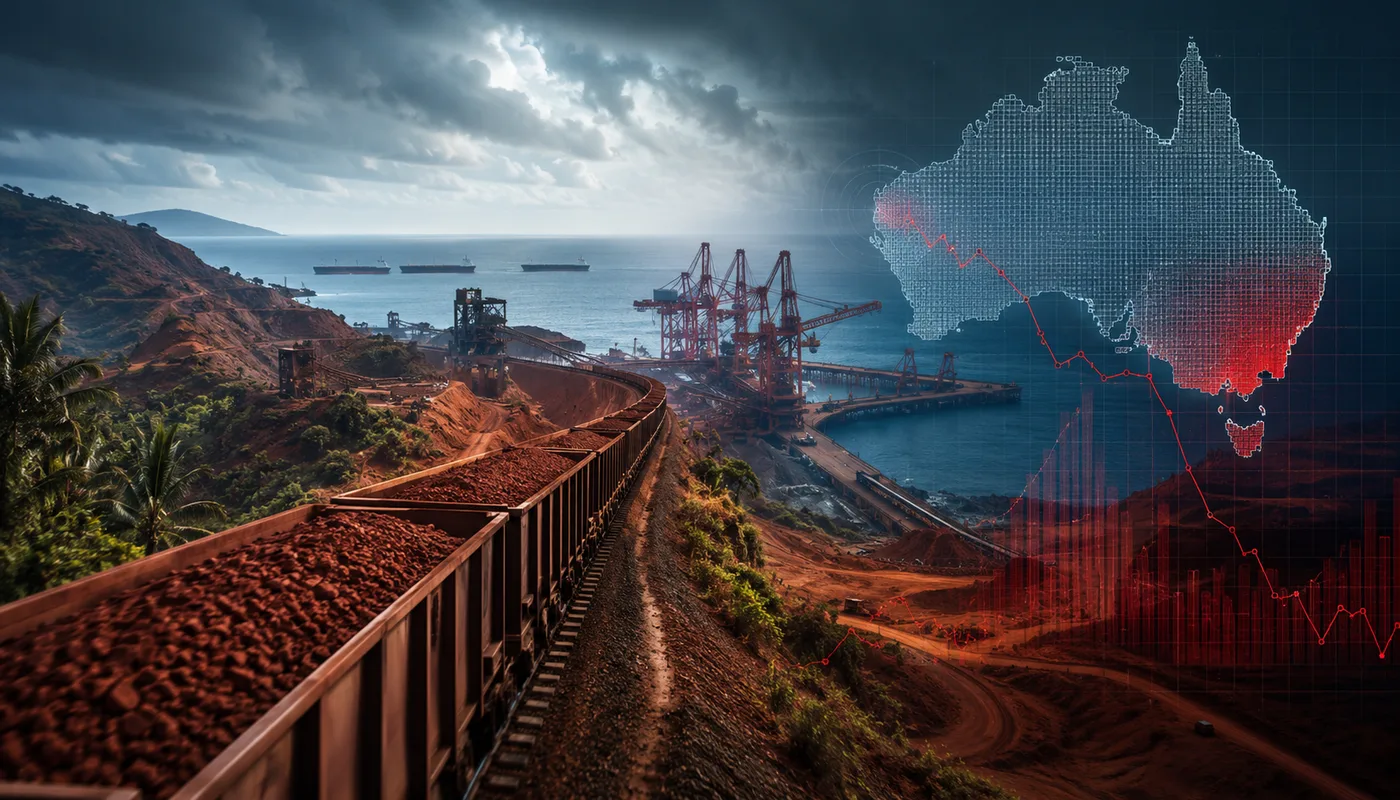
Liberia Tests Australia’s Iron Ore Comfort Zone
Liberia is a West African mining, shipping and reform story now relevant to Australia because its iron ore expansion can press Australia’s market.
Key takeaways
- Liberia is a pricing signal for Australia because official forecasts expect iron ore prices and earnings to ease as supply rises from Africa, Brazil and Australia (Department of Industry, Science and Resources).
- ArcelorMittal’s Liberia deal is the trigger: the amended concession runs to 2050, includes a US$200 million payment, and targets 20 million tonnes per annum (Mtpa) in 2026 (ArcelorMittal).
- The International Monetary Fund (IMF) has backed Liberia’s reform path, approving a 21-month US$266 million Resilience and Sustainability Facility on April 27, 2026 (IMF).
- Australia’s latest trade pulse still runs through ore: goods exports rose 7.2% in April 2026, driven by metal ores and minerals (Australian Bureau of Statistics).
Liberia is no longer just a far-off country name in an Australian search spike. It is a compact test of how frontier supply becomes financially relevant: ore in the ground, rail to port, multilateral funding and a government keen to turn extraction into revenue. For Australia, the tension is blunt: the government forecasts iron ore export earnings of A$114 billion in 2025–26, but the price is set at the margin (Department of Industry, Science and Resources). A credible new source can move expectations before it moves trade flows. Liberia’s economy grew 5.1% in 2025, and the IMF expects 5.1% again in 2026, largely on stronger mining output (IMF). The useful question is whether Liberia helps reset the price conversation.
Why is Liberia suddenly relevant to Australian business?
Liberia is relevant to Australian business because it connects iron ore, shipping and African investment diplomacy in one small market.
Australia’s Department of Foreign Affairs and Trade says Liberia’s primary export revenue comes from iron ore, rubber, gold and timber, and Australia covers Liberia through the Australian High Commission in Accra, Ghana (DFAT). The official channel is regional, but commodity exposure is wider than diplomacy.
Australia signed a memorandum of understanding with the African Continental Free Trade Area Secretariat on June 19, 2025, to promote mutually beneficial Australia-Africa partnerships (DFAT). The myth to drop: Liberia matters only if an Australian company is on the ground. In commodities, sentiment moves earlier.
How big is Liberia’s iron ore signal for Australia?
Liberia’s iron ore signal is small beside Australia, but it is becoming sharper in logistics and price impact.
| Signal | Liberia fact | Australia read-through |
|---|---|---|
| Mine capacity | ArcelorMittal says Liberia shipments are set to rise from historic levels near 5 Mtpa to 20 Mtpa in 2026 (ArcelorMittal). | A credible 20 Mtpa source can influence expectations without rivaling Pilbara scale. |
| Corridor economics | Rail infrastructure could transport up to 30 million tonnes a year if further expansion is approved (ArcelorMittal). | Rail and port access decide whether ore becomes a tradable product. |
| Price pressure | Australia’s iron ore earnings are forecast to fall from A$116 billion in 2024–25 to A$107 billion in 2026–27 (Department of Industry, Science and Resources). | New supply from Africa is part of the official price-pressure story. |
Australia’s June 4, 2026 trade release shows why this matters. Goods credits rose A$3.18 billion, or 7.2%, in April 2026, and the Australian Bureau of Statistics said metal ores and minerals drove the gain (ABS).
What changed as of June 5, 2026?
As of June 5, 2026, Liberia has moved from prospect story to funded infrastructure story.
On January 30, 2026, ArcelorMittal said Liberia had ratified an amended Mineral Development Agreement extending the concession to 2050, with a possible 25-year renewal (ArcelorMittal). The deal includes a US$200 million payment for rights including mining extension and reserved railroad capacity (ArcelorMittal).
On April 27, 2026, the IMF approved a 21-month facility worth 193.8 million Special Drawing Rights (SDR), or about US$266 million, and completed the third review under Liberia’s existing Extended Credit Facility (ECF) (IMF). The same decision enabled an immediate US$26.49 million disbursement (IMF).
UN Trade and Development (UNCTAD) also places Liberia among the top three flag states by vessel capacity as of January 1, 2025 (UNCTAD). That is not ownership; it is legal plumbing inside global trade.
What should Australian investors and exporters watch?
Australian investors should watch Liberia through a three-part filter: tonnes, terms and trust.
Tonnes means actual export capacity, not ministerial mood music. ArcelorMittal’s 20 Mtpa target for 2026 is the near-term marker; 30 million tonnes of possible rail capacity is the next ceiling (ArcelorMittal).
Terms means who captures the economics. The IMF named domestic revenue mobilisation, mining taxation reform and rationalising tax exemptions as priorities for Liberia’s program (IMF).
Trust means the macro frame. World Bank data show Liberia’s 2025 fiscal deficit narrowed to 1.1% of GDP, public debt declined to 54.6% of GDP, and reserves were US$576 million, or about 2.0 months of import cover, at end-2025 (World Bank). That is improvement, not invincibility.
What is the main risk in reading Liberia as a bullish signal?
The main risk is mistaking a mining ramp-up for a diversified economy.
Liberia’s economy expanded 5.1% in 2025, with mining sector growth rising to 17.0% from 2.1% in 2024, according to the World Bank (World Bank). That is strong, but concentrated. The World Bank also says the current account deficit was 6.5% of GDP in 2025, while external buffers remained limited at about 2.0 months of import cover (World Bank).
For Australia, Liberia is a marginal-supply signal, not a new Pilbara.
FAQ
Liberia’s finance story is best read through mining capacity, IMF support and trade exposure.
Why is Liberia trending in Australian business news?
Liberia is trending because its iron ore expansion, IMF-backed reform program and role in global shipping overlap with markets Australian investors already track.
Is Liberia a direct threat to Australian iron ore exporters?
Liberia is not a direct volume threat to Australia yet; its sharper effect is as marginal supply that can influence iron ore price expectations.
What did the IMF approve for Liberia in 2026?
The IMF approved a 21-month US$266 million Resilience and Sustainability Facility for Liberia on April 27, 2026, alongside an ECF review.
Why does Liberia’s shipping registry matter?
Liberia’s shipping registry matters because Liberia is one of the world’s top flag states by vessel capacity, placing it inside global trade infrastructure.
Sources
These sources support the figures, dates and institutional claims in this article.
- IMF Executive Board Concludes the Third Review under the Extended Credit Facility, and Approves a SDR 193.8 million Resilience and Sustainability Facility Arrangement for Liberia — International Monetary Fund, 2026-04-27.
- Liberia — World Bank Group, unknown.
- Liberia — Australian Government Department of Foreign Affairs and Trade, unknown.
- Government of Liberia and ArcelorMittal sign new long-term Mineral Development Agreement — ArcelorMittal, 2026-01-30.
- Resources and energy quarterly: December 2025 — Australian Government Department of Industry, Science and Resources, 2025-12-19.
- International Trade in Goods, April 2026 — Australian Bureau of Statistics, 2026-06-04.
- Review of Maritime Transport 2025: Staying the course in turbulent waters — UN Trade and Development, 2025-09-24.
- Memorandum of Understanding between the African Continental Free Trade Area Secretariat and the Government of Australia — Australian Government Department of Foreign Affairs and Trade, 2025-06-19.