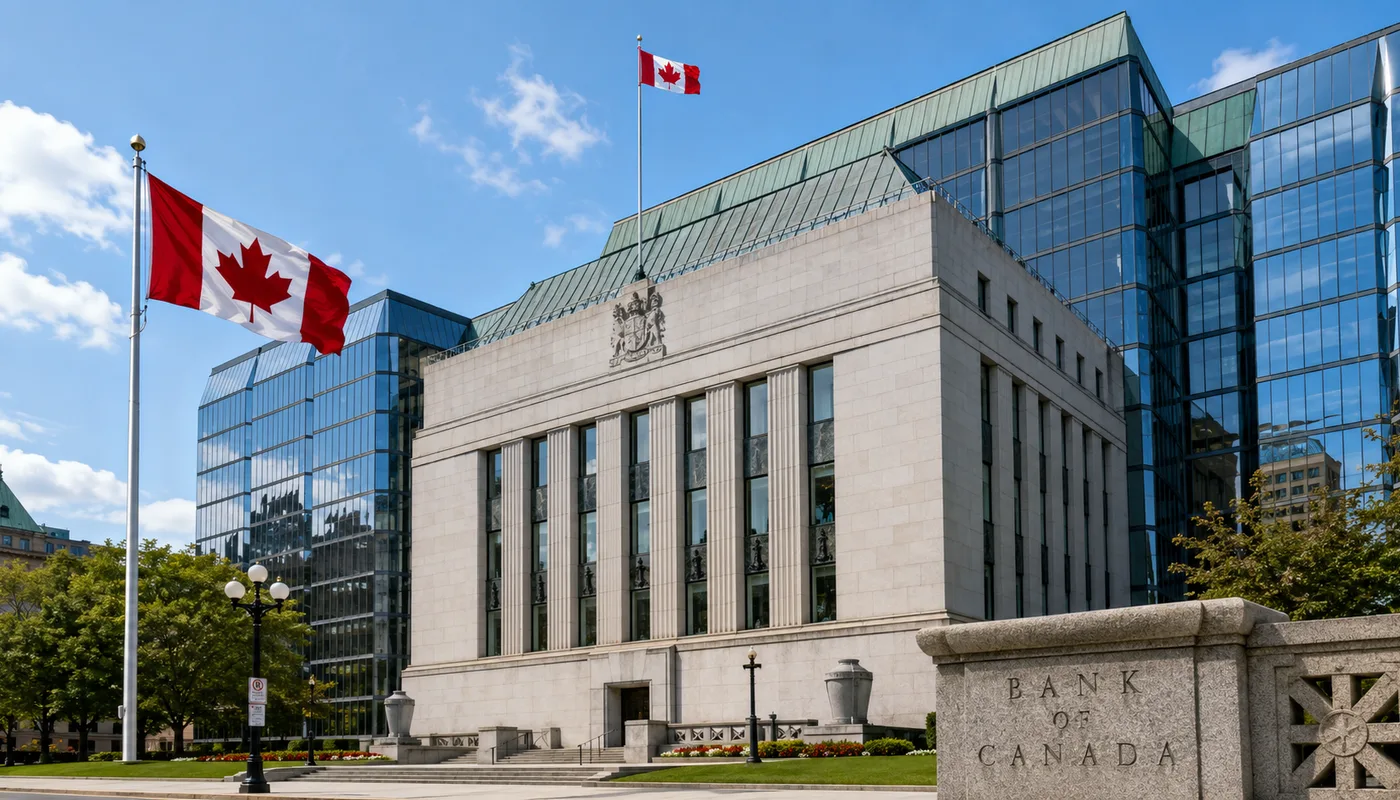
Banque du Canada’s Rate Pause and Canada’s Economic Balancing Act
Banque du Canada’s primary role in 2026 is maintaining price stability by holding its key overnight rate at 2.25%, a stance that reflects inflation near target but rising risks from energy prices, trade tensions, and modest growth.
Key takeaways
- Banque du Canada’s key rate is 2.25% as of April 29, 2026, unchanged through multiple meetings in 2026. (Bank of Canada)
- Inflation remains within the Bank’s 1–3% target range, with core pressures softening even as energy prices tick up. (Reuters)
- Economists widely expect no rate changes through 2026, reflecting mixed economic signals and uncertainty from trade and geopolitical shocks. (Reuters)
- Canada’s economy showed a technical recession, but the Bank warns against overinterpreting single-data-point GDP drops. (Reuters)
- Mortgage markets are reacting to longer-term bond yields, meaning fixed rates can move even as the central bank holds the overnight rate. (Reddit)
Banque du Canada today: rate, risks, and rationale
Banque du Canada is Canada’s central bank and monetary authority, tasked with maintaining low, stable inflation by setting short‑term interest rates. (Bank of Canada) In 2026, it has consistently kept the overnight policy rate at 2.25%, a level chosen to balance inflation control with modest economic growth. (Bank of Canada) Inflation has hovered close to the bank’s 1–3% target range, supporting the case for a steady policy stance. (Reuters)
This consistency follows a series of cuts between 2024 and 2025, which brought the rate down from highs near 5% as inflation cooled. (Forbes) The Bank’s governing council — led by Governor Tiff Macklem — argues that current conditions don’t decisively warrant hikes or cuts, given conflicting pressures from energy prices, trade tensions, and weak demand. (Reuters)
Why the policy pause matters
The Bank’s rate decisions directly influence borrowing costs for consumers and businesses. The overnight rate serves as the benchmark for variable mortgage rates, credit cards, and even saving instruments. (Bank of Canada) When the Bank holds rates, money remains relatively stable in cost, giving households and firms a predictable planning horizon.
However, fixed mortgage rates are tied to longer‑term government bond yields, which can move independently of the overnight rate. Even with the Banque du Canada on hold, 5‑year fixed mortgage rates have risen in 2026 because benchmark bond yields climbed amid inflation risks and global uncertainties. (Reddit) This divergence means borrowers can face higher fixed costs even when the central bank isn’t tightening policy.
The inflation target and risks on the horizon
Inflation in Canada in early 2026 remained within the official 1–3% target but edged higher in April to about 2.8% month‑over‑month, partly due to elevated energy prices from geopolitical tensions in the Middle East. (Reuters) Core inflation — which strips out volatile items like energy — has softened, suggesting underlying demand is still modest.
In its Monetary Policy Report, Banque du Canada projects inflation will eventually ease back toward the 2% midpoint, assuming global energy markets stabilize. (Bank of Canada) But the Bank also acknowledges risks: prolonged high oil prices could feed persistent inflation, and trade frictions — in particular the upcoming review of the Canada–US–Mexico Agreement — add uncertainty to export‑dependent sectors. (Reuters)
This uneven picture is why the central bank continues its cautious pause rather than pre‑emptive cuts or hikes.
Economic growth and the “technical recession”
Recent data flagged two consecutive quarters of negative annualized GDP growth — a common definition of a recession. (Reuters) But the Bank warned that technical recessions don’t tell the full story, noting that initial estimates can overstate weakness and that broader indicators show resilience in jobs and consumer spending. (Reuters)
A holistic view — factoring labour, production, trade, and spending — remains central to the Bank’s deliberations. This broader assessment explains why the overnight rate stays unchanged even amid slower growth.
What economists expect through 2026
Most market economists surveyed by Reuters and other outlets expect Banque du Canada to hold the policy rate at 2.25% through the remainder of 2026. (Reuters) Their forecast reflects the belief that inflation pressures will ease and that neither strong growth nor rampant inflation will materialize soon.
That consensus isn’t unanimous, but it’s strong: over 80% of surveyed analysts see no change through year’s end. (Reuters) If inflation were to sustain above target due to persistent energy or wage pressures, the Bank has signaled it would consider raising rates.
How this affects Canadians
For Canadian households and lenders, the policy pause offers clarity. Variable‑rate mortgage holders can expect relative stability in monthly payments tied to the overnight rate. But fixed‑rate borrowers need to watch bond markets, not just Banque du Canada announcements, because those yields set longer‑term borrowing costs. (Reddit)
Business investment decisions, too, hinge on expectations of future financing costs. A stable policy rate can encourage capital spending, but uncertainty about trade and global growth tempers enthusiasm.
FAQ
What is the current policy interest rate set by Banque du Canada?
As of late April 2026, Banque du Canada’s target for the overnight rate is 2.25%, unchanged across several meetings in 2026. (Bank of Canada)
Why is Banque du Canada holding interest rates steady?
Banque du Canada is holding rates because inflation remains within its 1–3% target range, even as energy prices and trade risks complicate the outlook. (Reuters)
How does Banque du Canada’s rate decision affect mortgage rates?
The central bank’s overnight rate influences variable mortgage pricing directly, while fixed mortgage rates depend primarily on longer‑term Government of Canada bond yields that can move independently of policy decisions. (Reddit)
Sources
- Bank of Canada — Policy interest rate — Bank of Canada
- Bank of Canada — Monetary Policy Report — Bank of Canada
- Reuters: BoC expected to hold rates through 2026, look past temporary inflation pressures — Reuters (2026‑06‑05)
- Reuters: Bank of Canada says don't put much weight on GDP data showing technical recession — Reuters (2026‑06‑01)
- Forbes Advisor Canada: The Bank Of Canada Holds Key Interest Rate At 2.25% Again — Forbes Advisor Canada (2026‑04‑29)