
Case Study · Publishing and communication
Beyond translation: a multilingual publishing case study
Explore Review-in-Korea’s locale, route, and article metadata boundaries. Reuse the release matrix for language availability, factual review, navigation, and corrections.
In this article
A translated paragraph still needs a working route
A multilingual article is not finished when its sentences have been translated. A reader needs a reachable page, the right language, a meaningful title, and a way to switch to an equivalent version. Search metadata must describe the page actually served. Images, captions, dates, and corrections must remain connected to the same editorial work.
The operator's Review-in-Korea project provides a concrete implementation to inspect. Its locale registry records language labels, HTML language values, and writing direction. Blog routing derives paths from locale and article identity. Its SEO helper builds alternate-language links from supplied alternate records and chooses a default destination. These are separate responsibilities around the translated content.
This case study is based on local source inspection and current Google documentation. We did not audit every live language page, verify translation accuracy, or measure search traffic. The article explains the inspected mechanisms and provides a release worksheet for a multilingual publication. It does not claim that configuration alone proves every translation is published correctly.
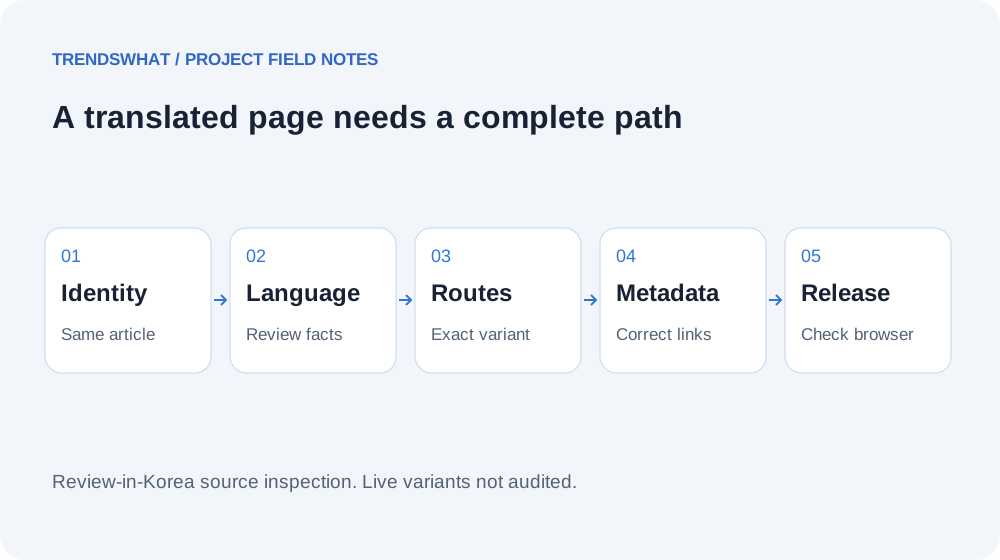
Original TrendsWhat guide redrawn from the inspected routing and metadata responsibilities. Source inspection is not a live-site acceptance test.
Separate language support from article availability
A locale registry tells the application which languages it recognizes. It does not prove that every article exists in each language. A publication can support a language in its interface while still having only some translated articles available. Conflating those sets can produce links to missing pages or misleading language selectors.
In the inspected blog helper, alternate-language URLs are built from the alternate records supplied for that article. That is an important boundary: article availability should come from the article's actual variants, not merely from the global list of supported languages. The source inspection establishes the helper's input and behavior, not the correctness of every record passed to it.
For an AI translation workflow, keep the original article identity separate from its localized slug and publication state. A generated translation can exist as a draft without becoming a public alternate. Release decisions should use the state of the complete localized page rather than the presence of translated text alone.
What the locale registry contributes
The inspected registry includes a display label, short label, HTML language value, and text direction for each locale. English is the default locale in that source. Arabic has a right-to-left direction value, while the other listed entries use left-to-right. These fields give rendering code explicit information rather than requiring it to infer presentation from a language name.
The registry is a configuration snapshot. The public portfolio's description of language coverage is useful context, but it should not be treated as a live count of article availability. For this article, the implementation details come from the inspected files rather than a promotional total.
A useful release check asks whether the page consumes these values consistently. The presence of a direction field does not establish that every card, table, breadcrumb, or embedded asset handles right-to-left layout correctly. A browser inspection is still needed for the actual page and its important components.
Routing is part of the editorial contract
The blog routing helper builds an article path from a locale, category segment, and slug through a shared localized-path function. Centralizing that construction reduces the chance that a card, canonical URL, and language selector invent different paths for the same article.
The practical issue is identity. Two translations may use different slugs while representing the same editorial work. A language switch should resolve the corresponding variant rather than replace a prefix blindly and hope that the translated slug matches. Conversely, unrelated articles should not be declared alternates merely because their titles are similar.
For a reader, the difference appears as navigation quality. A language switch that lands on a generic homepage may be technically reachable but loses the article context. A switch to a missing page is worse. Treat the destination as part of the content's usability, not a secondary concern to fix after translation volume grows.
Canonical and alternate links have different jobs
A canonical identifies the preferred URL for a page's content. Alternate-language annotations describe equivalent localized versions. They should be planned together, but they are not interchangeable labels. The inspected SEO helper can use a canonical-path override, so a release check must also consider whether an override is appropriate for the article being served.
Google's localized-version guidance calls for fully qualified alternate URLs and reciprocal references, including the page itself. It also describes a default destination for unmatched language choices. Those are documentation requirements to verify in the rendered output; a helper function's existence is not evidence that every page satisfies them.
The inspected helper selects the default-language alternate when available and otherwise uses the current article as its default destination. That is a concrete fallback policy. Whether it is appropriate for a particular publication depends on its language-selection experience and the variants actually available. Record the policy rather than letting it emerge accidentally from missing data.
Translation can preserve words and change the claim
A fluent translation may still alter a qualification, unit, or named entity. A sentence saying a place is “usually open” is different from a guarantee that it is open today. A source price without a date can become misleading when presented as current. These problems require editorial review, not only language detection.
For a practical travel article, keep names, locations, dates, quantities, and source links in a review table beside the translation. Mark phrases that should remain literal and phrases that need localization for the audience. If the source is uncertain, preserve that uncertainty in the translated version rather than smoothing it away.
This case study did not evaluate Review-in-Korea's actual translations. The examples are general release checks suggested by the type of content and the inspected publishing structure. A source-code review cannot establish the accuracy of prose it has not read, especially across languages the reviewer cannot assess confidently.
Metadata must follow the localized article
The inspected structured-data builder uses the article's title, description, author, dates, cover image, and language value. It connects the page to its canonical URL and can include a source citation. This shows how metadata can be generated from article data rather than maintained as a separate hand-written copy.
Google's Article structured-data documentation describes properties that help communicate article information. Adding those properties does not guarantee a particular search appearance. The useful engineering check is whether the structured data accurately describes the visible page and uses the intended URLs and dates.
A translated article should not inherit an unrelated title or stale description merely because its body changed successfully. Inspect social previews as well as search metadata. A reader opening a shared link may encounter the preview before the page, so a language mismatch can create confusion before the content has a chance to help.
Copy this localized release matrix
| Layer | Verify for each published variant | Evidence |
|---|---|---|
| Availability | Public variant exists and is intended for release | Publication state and HTTP response |
| Identity | Variant belongs to the same editorial work | Shared article relationship |
| Content | Names, facts, caveats, and sources remain correct | Bilingual review or qualified review |
| Routing | Cards and language switches reach the exact variant | Clicked destination |
| Metadata | Title, description, canonical, and alternates agree | Rendered head elements |
| Layout | Direction, wrapping, tables, and captions work | Browser inspection |
| Maintenance | Corrections reach affected variants | Revision record |
Keep one row set per article family rather than assuming the global language configuration proves coverage. This makes partial releases visible. It also helps a small publisher decide to release fewer well-checked variants instead of creating a large set of pages whose navigation and editorial state are uncertain.
Test an unavailable translation deliberately
A useful multilingual test includes an article that has no variant in one supported language. The interface should handle that condition deliberately. It might omit the unavailable choice or explain that the translation is not available. It should not manufacture an alternate URL that returns an error or silently show unrelated content.
Test a renamed slug as well. The article's current variant relationship should drive the switch, not an assumption that every language shares a path segment. Then test an article whose default-language version is absent, since that exercises the fallback policy rather than the common case.
These tests are proposed acceptance checks. We did not execute them against the operator's live service for this article. They follow from the inspected helper's inputs and decisions, and they identify the evidence needed before describing a multilingual release as complete.
Plan corrections as a family of changes
If the source article's opening hours, price, or safety qualification changes, every published translation containing that claim may need review. A translation pipeline that only creates new pages can leave old variants inconsistent. The editorial relationship should therefore support maintenance as well as initial generation.
Keep a correction note identifying the changed claim and affected variants. Distinguish a wording improvement from a factual correction. A factual change may require rechecking titles, summaries, captions, and structured data in addition to the main body. Those surfaces can repeat the same outdated claim in different forms.
Do not update all modification dates simply because a batch ran. A date should communicate a meaningful revision or review under a clear policy. Readers need to know whether the underlying information changed, not merely whether an automation touched the record.
Where AI assistance is useful
AI can produce a first translation, identify repeated entities, flag mismatched numbers, and suggest localized phrasing. Those are useful preparation tasks when the source material and review requirements are clear. Keep the source and target passages aligned so a reviewer can inspect important differences.
For a language you cannot review well, use a qualified reviewer for consequential content or limit the scope of what you publish. A model's assurance that a translation is accurate is not a substitute for evidence. The same principle appears in our citation experiment: a confident presentation can pass a superficial check while missing the actual support requirement.
The publication's goal should be a useful page for a real reader in that language. Translation volume is only one activity on the way to that result. Routing, evidence, layout, and maintenance determine whether the page remains usable after the first draft is generated.
The lesson from the inspected project
Review-in-Korea's source makes several responsibilities explicit: locale configuration, localized paths, article-specific alternates, canonical selection, and structured article metadata. Those boundaries provide a practical map for reviewing an AI-assisted multilingual publishing process.
They do not establish translation quality or live search performance on their own. Use the release matrix to collect that missing evidence, and treat unavailable variants as a normal state rather than an error to hide. A smaller set of complete, coherent language pages is a more useful outcome than a larger count whose promises exceed what readers can actually access.
Sources, materials, and limits
- Project inspection notes: Review-in-Korea locale, routing, and SEO source locations.
- Google localized-version guidance and Article structured-data reference, consulted for the relevant metadata principles.
- Original diagram and release matrix. No full live-language crawl, translation-quality study, ranking measurement, or claim that every configured locale has every article.