
Case Study · Building with AI
What a quiz remembers: a Send learning-state case study
Inspect the operator’s quiz submissions, progress, grading, and chat snapshots. Learn why current state cannot automatically support a story about learning history.
In this article
A conversation is not the whole learning record
A quiz app can look like a conversation while storing several different kinds of state underneath. The question and answer define the material. The learner's submission records an interaction. A progress marker helps resume the session. A saved chat transcript restores the screen. Those records may look related, but they answer different questions.
In the operator's Send project, we inspected these boundaries in the quiz controller, model, payload utilities, and the query text those functions use. The implementation separates item content, progress, attempt persistence, wrong-item selection, and saved chat logs. It also shows why calling all of that “history” can be misleading: a log-set operation replaces a prior set, and an attempt operation uses an upsert.
This is a local source-inspection case study. We did not query the live database, submit a learner answer, or measure learning improvement. The article describes the operations present in the inspected code and uses fictional examples to explain their implications. It does not claim that every interaction is preserved as an immutable event.
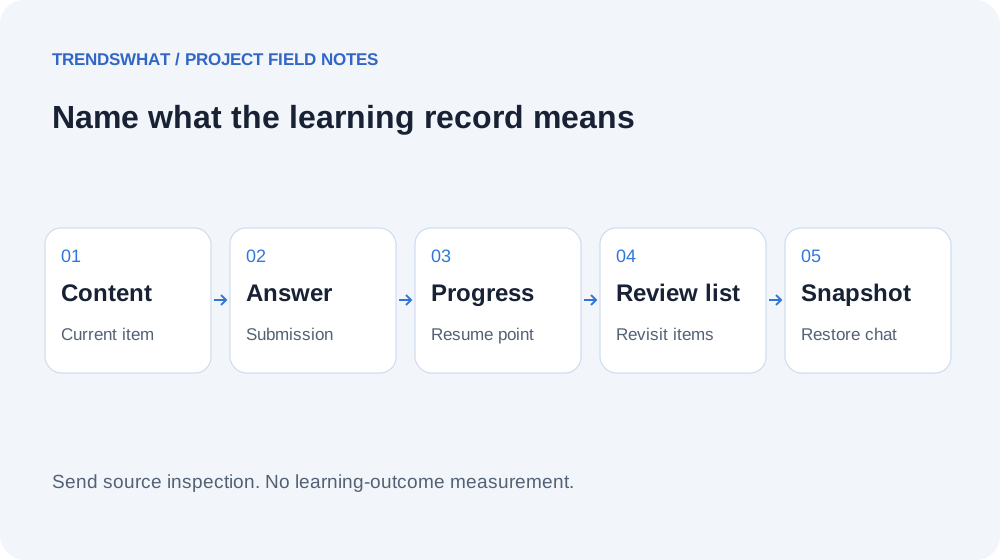
Original TrendsWhat diagram based on inspected Send source. Separate storage responsibilities do not automatically imply a complete historical archive.
Start by asking which question the record answers
Suppose a learner answers a question incorrectly, edits the question later, and returns to study again. “What should appear next?” is a progress question. “What answer did the learner submit?” is an attempt question. “What did the question say at the time?” is a content-version question. “What messages should the screen restore?” is a display-state question.
These questions can require different records. If the application stores only the latest question text, an old attempt may not explain the exact material originally shown. If it stores only a transcript, it may be difficult to calculate progress reliably. A structured state model makes the distinction explicit, even when the user interface combines the information.
For an AI learning assistant, this matters because the model may be asked to summarize performance. The answer is only as meaningful as the records it receives. A latest-state table cannot justify a detailed story about how the learner improved across every attempt unless that sequence was actually retained elsewhere.
What the submission path does
The inspected answer controller first obtains the quiz-item context, including the user, chat, and item. It retrieves the stored answer, reads the submitted text, and evaluates correctness through a helper. When a valid question number is available, it records the attempt with the learner's text and the current date key.
The model function wraps several writes in a transaction: it updates the progress marker, touches the chat's update time, and persists the attempt. This ties the recorded answer submission to the progress update at that boundary. It is a concrete implementation detail, not proof that all possible failures across the complete application have been tested.
The response returns the correct answer and the correctness result. A separate operation adds an item to the wrong-item collection. That separation is worth noticing: an incorrect answer and membership in a review list are related concepts, but the inspected functions do not make them the same operation.
The grader is deliberately simple
The inspected correctness helper trims text, collapses whitespace, lowercases it, and compares the normalized strings. It does not call a language model or perform a semantic similarity assessment. An answer with different wording can therefore be marked different even if a human might consider its meaning equivalent.
This is not necessarily a defect. Exact normalized matching can be appropriate for a task with a specific expected answer. It is also predictable and inexpensive to inspect. But a product description should distinguish it from open-ended conceptual grading. The word “AI” elsewhere in an application does not mean every decision uses a model.
When designing a learning workflow, decide which equivalences are allowed. Should spelling variants count? Are units required? Does word order matter? Is a paraphrase acceptable? A simple normalization rule answers only some of these questions. The acceptance policy should fit the question type rather than inherit whatever a convenient string helper happens to do.
Upsert means the past needs careful interpretation
The attempt query uses an insert with an update branch when a duplicate key is encountered. That tells us the operation can replace fields of an existing matching record rather than always appending a new row. We inspected the query text, not the deployed schema or the exact set of live constraints, so we do not infer a complete retention policy from it.
The practical lesson is to inspect write semantics before interpreting counts. An “attempts” table name may suggest an event stream, but the operation may represent the latest result under a uniqueness rule. A statistic derived from those rows should be explained in terms of the records actually stored.
For an AI summary, avoid statements such as “you tried this question five times” unless the underlying data supports that count. If the context contains only a latest result, say that. Honest analytics begins by matching the language of the report to the granularity and retention of the data.
A saved transcript may be a snapshot
The inspected chat-log function deletes a prior log set for the same user, chat, and mode, then inserts the new message set within a transaction. The retrieval query asks for the latest matching set. This looks like a screen-restoration snapshot boundary, not an append-only archive of every conversation revision.
The payload utility also normalizes message records and keeps at most five hundred entries from the supplied list. It retains selected fields such as text, time, role flag, item identifier, and question number. These observations show the shape of the saved representation, not a guarantee about every client-side message or retention period.
A snapshot can be the right design for restoring a session. The important point is to name it accurately. If a later feature needs a complete interaction history, it should not assume the snapshot already provides one. That new requirement may need a different record or a carefully defined event model.
Editing content changes what an old result means
The item-update operation changes question and answer text and touches the chat timestamp. The inspected item-deletion path also resets progress for the relevant user and chat. These are examples of content changes affecting navigation state.
A fictional example makes the interpretation problem clear. A learner answered “blue” when the question asked for a color. Later, the item is edited to ask for a temperature. An old answer row linked only to the current item cannot, by itself, explain the original assessment. The correct historical interpretation depends on what version information is retained.
We did not establish a full content-version mechanism in this inspection. The worksheet below therefore includes version identity as a design question rather than presenting it as a feature already verified in Send. This is how a source-backed case study can be useful without turning missing evidence into a criticism or an invented capability.
Copy this learning-record worksheet
| Record | Question it should answer | Check before using it in an AI summary |
|---|---|---|
| Item content | What is the current question and answer? | Is the relevant version available? |
| Submission | What did the learner provide? | Is the original text retained? |
| Assessment | How was correctness decided? | Exact match, rubric, or model judgment? |
| Progress | Where should the learner resume? | Can edits invalidate the position? |
| Review list | What should be revisited? | Automatic selection or explicit action? |
| Transcript snapshot | What should the interface restore? | Replacement and size limits |
| Historical events | What happened over time? | Are events actually appended and retained? |
Use the worksheet before adding a personalized coaching prompt. Mark unavailable fields explicitly. A model should not be expected to reconstruct an event history from a current snapshot, and a user should not receive confident progress claims based on data that does not establish them.
Separate feedback from conclusions about learning
A correctness flag can support immediate feedback under the grader's rules. It does not by itself establish durable understanding, improved recall, or readiness for an exam. Those are different outcomes requiring appropriate evidence.
For a practical assistant, a useful message might identify the currently missed item and invite another attempt. A stronger claim about improvement should specify the comparison period and the actual measure. If the data records only latest outcomes, the assistant can describe that limitation rather than inventing a learning trajectory.
This distinction protects the usefulness of simple systems. A quiz tool does not need to pretend it measures everything to help a learner practice. It needs to explain what its feedback means and avoid extending a narrow score into a broad judgment about ability.
A focused validation plan
In a suitable test environment, submit a fictional answer and inspect the resulting progress and attempt state. Repeat the submission and determine exactly which records are added or updated. Save a transcript twice and confirm whether the earlier snapshot remains accessible. Edit an item and check the effect on progress and prior results.
Test normalization separately with whitespace, case, punctuation, and paraphrases. Record which variations should count as equivalent before changing the helper. A test that merely mirrors the current function cannot tell you whether its grading policy fits the learning task.
These are proposed runtime checks, not actions performed during this article's preparation. The current evidence is the inspected source path. No learner data was accessed, and no database state was changed to make the case study appear more comprehensive.
The transferable design lesson
The operator's project illustrates how much ordinary state management sits behind a conversational learning interface. Content, progress, submissions, review lists, and display snapshots serve different purposes. Treating them as interchangeable can lead an AI feature to tell a story the data cannot support.
Before asking a model to personalize a lesson, inspect what each record actually means. Keep the grading method visible, distinguish a snapshot from an event history, and preserve uncertainty about missing versions. The result may be a more modest message, but it will be grounded in the learner's actual available data.
Sources, materials, and limits
- Project inspection notes: Send controller, model, payload utility, and query locations inspected for this article.
- Context guide: distinguishing supplied facts from assumptions.
- Original state diagram, fictional examples, and learning-record worksheet.
- Source inspection only; no live schema inspection, answer submission, complete-history guarantee, semantic-grading benchmark, or learning-outcome study.