SpaceX’s SPCX IPO: Why the $1.75T Nasdaq Debut Is the Defining Financial Event of 2026
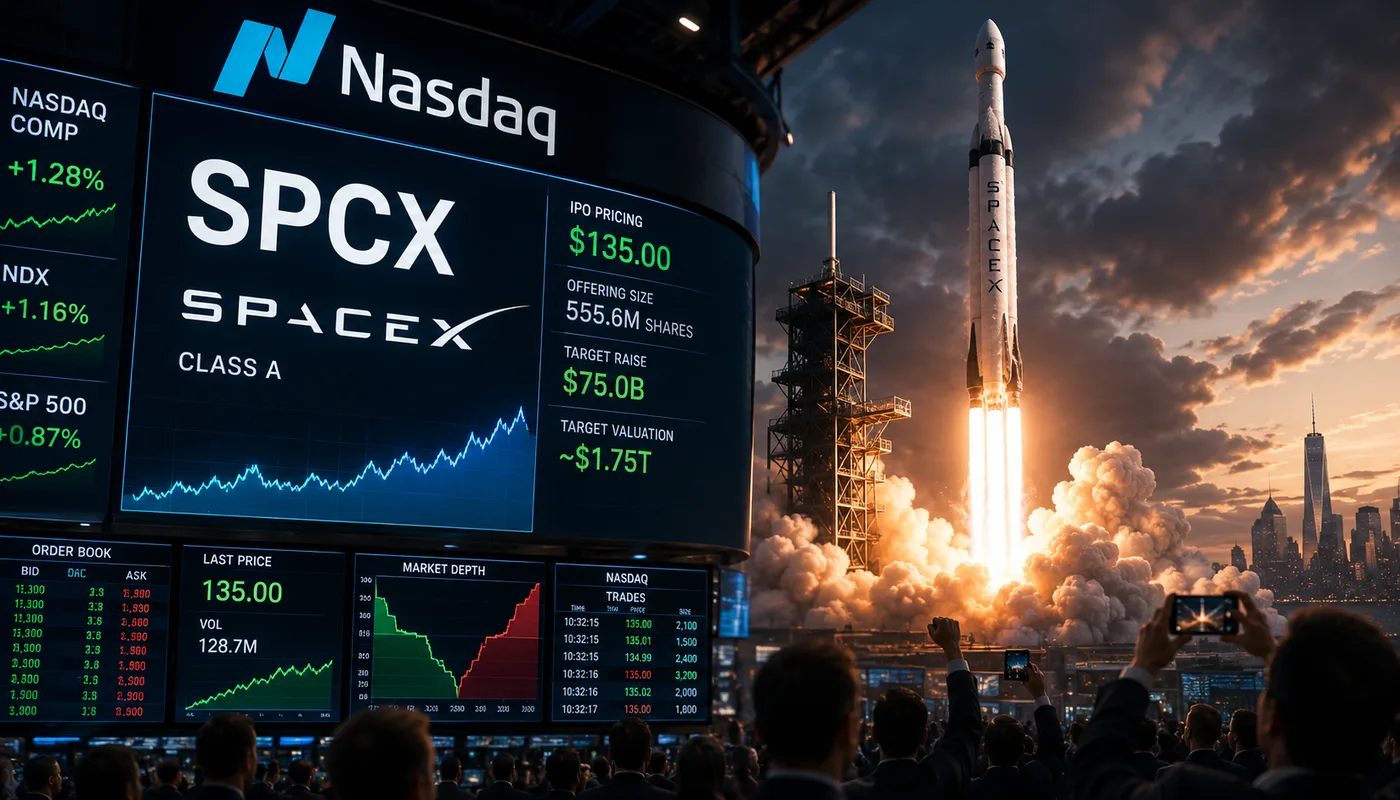
SpaceX’s SPCX IPO is the planned Nasdaq debut of Space Exploration Technologies Corp., targeting a historic $75 billion capital raise at roughly $135 per share and a potential ~$1.75 trillion valuation, making it the largest U.S. IPO ever and a defining moment in financial markets.
Key takeaways
- Massive IPO on the horizon: SpaceX plans to list under the ticker SPCX on the Nasdaq on June 12, 2026, selling about 555.6 million Class A shares at $135 each to raise around $75 billion. (Simply Wall St)
- Record valuation target: At that price, SpaceX’s implied valuation is roughly $1.75 trillion, eclipsing all previous U.S. IPOs and rivaling some of the world’s largest companies. (Simply Wall St)
- Mixed financials beneath the hype: In 2025 SpaceX generated about $18.7 billion in revenue but posted a loss of around $2.6 billion, underscoring the risk behind its growth narrative. (Simply Wall St)
- Retail access is expanding: Brokers like Fidelity are offering retail participation with as little as $2,000, but allocations may be limited by lottery systems. (Business Insider)
- Market mechanics matter: Index inclusion (e.g., S&P 500) may be delayed due to rule criteria, affecting passive fund flows and broader demand after SPCX begins trading. (Yahoo Finance)
The SPCX IPO is history in the making
SPCX is no meme ticker — it’s the official Nasdaq symbol for SpaceX’s upcoming initial public offering, now scheduled for June 12, 2026 after the company filed its S‑1 with the U.S. Securities and Exchange Commission. (Roic AI)
Financial markets haven’t seen a debut this large in U.S. history. SpaceX plans to sell about 555 million shares at $135 each to raise roughly $75 billion, a tally that easily surpasses the $25 billion IPO of Saudi Aramco in 2019 and could make SpaceX’s valuation — around $1.75 trillion — bigger than many incumbents of the Fortune 500. (Simply Wall St)
Yet this isn’t merely a record‑book matter. SPCX’s arrival is reshaping how markets think about private tech giants transitioning to public ownership and how retail and institutional demand interplay in gargantuan offerings.
SPCX basics: ticker, price, and timeline
SPCX is SpaceX’s chosen Nasdaq ticker as it moves from a private firm to a public one. (MarketWatch)
- Ticker symbol: SPCX (acquired ahead of the IPO). (MarketWatch)
- Listing exchange: Nasdaq. (Roic AI)
- Expected trading date: June 12, 2026. (Simply Wall St)
- IPO price: $135 per share. (Simply Wall St)
- New shares offered: around 555.6 million Class A shares. (Simply Wall St)
Underwriters include major names like Goldman Sachs, JP Morgan, and Morgan Stanley, signaling Wall Street’s belief that this offering could anchor markets for some time. (Investing.com)
Why the valuation is both bold and contested
At a $135 IPO price and 12.9 billion share base, SpaceX’s market cap is targeted near $1.75 trillion — a number few public companies reach. (Simply Wall St) This mirrors valuations of entrenched tech giants rather than a firm still harvesting heavy R&D costs.
SpaceX’s 2025 revenue was about $18.7 billion with an operating loss near $2.6 billion, reinforcing how growth expectations, not current profits, power the SPCX narrative. (Simply Wall St)
Critics argue that such lofty valuations — often expressed in price‑to‑sales multiples far above market norms — can leave new shareholders exposed if growth falters or macro winds shift. This skepticism isn’t unique to SpaceX, but the scale here is extreme compared to typical IPO valuations.
Retail access challenges and opportunities
Traditionally, retail investors (everyday brokers like Schwab or Fidelity clients) struggle to access hot IPOs on favorable terms. But SPCX is bending that norm.
Fidelity, for instance, is allowing participation with minimum indications of interest as low as $2,000, dramatically lower than institutional blocks historically required. (Business Insider)
This expanded access is partly enabled by SpaceX’s decision to allocate up to 30 % of the IPO to retail, a notable departure from the usual 5‒10 % seen in major offerings. (Business Insider)
However, participating isn’t guaranteed. Many brokers use lottery systems to distribute allocations on high‑demand IPOs. Retail demand could outstrip supply, meaning lucky small investors may still see limited shares.
Post‑IPO mechanics: index inclusion and demand
Indices like the S&P 500 or Nasdaq‑100 exert powerful influence on capital flows once a stock becomes eligible. Yet as of early June 2026, SpaceX faces a delay in S&P 500 inclusion because the index provider hasn’t amended criteria to fast‑track SPCX, unlike some market rumors suggested. (Yahoo Finance)
That delay matters: many passive funds only buy stocks once fully approved for index inclusion. Without that signal, early SPCX demand may rely more on active managers and selective ETFs.
Retail investors vs. institutional demand: a balancing act
SpaceX’s unique structure and Musk’s status have invited both fervent retail interest and deep institutional commitments. Analysts note that demand from large asset managers could absorb much of the IPO, relegating retail to smaller positions — even if the allocation rules favor them. (Business Insider)
For retail participants, that dynamic creates a trade‑off: gaining exposure to a historic IPO at its start versus the possibility of limited allocation and early volatility.
Market implications beyond SpaceX
SPCX’s debut doesn’t only affect SpaceX shareholders. The reallocation of investor capital toward one of the largest IPOs ever could influence sectors like big tech, aerospace, and AI‑linked equities. Some analysts suggest that major IPO demand can pull liquidity out of crowded segments, impacting performance in other parts of the market.
Moreover, the broadening of retail participation norms — if SPCX’s retail access proves smooth — could shift brokerage strategies for future blockbuster IPOs.
Strategic framing: SPCX as a liquidity event
One way to understand SPCX is as a liquidity transformation for SpaceX. After years as a private giant with limited shareholder access, the IPO is a mechanism to convert private stakes into tradable public equity. For long‑time investors, employees, and early backers, SPCX means unlocking value.
For the public markets, it’s both a culmination of private tech’s ascent and a stress test of valuation discipline — investors will be pressured to price future growth while scrutinizing current fundamentals like revenue, margins, and capital intensity.
FAQ
What is SPCX?
SPCX is the Nasdaq ticker that Space Exploration Technologies Corp. will use when its IPO begins trading, expected on June 12, 2026. This symbol represents shares offered in what could be the largest IPO in U.S. history.
When will the SpaceX SPCX IPO happen?
SpaceX’s registration statements and roadshow point to a mid‑June 2026 pricing and a June 12 trading debut under the SPCX symbol.
How big could the SPCX IPO be?
The deal targets roughly $75 billion in capital raised at about $135 per share, which implies a company valuation around $1.75 trillion at listing.
Can retail investors participate in SPCX?
Yes. Some brokers, like Fidelity, are lowering minimums (to about $2,000) and allocating up to 30 % of shares to retail, but high demand and lottery systems mean actual access is uncertain.
Sources
- SpaceX Targets Historic $75 B IPO, Files for Nasdaq Listing Under Ticker SPCX — Roic News, 2026‑06‑04
- SpaceX IPO: Every ETF That Will Hold SPCX — and When — ETF.com, 2026‑06‑04
- SpaceX files IPO prospectus, offering a peek into its finances — Yahoo Finance, 2026‑05‑20
- SpaceX Excludes China and Hong Kong Investors From Planned $75 B IPO (SPCX) — Yahoo Finance, 2026‑06‑05
- SpaceX Faces Delay to S&P 500 Inclusion After Index Provider Keeps Existing Criteria (SPCX) — Yahoo Finance, 2026‑06‑05
- Fidelity just announced how it will make SpaceX stock available to more investors — Business Insider, 2026‑06‑05
- Elon Musk's SpaceX paid to secure its ticker symbol ahead of blockbuster IPO — MarketWatch, 2026‑06‑05