
Workflow · AI foundations
A five-session AI practice plan with work you can inspect
Produce a task contract, context pack, evaluation record, action map, and reusable field note. Follow a practical learning plan using our original labs and worksheets.
In this article
Finish with five artifacts, not five new tools
Learning to use AI can turn into a cycle of trying interfaces without keeping evidence of what improved. A new tool produces a persuasive answer, another tool produces a different one, and the experience becomes a collection of impressions. A more useful practice plan leaves small artifacts that show how you framed a task, supplied evidence, checked a result, and decided what to do next.
This plan uses the original labs and project case studies created for TrendsWhat. You can complete the reading and review activities without writing code. If you want to run the experiments, the articles provide small downloadable scripts and synthetic inputs. The plan is a proposed learning routine, not a report that the operator completed a five-day challenge or a study proving a particular learning gain.
Treat the sessions as a sequence rather than a deadline. Spend enough time to produce the named artifact and understand its limits. The goal is not to become an expert in five sittings. It is to establish a repeatable way of turning AI output into work you can inspect.
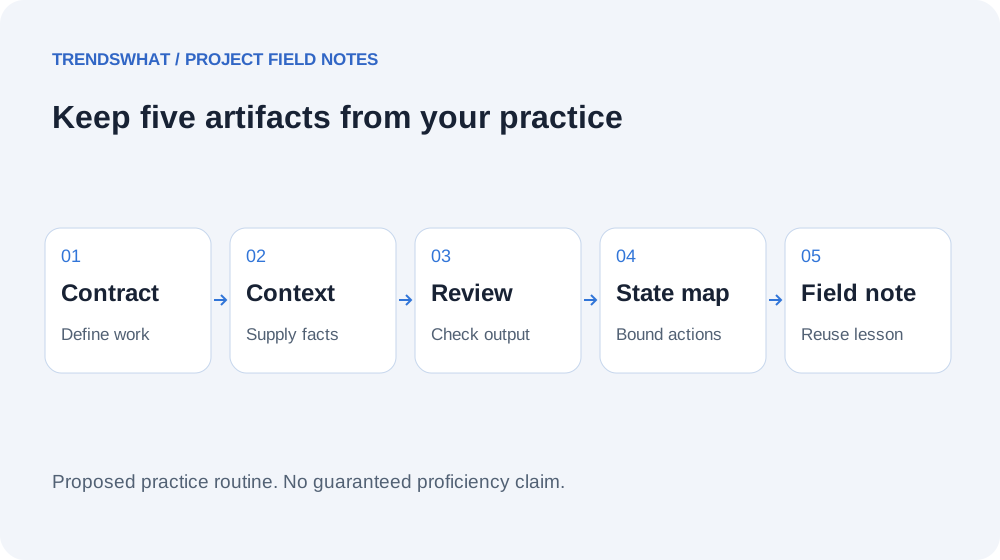
Original TrendsWhat practice plan. Completion means producing and reviewing the artifacts, not achieving a guaranteed level of proficiency.
Session one: make a task small enough to judge
Choose a harmless task with a clear deliverable. A fictional workshop reminder, a summary of a short public document, or a comparison of supplied feature descriptions can work. Avoid sensitive records and consequential decisions for the practice exercise. You want the difficulty to come from defining quality, not from managing real-world stakes.
Write a one-paragraph task contract. Name the reader, the output, the permitted sources, and the conditions that would make the result unacceptable. For a workshop reminder, those conditions might include inventing a venue, changing the date, or implying that the message has been sent. Mark the result as a draft.
Read What actually makes an AI workflow useful? and fill its canvas for this one task. Do not add a complicated agent or several tools yet. Your first artifact is the contract itself. Ask whether another person could use it to reject an attractive but incorrect answer.
Check your first artifact
A weak contract says “write a good reminder.” A stronger one says who the reminder is for, which event details are established, what remains unknown, and what format is needed. The second gives you a basis for review. If you cannot identify a possible failure, the task may still be too vague.
Save the contract before generating an answer. This preserves the difference between your original standard and preferences that arise after seeing the output. You can revise the standard later, but record why it changed rather than silently moving the goalposts.
Session two: build the context the task needs
Create a small source pack for the same task. Separate instructions, evidence, current state, constraints, and examples. If you use a fictional event, keep all values clearly labeled. If you summarize a public source, record the direct link and the passage the answer should rely on.
Read the context guide. Look especially for relative dates, units, allowed choices, and defaults. A word such as “tomorrow” needs a reference date. A number needs its unit. An example can demonstrate structure without supplying facts for the real output.
Your second artifact is a context pack with an explicit unknowns section. Use a plain document or JSON, whichever you can inspect comfortably. The format matters less than the separation of roles. Remove material that does not help the task and could distract from the evidence that does.
Introduce one missing fact deliberately
Remove one nonessential detail from the pack and ask an assistant to produce the draft, if you have an appropriate tool available. Observe whether it preserves the gap, asks a useful question, or invents a plausible value. Save the actual response. This is your own practice run; this article does not predict or report its outcome.
If you do not use a model, review a manually written sample with the missing fact instead. The skill being practiced is identifying which claims the input can support. The exercise remains useful without a particular subscription or model brand.
Session three: evaluate before rewriting
Choose three criteria from your task contract and one critical failure. Review the saved output against them. Record the exact sentence or field that supports each judgment. Avoid beginning with a global score such as “eight out of ten,” because it can hide why you would accept or reject the result.
Read the prompt evaluation guide and the citation experiment. The latter shows why a real quotation does not automatically support the claim attached to it. Use that distinction when reviewing any factual sentence in your draft.
Your third artifact is an evaluation record containing the input version, actual output, criteria, observed failures, and a short decision. A useful decision might be “revise the context to make the unknown venue explicit,” not merely “try a smarter prompt.” Choose the change that addresses the failure you actually observed.
Test the revision on a different example
Create a second small example that was not used to write the revision. Keep the same task type but change something meaningful, such as the source structure or the missing detail. Evaluate the new output under the same criteria.
Do not treat one success as proof of general reliability. Record what changed and what remains untested. If the revision fixes one problem but introduces another, that is useful evidence. The practice goal is to make a defensible decision, not to force a success story before the session ends.
Session four: draw the action boundary
Now ask what would happen if the draft were connected to an action. Would a message be sent, a record saved, or a page published? Draw the states from proposal to completion. Identify who may authorize the action and which exact version they would approve.
Read the StockNote approval case. Its inspected code separates an AI-structured expense draft from the operation that commits reviewed fields. Then read the outbox case for the distinction between a failed response and an action that may already have happened.
Your fourth artifact is an action map. You do not need to implement it or send anything. Include pending, approved, completed, and uncertain states where relevant. Mark what evidence would establish completion and what should happen after a timeout. This keeps the practice focused on reasoning about consequences rather than performing real actions unnecessarily.
Challenge the map with a late response
Use a fictional sequence: an action starts, the user changes the draft, and the old response arrives. Which version should the response affect? If your map cannot answer, add the version or identity information needed to distinguish them.
This is not a claim that every workflow needs a mobile outbox. A simple manual review may be enough for a harmless draft. The exercise teaches you to notice when the meaning of “done” depends on state outside the conversation. That awareness is useful when supervising more capable tools later.
Session five: package the lesson for reuse
Choose the most informative failure or decision from the previous sessions. Write a short field note that includes the task, input conditions, actual observation, change made, and remaining limits. Attach the relevant output or evaluation record so the note does not depend on your memory of what happened.
Read Turning one AI experiment into a reusable skill. Use its manifest to decide what to keep. You do not need a long report. A clear entry point, one representative example, and a useful stop condition can be enough for a small recurring task.
Your fifth artifact is a reusable procedure with an explicit scope. It should tell your future self when to use it, what material to provide, what to check, and when to stop or ask for missing information. Keep fictional example facts separate from instructions that should transfer.
A compact completion checklist
| Session | Artifact | Completion question |
|---|---|---|
| Define | Task contract | Can I reject a plausible but wrong result? |
| Prepare | Context pack | Are facts, defaults, and unknowns distinguishable? |
| Evaluate | Review record | Can I explain each important judgment with evidence? |
| Bound actions | State map | Do I know what approval and completion mean? |
| Reuse | Field note | Could I repeat the method without reconstructing the conversation? |
Keep the five artifacts together. Their relationship is the point: the evaluation refers to the contract, the output depends on the context, and the reusable procedure preserves the decision. A folder full of disconnected prompts is less helpful because it does not explain why any particular prompt was kept.
Two paths through the same plan
If you prefer a nontechnical path, inspect the articles' result tables and downloaded JSON as documents. Use the worksheets to analyze a fictional task. Focus on identifying claims, missing information, and the evidence needed for a decision. You can practice these skills without executing code.
If you are comfortable with code, run one of the small local labs and add a fixture relevant to your task. Read the script first and use a suitable local environment. Define the expected result before editing the implementation. Keep the new result separate from the publication's recorded baseline.
Both paths should end with a bounded conclusion. “This checker rejects an impossible date under our contract” is more useful than “I understand AI now.” Specific conclusions accumulate into practical competence because they can be applied, challenged, and revised.
What to measure about your own practice
Track whether you can identify unsupported claims, locate a failure boundary, and explain what evidence is missing. You can also record active effort and correction time if useful, but do not turn speed into the only measure. A faster review that misses the decisive error is not an improvement under the task contract.
Keep a small list of recurring mistakes in your own process. Perhaps you forget to preserve source dates, confuse a snapshot with history, or accept a field because it has the right shape. Choose the next practice task to challenge one of those patterns rather than trying another tool at random.
This plan makes no scientific claim about training effectiveness. It offers a practical structure for producing inspectable work. If you want to compare your performance over time, keep the tasks and criteria sufficiently similar and acknowledge differences in difficulty rather than interpreting every better score as learning.
Continue with a real, permitted task
After the five sessions, choose one low-risk task from your actual work and adapt the procedure. Recheck the input permissions, acceptance criteria, and action boundary. Real material may introduce formats or ambiguity absent from the practice examples, so treat the first use as another evaluation rather than a guaranteed success.
The operator's project cases show several places to look: document boundaries before quiz generation, editable drafts before commitment, and explicit state around retries. You do not need to copy those systems. Use them to ask better questions about the work you already do.
The lasting habit is simple: define the job, preserve the evidence, inspect the result, and save the decision. That creates a record of what you can actually do with AI, beyond the impression left by the latest demonstration.
Sources, materials, and limits
- The linked TrendsWhat workflow, context, evaluation, approval, outbox, and experiment-package articles provide the original materials used in this plan.
- Executable starter labs and recorded results support the optional technical path.
- Original practice plan and completion worksheet. This is a proposed routine, not a fabricated personal diary, measured learning intervention, or guarantee of proficiency after five sessions.