
Workflow · AI foundations
What actually makes an AI workflow useful?
Map the work around an AI answer: preparation, review, exceptions, and delivery. Includes a reusable workflow canvas grounded in our labs and project inspection.
In this article
The output is only one part of the work
A convincing AI demo usually ends at the moment a result appears. Real work continues. Someone checks the result, corrects it, moves it into another system, and handles the cases that do not fit. If those steps are harder than the original task, the impressive output has not become a useful workflow.
While preparing this publication, we encountered that distinction in concrete form. Our CSV experiment produced three failures before any language model was involved. Our source-checking experiment accepted two claims that its quotations did not support. In the operator's StockNote code, an expense proposal remains a draft until a separate approval path commits it. Each example points to the same design question: what happens around the generated answer?
This guide turns those observed boundaries into a practical worksheet. It is an editorial synthesis of the linked experiments and inspected project code, not a claim that we measured productivity across a team. The worked planning examples are fictional. Use them to design a test of your own process, then replace the assumptions with actual observations.
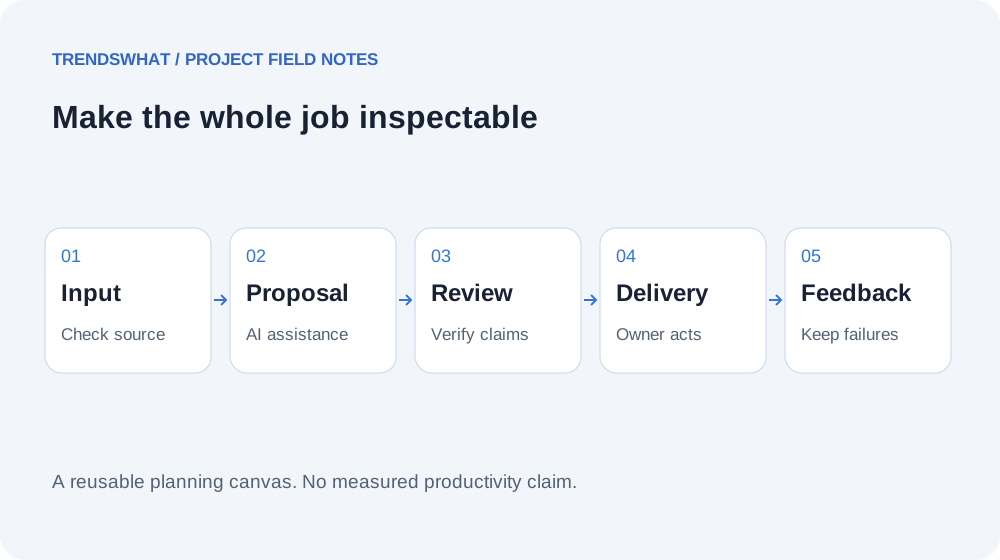
Original TrendsWhat workflow guide. The sequence is a planning aid, not an experimental result or a claim that every task requires five separate tools.
Start with a deliverable someone can reject
“Use AI for research” is too broad to evaluate. “Produce a one-page comparison of three export options, with a source beside each factual claim” creates a deliverable that a reviewer can accept or reject. The second statement identifies a result, a size, and an evidence requirement. It also makes failure easier to describe.
Write the acceptance criteria before designing the prompt. For the comparison, criteria might include correct product names, current source dates, a consistent comparison basis, and explicit unknowns. A missing price should remain unknown until verified. A longer response is not necessarily better if the intended reader needs a concise decision aid.
This step is useful even when you never automate the task. It exposes disagreements about what the work is for. One person may want a shortlist, another a complete market survey. No model setting resolves that difference. A workflow begins to improve when the people involved agree on the decision the deliverable should support.
Map the current process honestly
List the steps from receiving the input to delivering a usable result. Include clarification, source access, checking, formatting, handoff, and correction after feedback. These steps are easy to omit because they are less visible than drafting. Yet they often determine whether assistance is worthwhile.
For a fictional weekly research note, the process might involve collecting three questions, finding primary sources, extracting claims, drafting the note, reviewing it, and sending the approved version. If AI only speeds up drafting, the other steps still exist. The right comparison includes them rather than measuring the seconds until text first appears.
Record the baseline on representative work before making changes. Note active effort separately from waiting time. A task that takes thirty minutes of attention and two hours of external waiting is different from a task that consumes the full two and a half hours. Decide which dimension matters to the person doing the work.
Choose one boundary to improve
The simplest useful intervention is often a bounded assistance step. AI might group already validated comments into themes or turn approved notes into a first draft. Ordinary code might parse a file, check identifiers, or compare required fields. A person might resolve missing context or approve publication.
Our CSV experiment illustrates why this division matters. A format-aware parser preserved all eight synthetic fixtures, while comma splitting preserved five. Asking a model to infer the intended table would add uncertainty where a deterministic reader already handles the syntax. The experiment does not establish downstream answer quality, but it identifies a preprocessing improvement worth making first.
Choose a step with clear inputs and an inspectable output. Define what remains outside its responsibility. If the assistant drafts a comparison, it does not also decide whether an unsupported claim is acceptable. If it suggests a calendar event, it does not silently change attendees. Boundaries make assistance easier to evaluate and safer to expand deliberately.
Budget the review, not just the generation
A useful estimate includes preparation, generation, review, corrections, and delivery. For a fictional example, suppose the original task takes twenty minutes. An assisted draft takes three minutes, but preparing context takes five, checking takes ten, and correcting takes four. The assisted workflow uses twenty-two minutes. Those invented numbers illustrate the accounting; they are not observed savings from our projects.
A result can still be valuable if it improves quality or reduces fatigue, but name that benefit separately. Do not label a quality improvement as time saved. Likewise, a faster process that increases the rate of important errors may not be acceptable. Decide in advance which quality requirements are non-negotiable.
Review time also depends on how inspectable the output is. A source ledger can make verification easier. An answer that blends facts, assumptions, and recommendations in one fluent paragraph can make it harder. Prompt design should therefore consider the reviewer as well as the final reader. Sometimes the best intermediate output is a plain table.
Make exceptions part of the product
A workflow is not repeatable merely because it succeeds on the example used to build it. It needs behavior for missing inputs, contradictory sources, malformed data, and requests outside its scope. These cases should have visible outcomes rather than disappearing into an error log or becoming invented answers.
In the citation experiment, a quotation-matching gate could not determine whether a claim followed from the quotation. The useful next step was a separate support judgment. That is an exception-handling lesson: when a mechanical check cannot settle the decision, preserve the unresolved state and route it to the right reviewer.
A practical exception record includes the input identifier, failed criterion, evidence available, and next action. “Unknown date; ask the source owner” is actionable. “Low confidence” is less useful unless someone knows what to do with it. The exception path should be easy enough that people do not bypass it just to finish the task.
Give the final action an owner
The operator's StockNote case study shows an explicit separation between an AI-structured draft and the approved transaction. The local code provides a concrete place for review and correction. We did not test customer behavior or production outcomes, but the architecture makes the intended responsibility legible.
Apply the same question to your deliverable. Who approves the final email, published page, data change, or external request? What exact version do they approve? Where can they see the consequence? If the process changes the result after approval, the earlier review may no longer refer to what is actually delivered.
Not every task needs a formal approval screen. A person copying a draft into their own notes may provide an adequate boundary. A tool sending messages to others or altering persistent records needs stronger clarity. Match the control to the action instead of adding ceremony to harmless steps or omitting it from consequential ones.
Copy this workflow canvas
| Field | Write one concrete answer |
|---|---|
| Repeated task | What work happens often enough to improve? |
| Reader or user | Who needs the result, and for what decision? |
| Accepted output | What must be present for the result to be usable? |
| Input contract | Which sources, permissions, and formats are required? |
| Assistance step | What exactly will AI produce? |
| Deterministic checks | What can ordinary code verify? |
| Human judgment | Which decisions require context or responsibility? |
| Exception route | What happens when information is missing? |
| Delivery boundary | Who approves the final action or artifact? |
| Measurement | What effort and quality signals will be recorded? |
Fill this canvas for one actual task. If an answer contains several unrelated activities, split them. “Research, write, publish, and promote” is four different boundaries with different evidence and consequences. A smaller canvas makes the next experiment easier to interpret.
Run a comparison that can change your mind
Use a set of permitted, representative examples. Keep some examples aside while designing the workflow, then evaluate the revised process on them. Include a difficult input and an input that should be rejected or escalated. Record the same measures for the baseline and assisted versions.
Change one major factor at a time when practical. If you alter the source pack, output format, model, and reviewer together, an improvement may be real but difficult to attribute. For exploratory work, that may be acceptable; simply describe the comparison as a whole-workflow change rather than claiming a particular prompt caused the result.
Keep failures with the report. A workflow that saves time on ordinary cases but mishandles one important exception may need a narrower scope. That is a useful conclusion. The purpose of testing is to decide what to adopt, not to defend the first design. Write down what evidence would make you stop or revise the approach.
A weekly maintenance habit
After adoption, collect a small number of failure examples and recurring edits. Look for patterns: missing context, unstable formatting, unsupported claims, or handoff confusion. Update the relevant boundary rather than lengthening the prompt indiscriminately. Some failures require a better source, a parser, or a clearer product decision.
Review the workflow when its inputs or tools change. A new document format can invalidate a parser assumption. A different audience can change the acceptance criteria. A new model may alter output behavior. Keep the version of the method beside the result so later observations are comparable.
Avoid measuring only volume produced. More drafts do not necessarily mean more accepted work. Track a signal tied to the deliverable, such as accepted notes with verified claims or correctly processed records. The most useful measurement is one that can reveal that the workflow should be simplified, narrowed, or retired.
What makes it useful in the end
A useful AI workflow has a clear job, preserves the input's meaning, produces an inspectable result, and includes the effort required to turn that result into completed work. It handles uncertainty visibly and keeps the final action attached to an appropriate owner.
The experiments and project inspection behind this guide do not prove a universal productivity gain. They offer concrete examples of where work succeeds or fails around the model. Use the canvas to locate one such boundary in your own process. Improve it, measure the complete result, and keep the method only if the evidence supports doing so.
Sources, materials, and limits
- Eight-case CSV lab: executed preprocessing comparison and reusable import worksheet.
- Citation support lab: executed provenance checker with unsupported false accepts.
- StockNote approval case study: inspected project architecture, not runtime outcome proof.
- Original workflow diagram and canvas. Timing examples are fictional; no team productivity study was conducted for this guide.