Amérique in Canadian Business: Why the Americas Market Still Shapes Strategy
In Canadian business strategy, **“Amérique” refers to the wider Americas market — North, Central, and South America — and remains a fundamental driver of trade, investment, and cross‑border finance.
Key takeaways
- Amérique (the Americas) is geographically the continent that includes 35 sovereign states from Canada to Argentina and often denotes the combined economic region for trade and investment strategies. (Wikipedia)
- Canada’s strategic gateway role gives enterprises duty‑free access to ~450 million consumers under the Canada–United States–Mexico Agreement (CUSMA). (Investissement Québec)
- Canadian financial and professional services — including banks and management schools — rank highly across North America, underscoring continental influence on talent and capital. (McGill University)
- “Amérique” in business usage often extends beyond linguistic nuance to describe regional market planning that incorporates both US and broader Americas economic dynamics.
Defining “Amérique” beyond the dictionary
“Amérique” is the French term for the continent of the Americas — a vast landmass of 42 million km² stretching from the Arctic to the Antarctic with more than a billion inhabitants across 35 countries. (Wikipedia)
For Anglophone Canadian business leaders, the region is typically called the “Americas” or “North America” depending on context. In French‑language usage within Québec and other parts of Canada, “Amérique” can appear in corporate names, cultural references, and marketing as shorthand for this hemispheric economic space.
In simple business terms, thinking in “Amérique” frames means treating the market as more than the domestic Canadian economy or the United States alone — it’s a hemisphere‑wide strategic opportunity.
Why Canadian firms pivot to the “Amérique” market
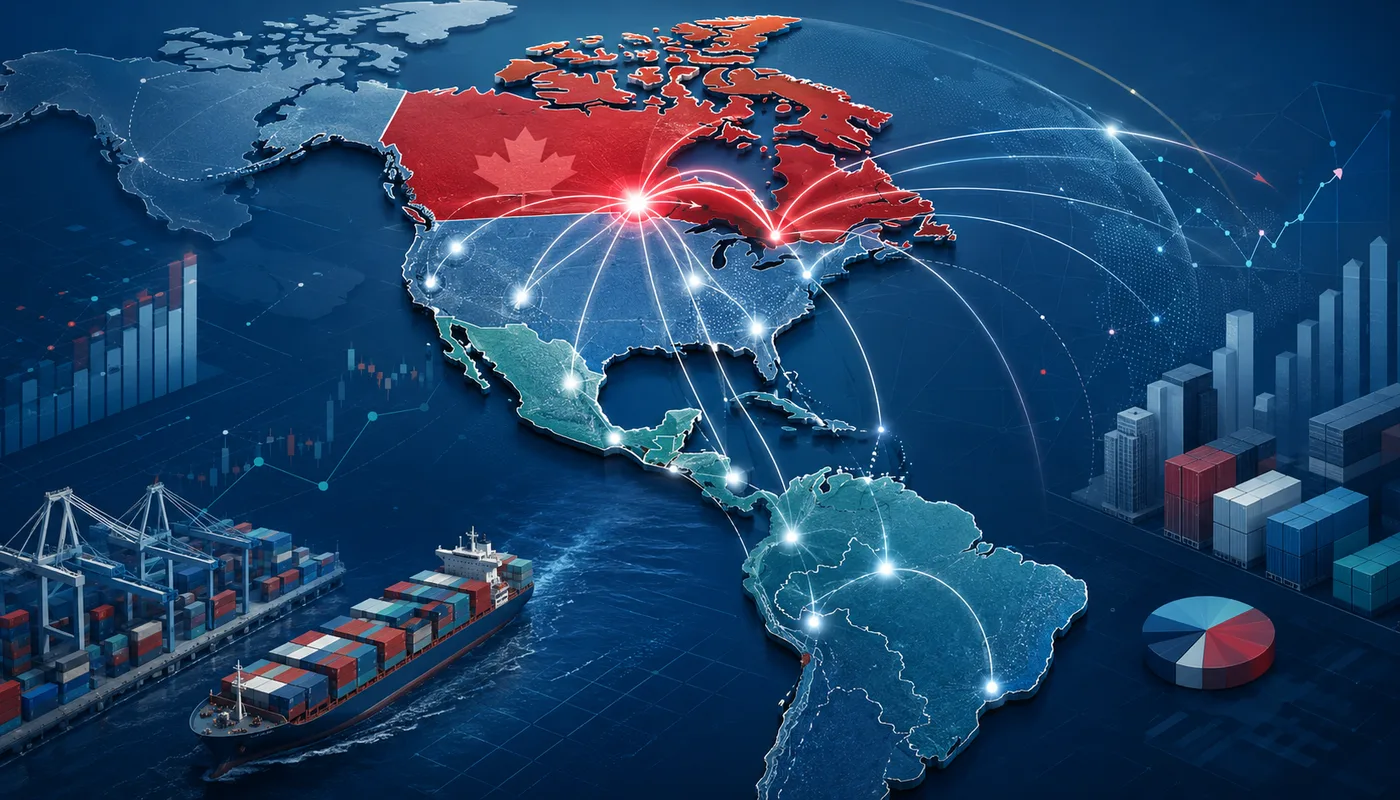
The Amérique market is neither theoretical nor vague — it’s where Canada’s trade happens. Canada’s largest export market is the United States, followed by Mexico and other Latin America partners. This is both a geographic and economic fact, not a slogan.
Canada, the U.S., and Mexico have operated under CUSMA (Canada–United States–Mexico Agreement) since 2020, which lets Canadian firms export goods and services duty‑free to roughly 450 million consumers across North America. (Investissement Québec)
This commercial reality means decisions about supply chains, pricing, and investment in Canada are deeply influenced by what’s happening across the Americas — from manufacturing hubs in Mexico to tech growth in U.S. cities and resource markets in South America.
The myth: “Amérique” is just slang for the U.S.
Contrary to a common misunderstanding, “Amérique” doesn’t just mean the United States in Canadian business contexts. While English speakers do sometimes refer simply to the U.S. as “America,” the broader term encompasses multiple economies and markets.
In French, “l’Amérique” can refer to the entire continent, and savvy Canadian companies adapt their strategies accordingly — not only chasing U.S. GDP but also aligning with Latin American growth corridors.
For instance, Québec‑based firms often leverage bilingual markets to bridge language and cultural gaps throughout the Americas. This linguistic advantage has spurred publishing ventures like Québec Amérique, a Montreal‑headquartered publisher that markets French language resources across the hemisphere. (Wikipedia)
What “Amérique” means in practical business strategy
Trade flows and investment patterns
Canada’s export economy is heavily tied to its continental neighbours. The U.S. consistently absorbs the majority of Canadian goods — from forestry products to automobiles — due largely to proximity and seamless trade under CUSMA.
Investment flows also reflect this pattern. Canadian pension funds, banks, and insurers are major investors across the U.S., with sectors like financial services and technology seeing cross‑border capital flows spike in recent years.
For example, Canadian banks are increasingly recognised for performance across the Americas, with institutions such as RBC noted for research and investment excellence on the continent. (RBC)
Talent and education within “Amérique”
Canada produces notch talent that competes across North America. Desautels Faculty of Management at McGill University, for instance, holds top rankings in finance programs within North America — a proxy for Canadian competitiveness in the broader region. (McGill University)
For firms contemplating cross‑border expansion, this means recruiting staff who understand both Canadian regulations and international business within the Americas economy.
A framework: The “Amérique Advantage”
To integrate “Amérique” into strategy without buzzwords, Canadian executives can apply the Amérique Advantage Framework:
- Regional market mapping – Identify where Canadian products or services match demand across the entire Americas, not just the U.S.
- Trade leverage alignment – Use existing agreements like CUSMA to minimise tariffs and regulatory friction.
- Bilingual brand positioning – Especially for Québec‑based firms, apply French and English brand assets to expand reach into multilingual markets in the Americas.
- Capital mobility strategy – Plan financing and investment with a North America lens, accounting for currency dynamics and regulatory environments.
This framework simply acknowledges that “Amérique” is an economic zone, not a point on the map.
Friction and risks when thinking hemisphere‑wide
Expanding across the Americas isn’t without tradeoffs. Regulatory environments vary sharply from country to country — Canada’s financial regulations differ from the U.S. Securities and Exchange Commission rules or Mexico’s commercial codes. Corporations must weigh compliance costs against market potential.
Market entry into Latin American countries also exposes firms to political and currency volatility — factors less pronounced in Canada–U.S. trade.
Understanding and budgeting for these risks is part of treating “Amérique” as more than a buzzword.
What changed in 2026 for Canada and the Americas market
There’s no single headline rewrite of Canada’s position in “Amérique” this year, but two trends are evident:
- Elevated north‑south awareness: Canadian firms continue moving beyond U.S‑centric views to include Latin America in growth plans, influenced by multilateral agreements and regional supply‑chain diversification.
- Talent mobility: Finance and technology education in Canada remains competitive within North America, helping homegrown firms attract and retain employees prepared for pan‑Americas markets.
FAQ
What does “Amérique” mean in a Canadian business context?
In Canada, “Amérique” generally refers to the broader economic region of the Americas — including North, Central, and South America — which is vital for trade, investment, and strategic market planning.
Why is the Americas market important for Canadian business?
The Americas market includes major economies like the United States and Mexico, and access under agreements such as CUSMA gives Canadian companies prioritised duty‑free trade with roughly 450 million consumers.
How can Canadian companies leverage “Amérique” for growth?
Canadian companies can leverage the Americas market by using trade agreements, regional partnerships, and localized infrastructure investments to expand exports and foreign investment across hemispheric markets.
Sources
- Wikipedia (French) — “Amérique” definition and geographic context. Wikipedia, accessed June 2026.
- Investissement Québec — CUSMA and strategic financial destination documentation. Investissement Québec, accessed 2026.
- McGill University Desautels — Rankings and business education context in North America. McGill University, accessed June 2026.