Ireland’s Solar Energy Leap: How Big Money and Policy Are Powering a New Business Finance Era
Ireland’s solar energy sector is transitioning from a marginal climate play to a core business finance story, driven by large public–private investments and policy support that are reshaping cost structures for companies and the grid alike.
Key takeaways
- Ireland’s solar energy capacity has surged rapidly, with installed capacity near or above 2 GW by late 2025, up from around 1.76 GW the previous year. (Solar Ireland)
- The European Investment Bank (EIB) has committed about €260 million in project finance for four utility‑scale solar farms totalling ~395 MW, a landmark non‑recourse deal. (Solar Now)
- Irish businesses can access €200 million in funded on‑site solar through a partnership between Activ8 Energies and SSE Airtricity, removing upfront costs via long‑term Power Purchase Agreements (PPAs). (SSE)
- Government policy reforms — including liberalised planning permissions and grid investment plans worth €18.9 billion — are materially lowering barriers to commercial solar deployment. (Smart Solar Ireland)
- Solar now contributes tangible grid output and corporate energy cost relief, but cost, grid integration, and the need for storage remain friction points.
A finance story disguised as clean energy
Solar energy in Ireland was once a niche marginalia line in annual energy reports. In 2026, it is a business finance headline.
After years of slow uptake, the sector’s installed photovoltaic (PV) capacity exploded in the past few years: by late 2025, Ireland had surpassed 2 GW of total solar capacity across rooftops, farms, businesses, and utility fields — a massive jump from the few hundred megawatts at the start of this decade. (Solar Ireland)
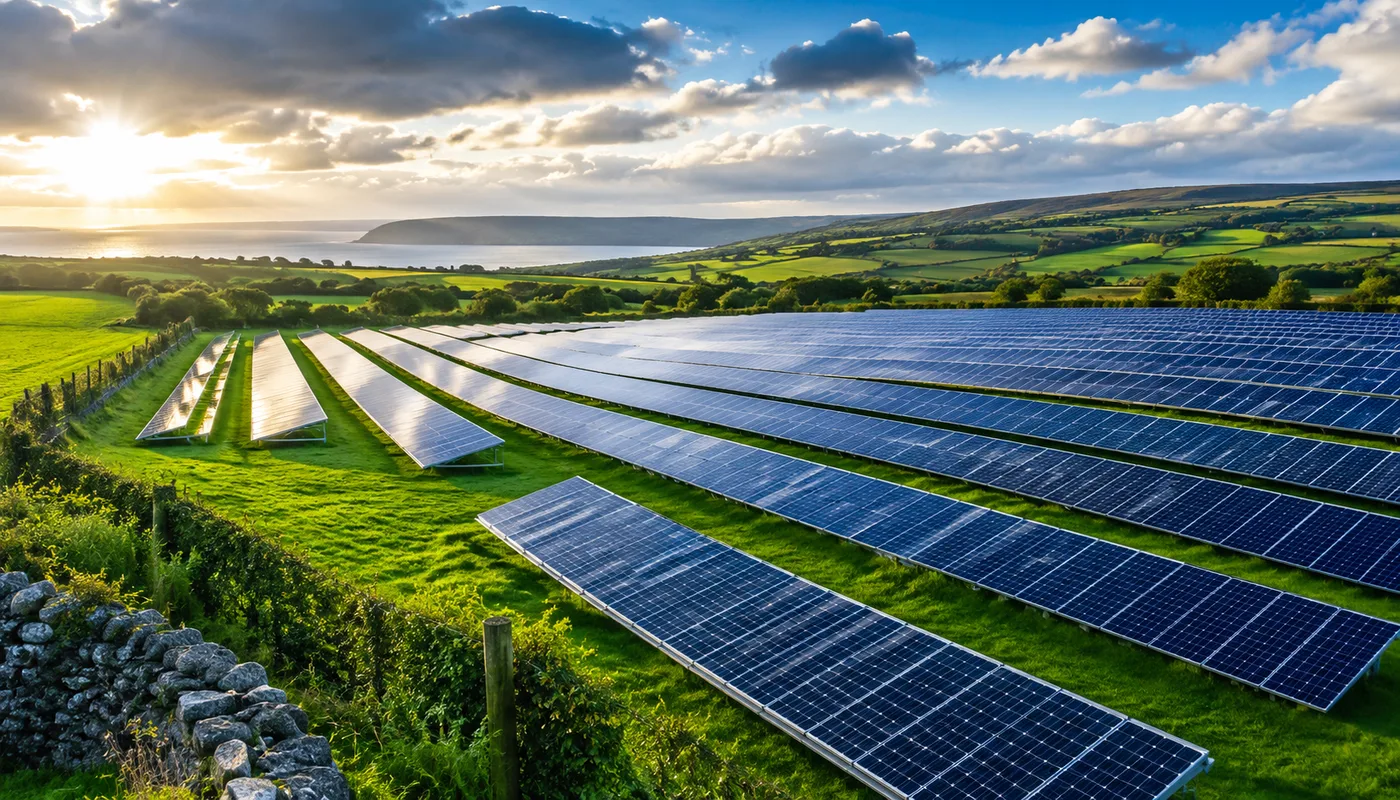
That growth has drawn real capital. In March 2026, the European Investment Bank (EIB) backed a series of Irish solar farms with approximately €260 million in financing — including a €100 million direct loan — in what analysts describe as Ireland’s first fully non‑recourse solar project finance portfolio. (Solar Now) The four projects will install almost 395 MW of utility‑scale capacity across Clare, Tipperary, Wicklow, and Wexford, enough to power tens of thousands of homes and reduce carbon emissions significantly.
Simultaneously, the private sector is innovating funded solar models for Irish companies. A new initiative by Activ8 Energies and SSE Airtricity promises up to €200 million of on‑site solar for businesses with no upfront costs. Through long‑termPPAs — contractual agreements to buy power at agreed rates — companies lock in predictable electricity costs for 15‑25 years, insulating themselves from volatile grid prices while decarbonising operations. (SSE)
This shift reflects a broader truth: solar energy in Ireland is now as much about corporate cost management and capital allocation as it is about climate targets.
From subsidy to scale: policy turning the tide
The Irish government’s strategic shift has been critical. For years, solar lagged because policymakers prioritized wind and lacked clear frameworks for PV financing. That changed with the Renewable Electricity Support Scheme (RESS), which offers fixed revenue streams to projects, making them bankable and appealing to institutional investors. (The Irish Times)
Under RESS and associated auctions, solar developers secured contracts that attracted commercial and infrastructure lenders, lowering the cost of capital and smoothing revenue risk. This structure was elemental to the EIB and commercial banks’ willingness to fund large‑scale solar. (Mason Hayes Curran)
In addition, Ireland’s Price Review 6 (PR6) and government budget allocations have earmarked nearly €18.9 billion for electricity grid upgrades between 2026 and 2030. (pv magazine Global) This investment is meant to improve grid capacity and integration for all renewables, a necessity as solar’s intermittent generation grows more influential.
Planning regulations have also loosened for commercial solar. Exemptions for rooftop solar and relaxed height restrictions mean many commercial systems can now be deployed without full planning permission, speeding project timelines and reducing cost and regulatory friction. (Smart Solar Ireland)
Why big finance sees Ireland’s sun
Ireland is not traditionally sun‑soaked — its climate doesn’t match southern Europe’s — but declining PV costs, better technology, and stronger policy frameworks have shifted economics heavily. Today’s panels generate useful power even in cloudier conditions, and corporate buyers value price certainty over marginal capacity gains. (The Irish Times)
For investors, the combination of long‑term contracted revenues (via RESS and PPAs), EU backing, and growing electricity demand makes Irish solar appealing as infrastructure finance. The EIB deal marks a turning point: lenders are willing to take long horizons and non‑recourse risk, a hallmark of mature renewable markets. (Solar Now)
Businesses, for their part, are responding to energy price volatility — compounded by geopolitical events — by seeking predictable generation costs and hedging strategies. The solar funded initiative packages take advantage of this risk aversion while removing the traditional barrier of upfront capital expenditure. (SSE)
Limits and tradeoffs still ahead
Despite the progress, grid integration and storage remain the biggest operational frictions. Solar’s intermittent nature requires investment in batteries and grid flexibility to handle peak outputs and avoid curtailment, especially as capacity nears 2+ GW. (Solar Ireland)
Cost remains another question. Although PPAs and subsidies reduce net expenses for many businesses, investor returns still hinge on long tenors and stable policy — a vulnerability if administrations shift incentives or reform schemes, as seen in other energy markets.
The residential market also faces challenges: while household solar interest is high, with online inquiries spiking amid energy price shocks, high upfront costs and limited grant sizes constrain adoption for many families. Independent reports cite installation costs around €8,000‑€10,000 with grants capped at €1,800, underlining the need for broader affordability strategies. (The Times)
What business leaders should watch now
For CFOs and energy strategists, a simple framework helps navigate the solar landscape:
- Opportunity: Evaluate on‑site solar with PPAs to stabilise long‑term energy costs against volatile grid pricing.
- Policy alignment: RESS and grid investment policies materially improve bankability now; monitor changes through 2030 targets.
- Grid risk: Incorporate storage or hybrid solutions where feasible to maximise value, given grid and intermittency risks.
Solar energy in Ireland is no longer a future prospect — it’s a present finance story. Whether for utility investors or corporate energy buyers, the sun is shaping strategic capital decisions that blend cost, risk, and sustainability.
FAQ
How is solar energy financing evolving in Ireland?
Solar energy financing in Ireland is evolving through large-scale investment deals like the €260 million European Investment Bank backing for utility solar and new funded solar initiatives that remove upfront costs for businesses while locking in long-term power purchase agreements.
What government support exists for solar energy in Ireland?
Irish government support includes the Renewable Electricity Support Scheme (RESS), capital allocations in Budget 2026 for grid upgrades and rooftop solar, and exemptions to planning permission for many commercial solar projects.
Why are Irish businesses adopting solar energy?
Irish businesses are adopting solar energy to stabilise energy costs amid volatile global markets and secure price certainty via funded installations and Power Purchase Agreements that lower long-term electricity expenses.
Sources
- EIB backs Irish solar with project finance, Now.Solar (2026‑03‑19)
- €200m funded solar initiative for Irish businesses, ThinkBusiness (2026‑05‑11)
- Solar surge: technology, policy and investment driving nationwide adoption, The Irish Times (2026‑04‑30)
- Irish solar rises in 2025 as government plans grid upgrades, pv magazine International (2025‑12‑22)
- Commercial Solar Planning Permission Ireland 2026, Smart Solar Ireland (2026‑05‑15)