
Workflow · AI foundations
Measure AI cost per accepted task, not just per call
Account for retries, review, and accepted results. Work through transparent fictional arithmetic and reuse the task-cost ledger for your own measured workflow.
In this article
The cheapest call can belong to the more expensive workflow
A model call has a visible price, while the work around it often does not. Preparing context, checking facts, correcting fields, retrying failures, and delivering the result all consume effort. Comparing only the inference bill can therefore favor a workflow that is cheaper to generate and harder to finish.
The operator's StockNote implementation records model provider, model identifier, token counts, and request/response trace linkage. That gives a useful foundation for understanding inference usage. It does not, by itself, measure how much human review was needed or whether the proposed record became an accepted result. Those questions need a task-level view alongside call-level accounting.
This guide combines that inspected trace design with a fully labeled arithmetic example. All workload counts, prices, review times, and acceptance rates in the example are invented to demonstrate the calculation. They are not current provider prices, observed project costs, or a claim that one model outperforms another. The reusable contribution is the measurement method and the worksheet.
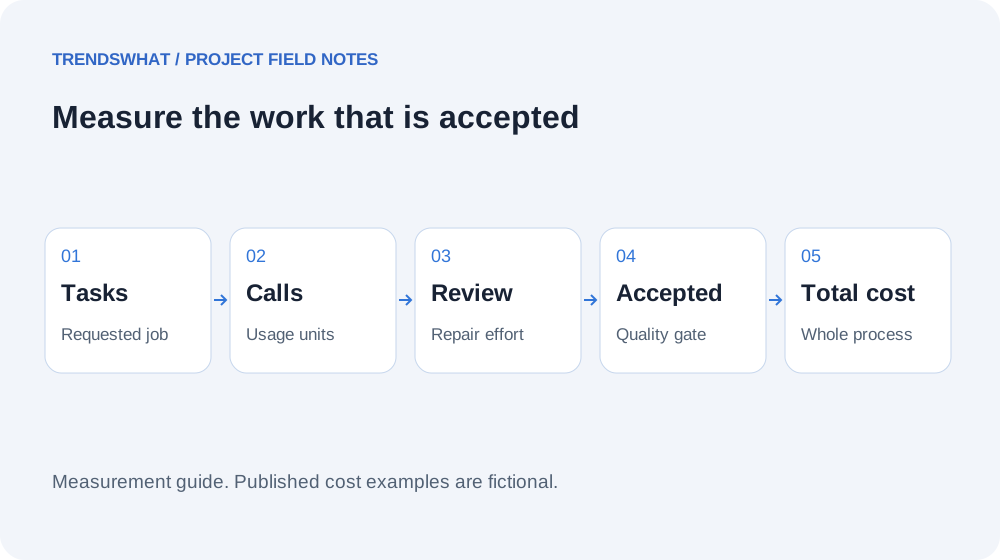
Original TrendsWhat measurement guide. Cost per accepted task uses the whole workflow and an explicit definition of acceptance.
Choose the denominator before collecting numbers
“Cost per response” divides spending by generated outputs. “Cost per submitted task” divides by all requested work. “Cost per accepted task” divides by results that meet the stated standard. These denominators answer different questions and can lead to different decisions.
For a source-based research note, acceptance might require verified claims, correct scope, and a usable format. For an extraction workflow, it might require a reviewed record with the necessary fields and no unresolved critical errors. Define that standard before comparing configurations, otherwise a cheaper workflow can appear better by accepting lower-quality work.
Also define what happens to unfinished tasks. If a task fails and a person completes it manually, include the recovery effort when comparing the process. Excluding difficult cases from the denominator while ignoring their cost makes the workflow look artificially efficient. The accounting should reflect the job the user actually needed done.
Keep call identity and task identity separate
One task may require several calls. A first call might gather information, another might draft, and a third might repair a format error. A retry after a transient failure adds another call without creating another accepted task. Counting calls as completed work confuses activity with results.
Assign a task identifier that can connect the related calls, tool operations, review, and final outcome. Preserve a call identifier for diagnosis and billing reconciliation. The task record should also capture whether the result was accepted, rejected, or completed through another route.
The inspected StockNote trace links model usage to a source message, which is a concrete example of associating inference with application context. This article does not establish a complete task-cost system in that project. It uses the trace fields as a starting point and identifies the additional measurements needed for a broader workflow comparison.
The illustrative workload
Imagine one hundred submitted tasks under each of two fictional configurations. Both use an average of one thousand input tokens and two hundred output tokens per call. Configuration A uses 110 calls, produces ninety accepted tasks, and requires six minutes of review per submitted task. Configuration B uses 150 calls, produces seventy accepted tasks, and requires ten minutes of review per submitted task.
For arithmetic only, assign A rates of two dollars per million input tokens and ten dollars per million output tokens. Assign B fifty cents and two dollars respectively. Value review time at thirty dollars per hour. These numbers were chosen to make the distinction visible, not to represent any vendor or actual employee cost.
The calculation record contains every assumption and the computed values. It is an illustrative scenario file, not an experiment log from a production system. Replace all assumptions with measured or verified values before using the method for a real decision.
Work through the calculation
| Measure | Scenario A | Scenario B |
|---|---|---|
| Submitted tasks | 100 | 100 |
| Calls | 110 | 150 |
| Accepted tasks | 90 | 70 |
| Input tokens | 110,000 | 150,000 |
| Output tokens | 22,000 | 30,000 |
| Illustrative inference cost | $0.44 | $0.135 |
| Review time | 10 hours | About 16.67 hours |
| Illustrative review cost | $300 | $500 |
| Combined cost | $300.44 | $500.135 |
| Cost per accepted task | About $3.34 | About $7.14 |
Inference cost is input tokens times the input rate plus output tokens times the output rate, using the rate's stated unit. Review cost is total review hours times the chosen hourly value. Divide the combined cost by accepted tasks to obtain the final row.
B has the lower inference bill in this fictional example and the higher cost per accepted task. That result follows from the assumptions about review and acceptance, not from a discovered law about cheap models. If B needed less review or achieved more accepted work, the comparison could change. The method makes those assumptions visible so they can be challenged.
Do not turn valued time into claimed cash savings
An hourly value is a way to compare effort; it is not automatically money that disappears from a budget. Saving an hour may create capacity for other work without reducing payroll or invoices. A useful report distinguishes cash spending, active human time, and any assigned economic value.
Likewise, faster completion can matter even when the direct cost is unchanged. A workflow may reduce waiting time, improve consistency, or make a task possible at all. Record those outcomes separately rather than forcing every benefit into a dollar figure.
For personal use, you can compare minutes per accepted result without assigning a wage. That may be more honest than using an arbitrary hourly rate. The key is to include the effort that determines whether the generated output becomes useful work.
Measure review effort without hiding corrections
Review includes reading the output, checking evidence, identifying errors, making corrections, and confirming that the final result meets the contract. If a person has to reconstruct the original task because the output is unclear, that effort belongs in the measurement too.
Separate routine review from exceptional recovery when possible. A median can describe the ordinary case while a small number of difficult failures consume much of the total effort. Report the total and the distribution relevant to your decision rather than selecting whichever statistic looks most favorable.
Use permitted examples and avoid turning measurement into unnecessary surveillance. A task-level log can record elapsed review effort and failure categories without collecting unrelated personal activity. The purpose is to understand the workflow, not to infer individual performance from an incomplete set of automated traces.
Copy this task-cost ledger
| Field | What to record |
|---|---|
| Task ID | One identifier for the requested deliverable |
| Configuration | Prompt, model, context, and tool version |
| Call usage | Input/output units and provider billing categories |
| Other services | Retrieval, storage, tools, or processing charges |
| Preparation | Active effort needed before generation |
| Review and repair | Effort required to meet the acceptance standard |
| Outcome | Accepted, rejected, unresolved, or manual recovery |
| Critical errors | Failures that block use regardless of cost |
| Total and unit cost | Cost per submitted and accepted task |
The ledger should match the actual billing model. Some services charge for units other than input and output tokens, and discounts or cached inputs can affect the calculation. Verify the current official pricing for the product and account configuration you are evaluating. This article intentionally supplies no current price recommendation.
Keep the original usage units alongside calculated currency values. If rates change, you can recalculate without pretending the historical workload changed. Record the rate date and any exclusions, such as taxes or infrastructure costs, so the comparison remains interpretable.
Compare configurations on the same job
Use a representative set of tasks and the same acceptance criteria. If one configuration receives cleaner sources or a more experienced reviewer, the result reflects those differences too. That may be a valid whole-workflow comparison, but it should not be presented as an isolated model-price finding.
Include failed and out-of-scope cases. A workflow that stops appropriately can be preferable to one that cheaply produces unsupported answers. Cost analysis should sit beside the quality rubric, not replace it. The prompt evaluation guide explains how to keep critical failures separate from an average score.
Run enough cases to expose the failures that matter to your workload and report uncertainty honestly. This guide does not prescribe a universal sample size. A small exploratory comparison can guide a next test, but it should not be treated as a stable forecast for a very different volume or input mix.
Find the expensive boundary before changing models
If review dominates effort, improve inspectability: source links, explicit unknowns, stable fields, and a clear distinction between facts and recommendations. If retries dominate calls, inspect the output contract and the reasons for rejection. If preparation dominates time, a better input pipeline may matter more than a different model.
Our executed labs provide examples of such boundaries. A CSV parser prevents structural loss before generation. A semantic validator catches an impossible date after parsing. A claim ledger separates a real quotation from a supported conclusion. None of those experiments measured cost savings, but they identify mechanisms worth investigating when the ledger shows repeated repair work.
Change one important factor at a time when you need attribution. If you change the model, prompt, source pack, and review interface together, report the outcome as a workflow revision. Preserve the previous configuration so a later comparison does not rely on memory of how it behaved.
What a useful cost conclusion sounds like
A useful conclusion names the task, accepted standard, measured workload, included costs, and remaining uncertainty. It might recommend a configuration for one class of work while keeping another path for difficult cases. It should also identify any quality condition that would override the cost advantage.
The fictional numbers in this article show why the cheapest call is not necessarily the cheapest completed job. They do not tell you which model to buy. Use the ledger to collect your own evidence, verify current rates, and compare cost only after defining what counts as an acceptable result.
The practical AI skill is accounting for the whole process. A generated response is an intermediate artifact. The meaningful unit is the work someone can actually use, with its checking and recovery effort included.
Sources, materials, and limits
- Illustrative calculation record: all invented assumptions and computed totals.
- Project inspection notes: StockNote's inspected usage-trace fields.
- Evaluation guide and workflow canvas.
- Original ledger and diagram. No current provider prices, production cost measurements, salary savings, or model-performance claims are presented.