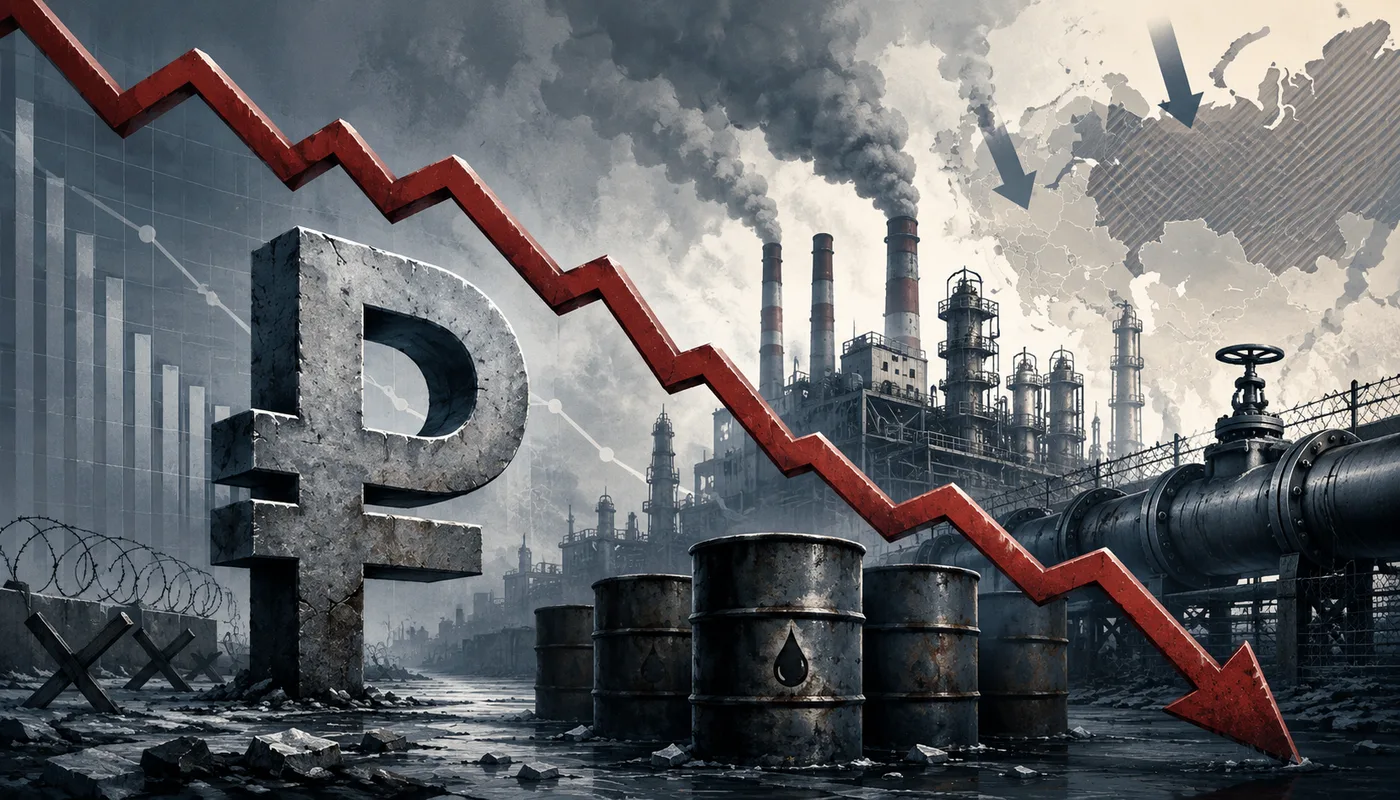
Why the Economy of Russia Is Stagnating in 2026
Russia’s economy is stagnating in 2026, with growth barely above zero as sanctions, war spending, high interest rates and weakening energy revenues blunt performance.
Key takeaways
- Russia’s GDP growth in 2026 is forecast at about 0.4–1.1%, down sharply from 4.9% in 2024 and slowing further into contraction early this year. (Investing.com)
- The first quarter of 2026 saw a year-on-year GDP contraction (~‑0.2%), the first in three years, despite higher oil prices. (Trading Economics)
- Western sanctions, including new UK measures targeting finance and energy sectors, continue to constrain access to markets and capital. (Fieldfisher)
- Oil and gas revenues, once half of budget income, remain depressed, forcing tax hikes and borrowing. (euronews)
- The war in Ukraine accounts for a growing share of public spending, crowding out investment in civilian sectors. (SIPRI)
What the economy of Russia looks like in 2026
The economy of Russia in 2026 is showing signs of structural stagnation rather than rapid growth. After decades of reliance on energy exports and state-directed investment, official and independent estimates point to a sharp slowdown in economic activity.
The International Monetary Fund (IMF) recently raised its forecast for Russian GDP growth to approximately 1.1% in 2026, up from an earlier 0.8% estimate due to elevated global oil prices. (Investing.com) However, official Russian data show the economy contracted by around 0.2% in the first quarter of the year, marking its first annual contraction in three years. (Trading Economics)
For context, Russia posted nearly 5% growth in 2024 amid high commodity prices, but that momentum evaporated as Western sanctions deepened and heavy war spending diverted resources. (Investing.com)
How sanctions, including UK measures, squeeze growth
Sanctions have become a central determinant of Russia’s economic trajectory. A complex regime of measures imposed by the United Kingdom, European Union, United States and partners targets finance, energy, technology and strategic sectors. (Fieldfisher)
In 2026, the UK expanded sanctions to include Russian cryptocurrency infrastructure and evasion networks, aiming to cut off avenues Moscow uses to circumvent financial restrictions. (The Moscow Times)
While some UK policy decisions have adjusted in response to market dynamics — such as easing crude oil import sanctions to manage fuel prices — the broader sanctions framework continues to isolate Russian firms from Western capital and technology. (Al Jazeera)
Independent analysis suggests that headline GDP numbers still mask deeper strains. Export earnings may appear stable, but sanctions chiefly weaken Russia’s ability to finance long-term growth and sustain investment — especially outside the defense sphere. (Stockholm School of Economics)
Oil, gas and the limits of energy windfalls
Russia remains a petrostate, heavily dependent on oil and gas revenues that historically underpinned government spending and export income. It is one of the world’s largest producers and exporters of hydrocarbons. (Wikipedia)
However, the energy windfall that buoyed growth after the 2022 invasion of Ukraine has ebbed. International sanctions on oil shipping, transport restrictions, and secondary market pressures have reduced export volumes and revenues. (euronews)
Government spending on the war and social support programs has forced policymakers into higher taxes and greater borrowing, further slowing private-sector demand. (euronews)
An illustrative paradox: even when global oil prices spike due to Middle East disruptions, Russia’s budget only gets temporary reprieve, not a structural fix, because the share of oil and gas in total revenues has fallen and logistical barriers remain. (The Moscow Times)
War spending and fiscal pressures
Military expenditure is now an entrenched part of Russia’s fiscal structure, accounting for a large share of public outlays. Stockholm International Peace Research Institute (SIPRI) data show Russia allocated a substantial portion of GDP to defense spending in 2025 and maintained a high budget share in 2026. (SIPRI)
This allocation crowding out civilian investment and productivity-enhancing sectors is a significant drag on growth. Private fixed investment has weakened, and business confidence indicators show firms pulling back from expansion. (Suomen Pankki)
Western sanctions amplify fiscal pressure by cutting off access to foreign capital and increasing borrowing costs, which, combined with domestic tax hikes, dampens consumption and investment. (Stockholm School of Economics)
Monetary policy and the ruble
Russia’s central bank has maintained high interest rates to control inflation and defend the ruble, which has remained relatively strong compared with pre‑war levels. (Reuters)
High rates have helped keep headline inflation down but also kept borrowing costs elevated for businesses and households, which further suppresses investment and consumption. (Reuters)
Recent government efforts to purchase foreign currency and gold to rebuild its sovereign wealth fund and weaken the ruble reflect an attempt to improve competitiveness, but these are tactical interventions with limited near-term impact on real economic activity. (The Moscow Times)
Private sector under pressure
Private investment and entrepreneurship are increasingly constrained. Analysts note that many non‑military industries face shrinking demand, high borrowing costs, and limited access to foreign technology and finance. (Stockholm School of Economics)
While some state-directed industrial and import substitution programs support output in select sectors, broad-based innovation and competitiveness remain weak. (BusinessCraft Nordic)
UK and other Western sanctions exacerbate these pressures by blocking cooperation in high-tech and finance sectors, reducing the scope for growth outside energy and defense. (Fieldfisher)
Strategic risks and longer-term outlook
The near-term outlook for the economy of Russia is one of sluggish growth and structural headwinds. Major international institutions project sub‑2% growth through 2027 unless there are major geopolitical changes or sanctions relief. (Suomen Pankki)
Key risks include:
- Prolonged war spending, which siphons resources from productive civilian uses. (SIPRI)
- Persistent sanctions, especially in finance and technology sectors. (Fieldfisher)
- Weak private investment, limiting diversification and innovation. (Stockholm School of Economics)
- Energy export constraints, which undercut traditional revenue sources. (euronews)
Without a shift in these dynamics, Moscow’s economy may continue to tread water rather than surge, even as commodity price volatility offers intermittent relief.
FAQ
What is the current GDP growth forecast for Russia in 2026?
Russia’s gross domestic product is forecast to grow only about 0.4–1.1% in 2026, down sharply from around 5% in 2024, reflecting sanctions, war spending and weak private demand. (Investing.com)
How do UK sanctions affect the economy of Russia?
UK sanctions, aligned with EU and US measures, restrict Russian energy and financial sector access to international markets and capital, increasing costs and reducing export revenues that are critical for growth. (Fieldfisher)
What are the main vulnerabilities in Russia’s economy?
Russia’s main economic vulnerabilities include heavy reliance on energy exports, high interest rates, weak private investment and diversion of spending to the Ukraine war, all of which suppress long-term productive growth. (euronews)
Sources
- TradingEconomics, “Russia GDP Annual Growth Rate”, 2026-05-15
- Reuters via Investing.com, “IMF raises Russia 2026 GDP growth forecast to 1.1% on higher oil prices”, 2026-04-14
- Fieldfisher, “UK, EU and US sanctions on Russia”, 2026
- Al Jazeera, “UK eases sanctions on Russian oil imports as fuel prices soar”, 2026-05-20
- Euronews, “Russia’s Oil Revenues Dwindle as Sanctions Bite”, 2026-02-10
- Stockholm School of Economics, “Sanctions squeeze Russia’s economy”, 2026-03-19
- SIPRI, “A Budget for a Fifth Year of War: Military Spending in Russia’s Budget for 2026”, 2026