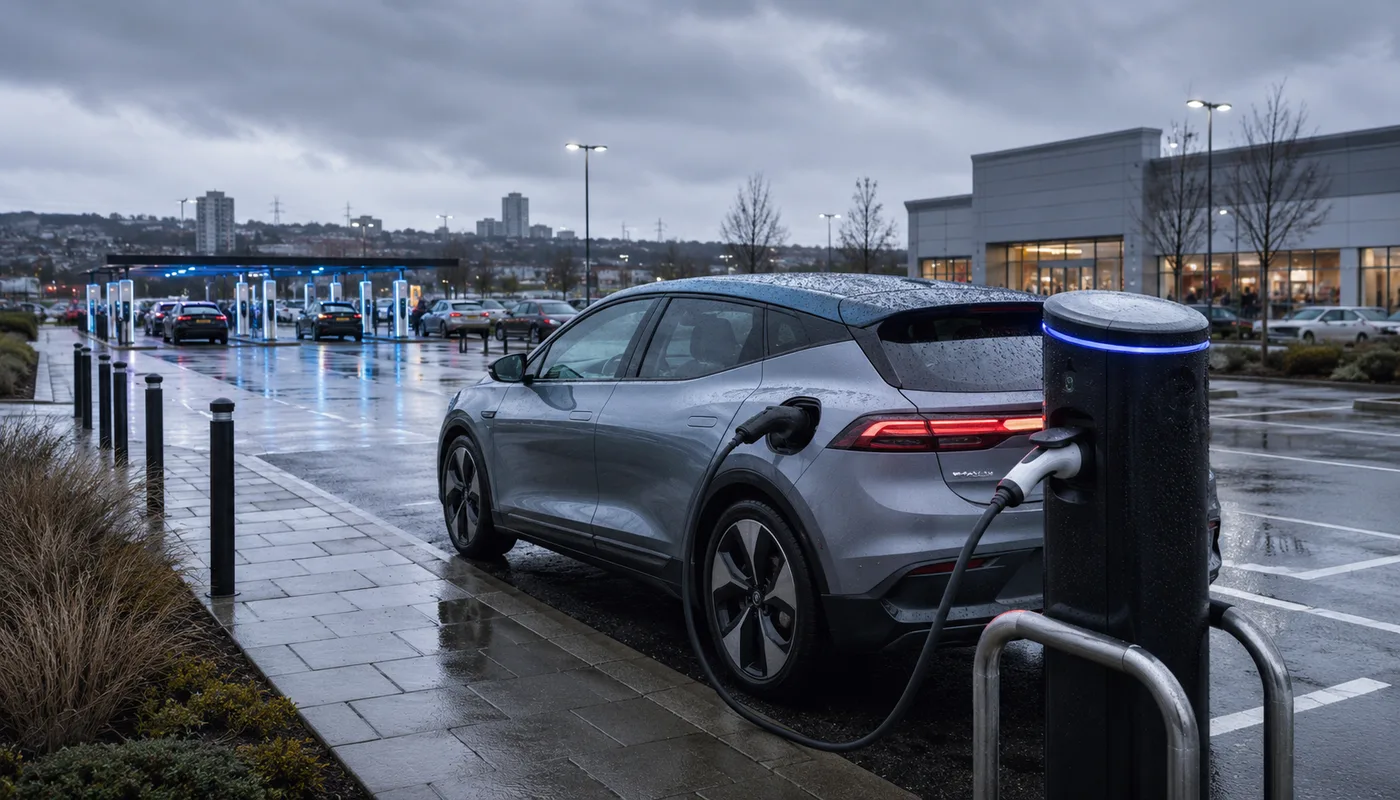
EV Chargers in the UK: The Socket Boom Is Becoming a Margin Test
UK ev chargers are growing fast, but the money now depends on location, power, VAT, and solving the driveway divide.
Key takeaways
The UK ev chargers market is moving from rollout volume to profitable capacity placement.
- Zapmap counted 121,262 public EV chargers at the end of May 2026; DfT’s official EVSE-based count was 119,080 on 1 April 2026 (Zapmap; Department for Transport).
- Rapid and ultra-rapid chargers are 23% of Zapmap’s public charger count but about 60% of network power capacity, which explains the finance focus on hubs (Zapmap).
- The 2026 headline ZEV mandate is 33% for new cars and 24% for new vans; SMMT put battery-electric cars at 27.3% of May 2026 new car registrations (GOV.UK; SMMT).
- HMRC still treats public EV charging as standard-rated VAT while seeking to appeal a tribunal decision, keeping public charging at a tax disadvantage to domestic power (HMRC).
EV chargers transfer electricity to electric vehicles, but in the UK business case they are now a real-estate, grid and tax product. The paradox is awkward: charger numbers are rising, while confidence still depends on whether drivers can find the right power at the right stop. DfT counted 119,080 public EV chargers on 1 April 2026, and Zapmap counted 121,262 at the end of May 2026 (Department for Transport; Zapmap). This is a matching problem, not a shortage story. Retailers want dwell time. Fleets want uptime. Councils want access for residents without driveways. Operators want utilisation high enough to cover grid connections, maintenance, compliance and rent. The useful rule is simple: do not count sockets; price the charging moment.
How big is the UK ev chargers market now?
The UK ev chargers market is now a six-figure public network measured by EVSE, not vague “charge point” language.
DfT says an EVSE, or electric vehicle supply equipment, is the independently controlled part of a charging device that usually lets one EV charge at a time; from 2026, DfT uses “EV chargers” as its baseline public-infrastructure metric (Department for Transport FAQ). The switch matters because “charge point” can mean a socket, device, location or bay, which makes market sizing slippery (Department for Transport FAQ).
As of 1 April 2026, DfT reported 27,372 public chargers rated rapid or above at 50kW and higher, out of 119,080 total public EV chargers (Department for Transport). The regional gap is material: London had 340.0 public chargers per 100,000 people, while Northern Ireland had 59.4; Scotland led rapid-or-above density at 57.2 per 100,000 people (Department for Transport).
What business model wins in UK EV charging?
The winning business model prices the driver’s stop, not the hardware count.
| Revenue pool | Typical charger | Best-fit owner | Main risk |
|---|---|---|---|
| Home substitute | Standard or standard-plus on-street charging | Councils, landlords, parking operators | Low pricing power and slow kerbside rollout |
| Journey insurance | Rapid and ultra-rapid hubs | Forecourts, fleets, motorway services, operators | Grid cost, uptime penalties and site rent |
| Dwell-time retail | Destination charging | Retail parks, supermarkets, hotels, employers | Drivers charge without spending enough on site |
DfT’s April 2026 location mix supports the split: 52% of public chargers were destination, 32% on-street, 11% en-route and 4% other (Department for Transport). Zapmap counted 1,009 open rapid charging hubs at the end of May 2026, defining a hub as at least eight rapid or ultra-rapid chargers at one location (Zapmap).
This is the market’s quiet trap. A 7kW kerbside unit can be excellent if it serves repeat overnight demand. A 150kW unit can disappoint if grid constraints, poor routing or broken payment flows keep utilisation low. DfT also warns that advertised power bands do not guarantee delivered power because vehicle limits, battery management, load management and grid capacity can reduce real charging speed (Department for Transport FAQ).
What could slow the charger business case?
The main friction is that UK charging policy fixes access faster than it fixes economics.
The Public Charge Point Regulations 2023 require consumer-facing rules including clear pricing, contactless payment on many public chargers, 99% reliability across an operator’s rapid network, a free 24/7 staffed helpline, open data and payment roaming (GOV.UK). That protects drivers, but it raises the operating bar for small networks and weak sites.
VAT is the sharper margin problem. HMRC’s May 2026 brief says domestic supplies of fuel and power can be reduced-rated at 5%, but HMRC’s policy remains that public EV charging is standard-rated for VAT; HMRC has applied for permission to appeal after the First-tier Tribunal found for Charge My Street (HMRC). Grants soften capex: OZEV schemes run until 31 March 2027 and include up to £500 for eligible renters or flat owners, up to £500 per workplace socket, and up to £2,000 per socket for eligible state-funded education providers (GOV.UK).
What changed as of 4 June 2026?
As of 4 June 2026, the UK charger story has shifted from scarcity to segmentation.
The freshest public market count used here is Zapmap’s end-May 2026 figure of 121,262 public EV chargers, while DfT’s detailed official breakdown is dated 1 April 2026 and counts 119,080 public EV chargers (Zapmap; Department for Transport). DfT says 300,000 public charge points by 2030 is often cited by others but is not a government target; its 2024 update estimated demand at 250,000 to 550,000 by 2030 (Department for Transport FAQ).
The smarter question is not “how many chargers?” It is “which charging moment is under-served, and who captures value when the driver stops?”
FAQ
The FAQ answer for UK ev chargers is that supply is growing, but each use case has different economics.
How many public ev chargers are in the UK?
At the end of May 2026, Zapmap counted 121,262 public EV chargers across 46,664 UK locations (Zapmap).
What is the biggest business issue for UK ev chargers?
The biggest business issue is not just count; it is matching power, location, price and utilisation to each use case (Department for Transport).
Do public EV chargers still pay 20% VAT?
HMRC’s May 2026 policy says public EV charging remains standard-rated for VAT while it seeks to appeal a First-tier Tribunal decision involving Charge My Street (HMRC).
What changed in UK charger statistics in 2026?
From 2026, DfT uses EV chargers, or EVSE, as its baseline metric because one EVSE typically charges one vehicle at a time and better represents available charging capacity (Department for Transport FAQ).
Sources
The sources for this analysis are official UK data, public regulatory guidance, and Zapmap’s latest market count.
- Public electric vehicle charging infrastructure statistics: 1 April 2026 — Department for Transport, 2026-05-21.
- EV charging statistics 2026 — Zapmap, 2026-06-02.
- Electric vehicle charging infrastructure statistics: frequently asked questions — Department for Transport, 2026-05-21.
- Electric Vehicle Data — SMMT, unknown.
- Updates to the Vehicle Emissions Trading Schemes Order 2023 — GOV.UK, 2025-10-17.
- Public Charge Point Regulations 2023 guidance — GOV.UK, unknown.
- VAT liability of supplies of electricity from public electric vehicle charge points — HMRC, 2026-05-12.
- Electric vehicle chargepoint grants — GOV.UK, 2026-04-01.