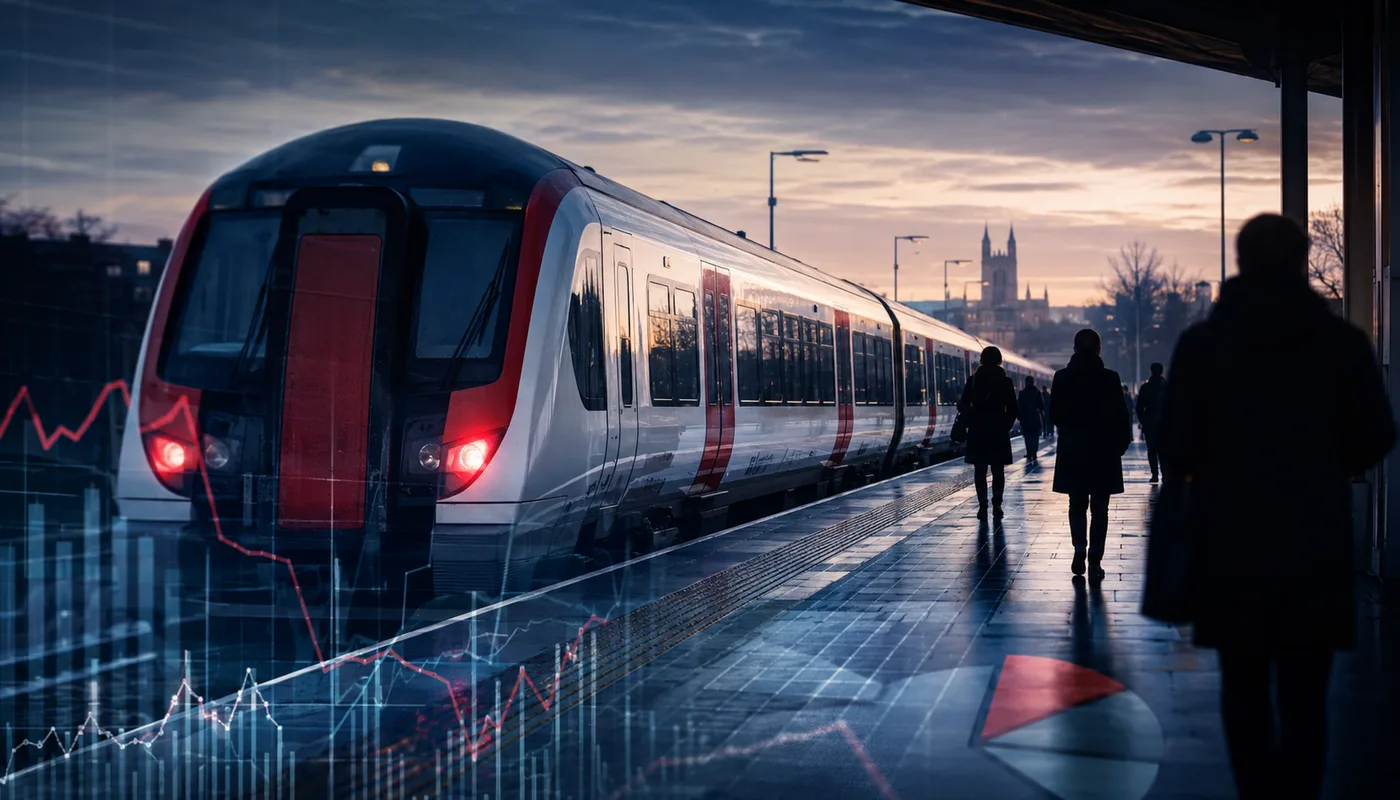
Greater Anglia Is Public Now: The Balance-Sheet Test for UK Rail
Greater Anglia is now publicly owned, turning an East Anglia railway into a test of UK rail reform. GOV.UK
Key takeaways
Greater Anglia is a live test of whether public ownership can turn rail demand into measurable value for passengers and taxpayers.
- Greater Anglia’s services transferred into public ownership on 12 October 2025 and are now run by GA Trains Limited, a subsidiary of DfT Operator Limited. GOV.UK
- The latest annual operator file from the Office of Rail and Road (ORR) shows 81.8 million Greater Anglia passenger journeys, 134 managed stations, 84.8% On Time performance and 1.8% cancellations in 2024-25. ORR
- Britain’s top-line rail demand is recovering: 466 million GB rail journeys generated £3.1 billion of passenger revenue in October to December 2025. ORR
- Public ownership changes accountability, not railway physics; ORR recorded 324,319 Network Rail-attributed delay minutes affecting Greater Anglia in 2024-25. ORR
Greater Anglia is the publicly owned train operator for East Anglia’s London-facing rail market. Greater Anglia Greater Anglia The business question is no longer whether the railway would be nationalised. It is whether a public operator can keep performance credible while fares, staffing, infrastructure and taxpayer value pull in different directions. Nationalisation can improve accountability. It does not magically clear a signal failure at Shenfield.
Why is Greater Anglia a business and finance story now?
Greater Anglia is a business story because its ownership moved into a public-sector chain of accountability.
The Department for Transport said Greater Anglia became the third service to transfer under the Passenger Railway Services (Public Ownership) Act, with operations run by GA Trains Limited under DfT Operator Limited. GOV.UK That makes a weak timetable, driver gap or infrastructure failure a taxpayer-value issue, not just operational pain.
The government said Govia Thameslink Railway entered public ownership on 31 May 2026, joining Greater Anglia and other DfT Operator-managed services, and said publicly owned operators would deliver around 8 in 10 passenger journeys that Great British Railways will ultimately be responsible for. GOV.UK
What changed when Greater Anglia entered public ownership?
Greater Anglia changed its ownership structure, not its basic role as an East Anglia rail operator.
Greater Anglia’s company page says its operations transferred into public ownership under DfT Operator Limited in October 2025, and says Greater Anglia is the trading name of GA Trains Limited. Greater Anglia The legal backdrop is the Passenger Railway Services (Public Ownership) Act 2024, which allows passenger railway services to be provided by public sector companies rather than franchises. Legislation.gov.uk
Government guidance says the Railways Bill was introduced in the House of Commons on 5 November 2025 and that GBR is expected to become operational around 12 months after Royal Assent. GOV.UK
As of 4 June 2026, the promised single “directing mind” for track and train is still being built.
How is Greater Anglia performing against the numbers?
Greater Anglia’s latest independent annual performance picture ends on 31 March 2025. ORR
ORR recorded 81.8 million passenger journeys for Greater Anglia in 2024-25, up from 76.4 million in 2023-24, plus 3,613 million passenger kilometres. ORR The same file, where On Time means early or less than one minute late at recorded stops, recorded 434,588 planned trains, 84.8% On Time performance and 1.8% cancellations in 2024-25. ORR
The live picture is useful but less tidy. Greater Anglia’s own performance page said its latest service-group figures covered four weeks to 2 May 2026 and listed the all-Greater Anglia row at 84.40% On Time and 93.70% within three minutes. Greater Anglia
For a national benchmark, ORR’s latest Great Britain performance release recorded 86.4% of station stops within three minutes, 1.9 million planned trains and 3.2% cancellations in January to March 2026. ORR Those periods are not identical. Compare dates and definitions.
What is the three-ledger rule for judging Greater Anglia?
The three-ledger rule judges Greater Anglia by ownership, demand and reliability together, not by ownership alone.
The ownership ledger asks who is accountable. The answer is now GA Trains Limited under DfT Operator Limited, with Great British Railways (GBR) planned as the future integrated body. Greater Anglia GOV.UK
The demand ledger asks whether passengers are returning and paying into the system. ORR’s latest national usage release showed 466 million journeys and £3.1 billion in passenger revenue across Great Britain in October to December 2025. ORR
The reliability ledger asks whether the railway is earning that demand. For Greater Anglia, the baseline is 84.8% On Time and 1.8% cancellations in ORR’s 2024-25 annual operator file. ORR
A public rail operator is improving only when all three ledgers move together. More journeys with rising cancellations is not success. Better punctuality bought by opaque subsidy is not clean reform either.
What friction could stop public ownership from working?
The main friction is that public ownership cannot separate Greater Anglia from infrastructure constraints and fare policy.
ORR’s 2024-25 delay table recorded 324,319 delay minutes attributed to Network Rail affecting Greater Anglia, 60,497 attributed to Greater Anglia itself, and 40,593 attributed to other train operators affecting it. ORR That supports tighter track-and-train coordination and corrects a lazy myth: changing the owner does not remove infrastructure risk.
The fare side has its own squeeze. Greater Anglia’s current customer site advertises Standard Season, Off Peak and Anytime fares as frozen until March 2027. Greater Anglia That helps passengers, but it narrows one visible revenue lever while managers still handle staffing, energy, maintenance and disruption.
What should passengers and businesses watch next?
The next signal is whether Greater Anglia keeps reliability high while the national rail ownership programme expands.
As of 4 June 2026, ORR’s latest Greater Anglia train operating company key statistics cover April 2024 to March 2025, and the ORR file says the next TOC key statistics publication is due in July 2026. ORR Government guidance says Chiltern Railways is due to transfer on 20 September 2026, Great Western Railway on 13 December 2026, and DfT-contracted passenger service transfers are expected to complete by the end of 2027. GOV.UK
For passengers and employers, watch Time to 3, cancellations, Delay Repay and weekday reliability into Liverpool Street, Cambridge, Norwich and Ipswich. The right verdict is operational, financial and visible on the platform.
FAQ
Greater Anglia’s public-ownership story is best understood through ownership, performance, fares and accountability.
Who owns Greater Anglia now?
Greater Anglia is publicly owned and operated as GA Trains Limited, a subsidiary of DfT Operator Limited, after transferring on 12 October 2025. GOV.UK
Did Greater Anglia passengers get a new operator name?
Greater Anglia remains the customer-facing trading name, while GA Trains Limited is the company behind it under DfT Operator Limited. Greater Anglia
How did Greater Anglia perform in 2024-25?
Greater Anglia recorded 81.8 million passenger journeys in 2024-25, with 84.8% On Time performance and 1.8% cancellations in ORR’s annual data. ORR
Is public ownership guaranteed to improve Greater Anglia?
Public ownership is not guaranteed to improve Greater Anglia; it improves accountability only if demand, reliability and cost control improve together. GOV.UK
Sources
These sources are the official records and data used for the article.
- Transfer of Greater Anglia’s services into public ownership - Department for Transport and DfT Operator Limited, 2025-10-13.
- Company Information - Greater Anglia, unknown.
- Great British Railways and the public ownership programme - Department for Transport and DfT Operator Limited, 2025-05-25.
- Britain’s biggest train operator’s services enter public ownership this weekend - Department for Transport and DfT Operator Limited, 2026-05-28.
- Train Operating Company Key Statistics, April 2024 to March 2025, Greater Anglia - Office of Rail and Road, 2025-08-21.
- Passenger rail usage - Office of Rail and Road, 2026-03-19.
- Passenger rail performance - Office of Rail and Road, 2026-05-28.
- Train Punctuality Statistics - Greater Anglia, unknown.
- Greater Anglia train times, tickets and service information - Greater Anglia, unknown.
- Passenger Railway Services (Public Ownership) Act 2024 - The National Archives, 2024-11-28.