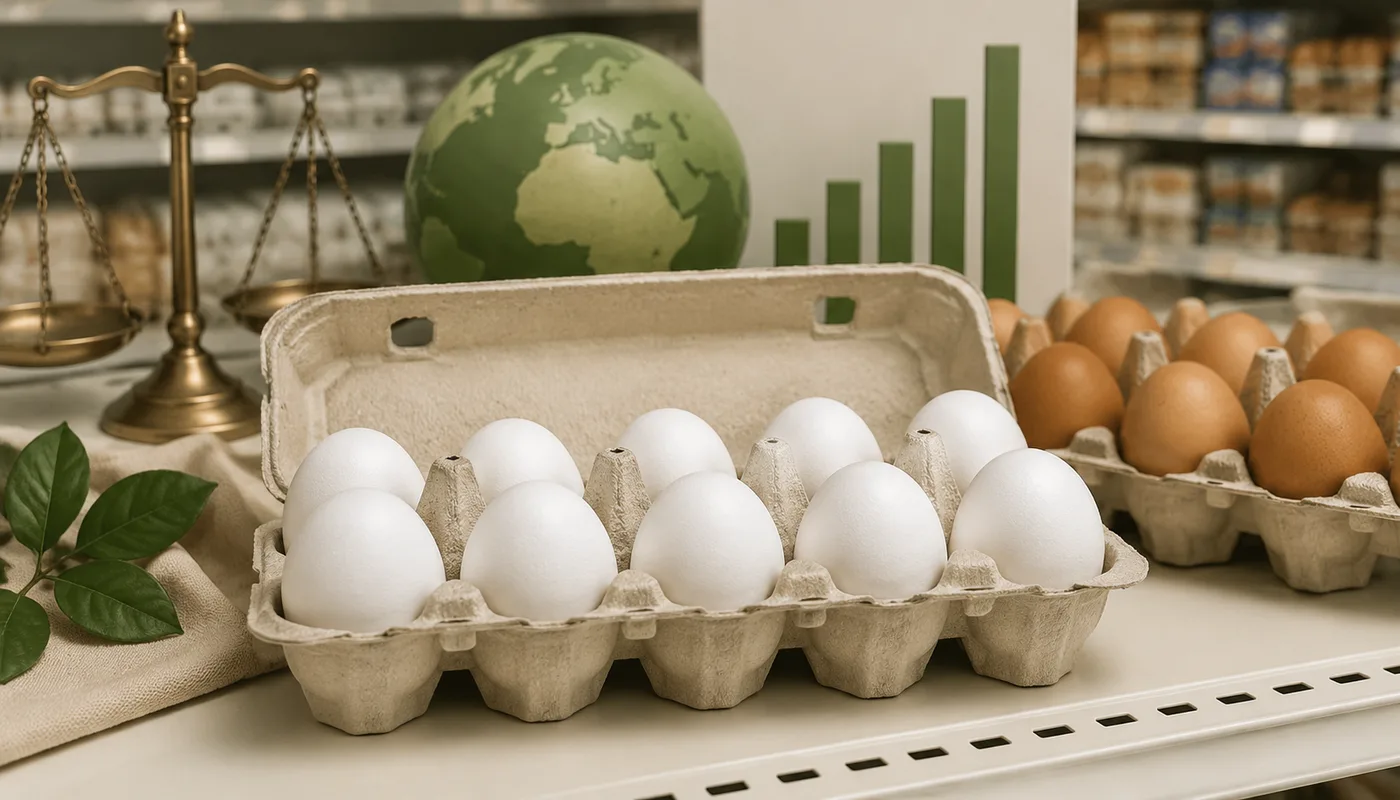
Sainsbury's brown to white eggs exposes new supermarket maths
Sainsbury's brown to white eggs move is a supply-chain carbon play, not a nutrition change, with free-range eggs staying on shelf. Sainsbury Egginfo
Key takeaways
The key takeaway is that Sainsbury's is using shell colour as a quiet carbon lever in a high-volume grocery category.
- Sainsbury's says white eggs in its 2024 supply had a 12.7% lower carbon footprint per kg than brown eggs, mainly from better feed efficiency and a longer productive lifespan for white hens. Sainsbury
- The switch targets Sainsbury's own-brand core egg ranges, and the company says 100% of its shell eggs will remain free range. Sainsbury
- Defra recorded 273.3 million dozen eggs produced for UK human consumption in Q1 2026, up 6.0% year on year. Defra
- Brown eggs are not healthier than white eggs; the British Egg Information Service says shell colour depends on hen breed and has no nutritional difference. Egginfo
Sainsbury's brown to white eggs is the sort of tiny shelf change that reveals where supermarket strategy is moving. The paradox is simple: the egg looks old-fashioned, but the maths is modern. White eggs were common in the UK before brown shells became the shopper default in the 1970s, according to the British Egg Information Service. Egginfo Now Sainsbury's is treating colour as a production variable, not a wellness signal. Its case is not that white eggs taste better. It is that white-feathered hens can deliver the same shell-egg proposition with less feed, lower calculated carbon and fewer welfare headaches in its own supply chain. Sainsbury The sharper point: grocery sustainability is shifting toward invisible specification changes.
Why is Sainsbury's switching brown eggs to white eggs?
Sainsbury's is switching because white-feathered hens can produce comparable eggs with lower measured supply-chain emissions in its own egg base.
The retailer says it is "aiming towards 100 per cent" white eggs in its own-brand core ranges and has launched Taste the Difference Golden Yolk white-shelled eggs. Sainsbury Sainsbury Poultry News reported the full-switch plan on 4 June 2026 as part of Sainsbury's net-zero strategy. Poultry News
Sainsbury says SAC Consulting carried out a life-cycle assessment across its 2024 egg supply and found white eggs had a 12.7% lower carbon footprint per kg than brown eggs. Sainsbury The assessment followed PAS 2050 standards and counted emissions from hatchery, rearing, laying, packing and transport to the retail shelf. Sainsbury
As of 4 June 2026, what changed is the ambition: white eggs are moving from occasional novelty to an own-brand core-range specification at a major UK grocer.
Are white eggs cheaper, worse or less nutritious than brown eggs?
White eggs are not nutritionally inferior to brown eggs, because shell colour mainly reflects the breed of hen.
Egginfo says white hens generally lay white eggs, brown hens generally lay brown eggs, and there is no nutritional difference between brown and white shelled eggs. Egginfo Sainsbury makes the same reassurance, saying white and brown eggs are identical in nutrition and quality. Sainsbury
The price point is more delicate. Sainsbury has not presented the switch as a consumer price cut in the official materials reviewed. Defra put the average UK farm-gate egg price at 153.6 pence per dozen in Q1 2026, up 3.9% from Q1 2025. Defra
What does this say about Sainsbury's business strategy?
The egg switch is a Scope 3 move, meaning Sainsbury is targeting emissions embedded in suppliers and products rather than only stores and lorries.
Sainsbury says Scope 3 emissions make up 98% of its total emissions, and it has 2030 targets to reduce Scope 3 forest, land and agriculture emissions by 36.4% and non-FLAG emissions by 50.4%. Sainsbury The deeper grocery carbon ledger sits in farming, feed, transport and supplier processes.
The shell switch belongs in Business & Finance, not just food trivia. The UK retail egg market was worth an estimated £2.1 billion in 2025, with 8.6 billion retail eggs sold and supermarkets holding 52.6% of retail-sector outlet share. Egginfo
Here is the decision rule: a grocery carbon switch becomes commercially plausible when the shopper gives up little, the supplier can measure the saving, and the retailer can scale it through own-brand control. White eggs pass the first two tests on Sainsbury's evidence. The third test is the friction.
Will shoppers notice the change on shelves?
Shoppers will mostly notice shell colour, not recipe performance, if Sainsbury's own-brand transition works as stated.
Sainsbury says white eggs have the same taste, cooking performance and nutritional benefits as brown eggs, while 100% of its shell eggs will remain free range. Sainsbury Defra's Q1 2026 data shows free range already dominates UK packing-station intake, accounting for 204.1 million dozen eggs and 76% of total throughput. Defra
The practical shopper test is narrow. The shell changes in targeted own-brand ranges, the stated nutrition does not change, and the stated welfare promise remains free range. Sainsbury Egginfo
The limit is obvious. A white shell does not make breakfast "green". It makes one supplier specification more efficient, based on one retailer's measured supply chain.
What is the tradeoff for suppliers?
The tradeoff is that a simple shopper swap can require farmers, packers and breeders to retool behind the scenes.
Defra says its egg packers survey covers 27 registered UK packing stations and about 75% of eggs packed in the UK, a reminder that egg supply is a coordinated industrial system. Defra Sainsbury says it is working with Egg Group Farmers and supply partners to transition eggs to white-feathered hens. Sainsbury
That is the friction competitors often miss: the consumer sees colour while the business changes breed planning, packer flow, assurance and messaging.
There is also a boundaries problem. Sainsbury's 12.7% figure is not a universal law of eggs; it comes from Sainsbury's 2024 supply chain and its commissioned life-cycle assessment. Sainsbury
FAQ
The FAQ answer is that Sainsbury's egg switch changes the production route more than the egg on the plate.
Why is Sainsbury's changing brown eggs to white eggs?
Sainsbury's is changing brown eggs to white eggs because its commissioned life-cycle assessment found a 12.7% lower carbon footprint per kg for white eggs in its 2024 supply. Sainsbury
Are Sainsbury's white eggs less nutritious?
Sainsbury's white eggs are not less nutritious than brown eggs; Egginfo says shell colour depends on hen breed and has no nutritional difference. Egginfo
Will Sainsbury's eggs still be free range?
Sainsbury's says 100% of its shell eggs will remain free range as it transitions own-brand ranges toward white shells. Sainsbury
How much lower is the carbon footprint of white eggs?
Sainsbury's says white eggs had a 12.7% lower carbon footprint per kg than brown eggs across its 2024 supply, mainly due to feed efficiency and longer hen productivity. Sainsbury
Sources
The sources for this article are official retailer, government and industry materials used for the claims above.
- Sourcing sustainable eggs - J Sainsbury plc, unknown.
- Reducing Scope 3 emissions - J Sainsbury plc, unknown.
- Quarterly UK statistics about eggs - statistics notice (data to Q1 2026) - Department for Environment, Food & Rural Affairs, 2026-04-30.
- UK egg industry data - British Egg Information Service, unknown.
- Brown vs white eggs - is there a difference? - British Egg Information Service, unknown.
- Sainsbury's to fully switch to white eggs - Poultry News, 2026-06-04.