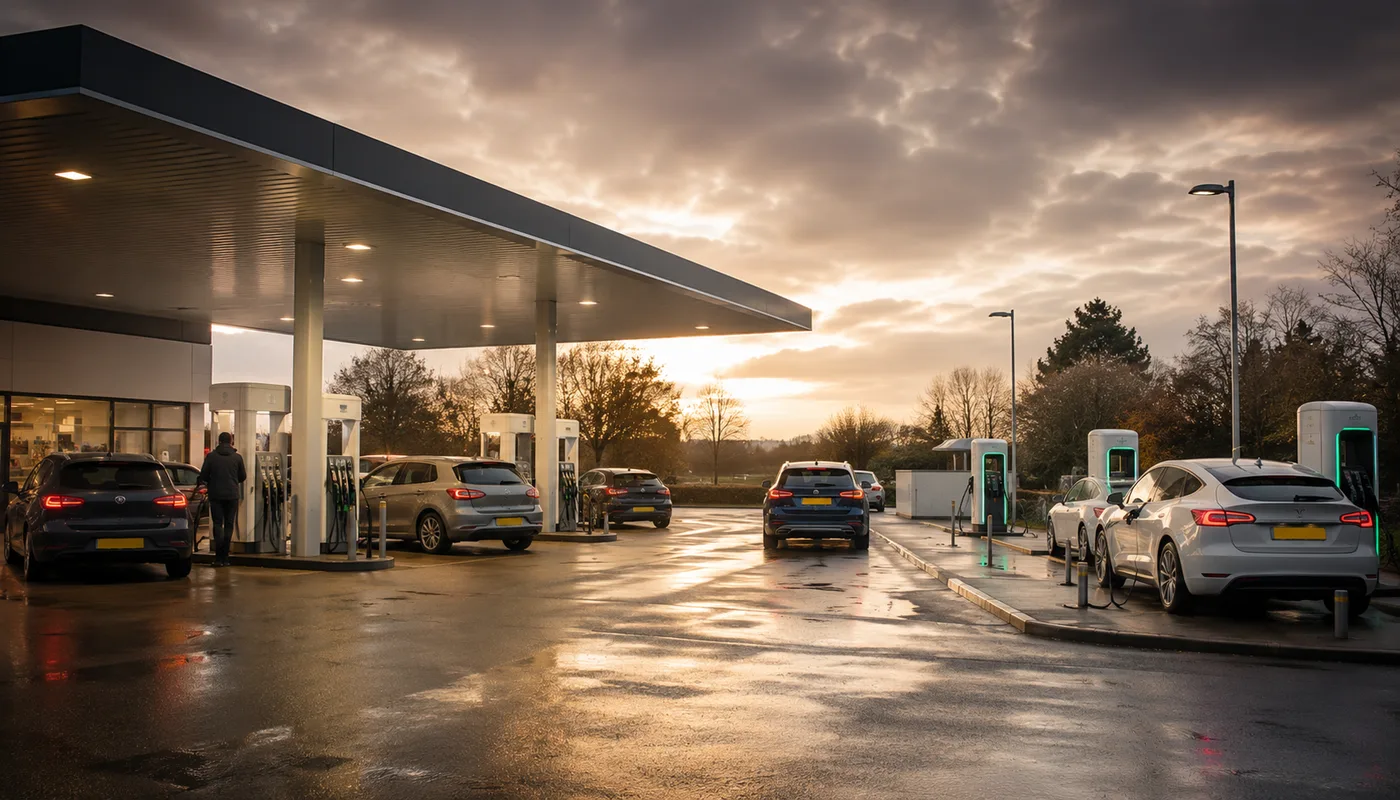
UK petrol stations: shrinking network, rising prices and the EV transition
The UK petrol stations network is shrinking, faces high prices driven by wholesale costs and competition, and is being reshaped by a surge in electric vehicle chargers.
Key takeaways
- Network contraction: UK petrol stations have fallen from about 40,000 in the 1960s to roughly 8,300 today, a long-term structural decline. (Fuelwise)
- Fuel price volatility: Pump prices reached multi‑year highs in early 2026, but the Competition and Markets Authority (CMA) found no evidence retailers are exploiting global tensions to inflate prices. (GOV.UK)
- Competition pressure: Supermarkets and large operators dominate fuel sales, squeezing margins and forcing smaller independents to exit. (fuelsindustryuk.org)
- EV charging surge: Public electric vehicle (EV) chargers now outnumber petrol pumps in the UK by nearly two to one, signalling a fundamental infrastructure shift. (airqualitynews.com)
- Retail evolution: Forecourts are diversifying into convenience retail, food‑to‑go and EV rapid charging hubs as core fuel sales decline. (Christie & Co)
What’s happening to petrol stations in the UK
The number of petrol stations in the UK has collapsed over decades, and that contraction is accelerating under economic and technological pressure. In 1967, there were about 40,000 filling stations; by early 2026 that figure had dwindled to around 8,300 sites — a nearly 80% decline. (Fuelwise) This is far more than a nostalgia story: it reflects weakening fuel demand and structural changes in mobility and retail.
Why does this matter to business and finance readers? Petrol stations have historically anchored roadside retail economies, shaped logistics spending and reflected broader transport trends. Their contraction is a visible sign that the UK’s energy and mobility landscape is in transition — with implications for investors, property owners, and planners.
Why petrol stations are closing
Petrol station closures in the UK are not random; they’re driven by structural demand and competitive forces.
First, fuel demand per vehicle has fallen as cars become more efficient and alternative powertrains gain share. This reduces volumes sold per station, squeezing gross revenue. (Fuelwise)
Second, supermarket chains have captured large market share by cross‑selling fuel at low margins to drive store traffic. According to industry data, supermarkets now hold a growing share of the retail fuel market, pressuring smaller independents that lack scale. (fuelsindustryuk.org) Smaller operators often find margins too thin to justify staying open, especially when the land itself becomes more valuable for other uses.
Third, operational and compliance costs are rising. Fuel retail requires underground storage, environmental safeguards and safety compliance, all of which demand capital. Many independents simply can’t afford the upgrades required on ageing infrastructure.
This mix of declining core fuel volumes, competitive pricing and rising costs means closures often outpace openings. Independent stations close not because demand vanishes instantly, but because the unit economics no longer work.
Fuel prices: high but not unfairly rigged
In 2026, UK petrol prices hit their highest level in over three years, with national averages climbing through early summer. Although headlines tied this to geopolitical tensions — especially disruptions in the Middle East — regulators find the story is more nuanced.
The UK’s Competition and Markets Authority reported that wholesale cost increases, rather than retailer behaviour, are the main driver of pump price rises linked to the global oil market. (GOV.UK) While average retailer margins remain historically elevated (often higher than pre‑pandemic norms), the CMA has so far found no evidence that petrol stations manipulated prices to exploit the crisis. (Business Motoring)
That said, consumers still face variability: in areas with limited competition, prices between stations can differ by more than 10p per litre. (Fuelwise) The new UK government fuel price reporting rules — where stations must update price changes quickly to a central database — aim to help shoppers compare and choose lower‑priced sites.
A tipping point: EV chargers vs petrol pumps
One of 2026’s biggest structural stories for UK petrol stations is infrastructure inversion. According to analysis combining Department for Transport and industry data, the UK had more than 116,000 public EV charging points early in the year, compared with roughly 61,000 petrol and diesel pumps. (airqualitynews.com)
This milestone doesn’t mean EV charging is effortlessly replacing fuel sales — many chargers are slower units in residential or retail locations — but it does shift the infrastructure narrative. The iconic forecourt, once defined by rows of pumps, increasingly integrates EV rapid chargers and can serve as hubs for a different kind of mobility economy.
The divergence also exposes a strategic paradox: forecourts must invest in EV infrastructure to remain relevant, but declining fuel revenues and rising capex compound risk. This dynamic is a classic “transition tax”: incumbents must pay to pivot before their legacy business fully erodes.
Market consolidation and new strategies
Despite closures, capital flows into the sector in new shapes. A major example is Motor Fuel Group (MFG), the UK’s largest independent forecourt operator, which in early 2026 acquired 337 petrol stations from Morrisons for a reported £2.5 billion. (Interchange UK) That deal underscores a consolidation trend: larger players buying forecourts to optimise operations, unify branding and invest in ultra‑rapid EV charging hubs.
This consolidation reflects a broader strategic choice among acquirers: integrate fuel retail with convenience retail, food‑to‑go services, and EV charging to diversify revenue streams. Data from industry tracking suggests that forecourts increasingly position themselves not just as places to refuel, but as retail and service destinations that capture higher‑margin non‑fuel spend. (Christie & Co)
The consumer impact: comparison matters
For British motorists, fewer petrol stations and volatile prices amplify the importance of price transparency tools. Technologies and government data that let drivers compare stations in real time can save up to £9 per tank when drivers shop around. (GOV.UK) In a landscape where an isolated station might price above competitors, comparison can shift behaviour quickly.
But the transition also brings friction. While EV charging points are more numerous, user experience varies by location, speed and payment systems, sometimes deterring adoption. The value proposition of a petrol station — speed, consistency in pricing and ubiquitous branding — remains a standard that EV charging networks are still matching in convenience.
What’s next for petrol stations
The future of UK petrol stations will be shaped by three competing forces:
-
Structural decline of fossil demand: As fuel‑efficient cars and EV adoption grow, total litres sold per forecourt will continue to shrink.
-
Competitive intensity: Supermarket chains and large operators will consolidate their share, pushing others to exit.
-
Infrastructure pivot pressure: Stations that successfully integrate EV charging and broaden retail offerings will be better positioned, but must absorb significant investment.
A simple decision rule for investors and operators today is this: if a forecourt cannot sustain diversified revenue (fuel plus non‑fuel plus EV charging), its intrinsic value will erode faster than land‑only valuations.
In other words, the petrol station business isn’t dying overnight, but its traditional model is. The winners will be those who redefine what a “forecourt” means for 2030 and beyond.
FAQ
Why are petrol stations closing in the UK?
Petrol stations are closing due to long‑term decline in fuel demand, competition from supermarkets, rising costs, and the growth of EV charging infrastructure.
Are UK fuel prices rising because of petrol stations exploiting the market?
UK regulators found no evidence that petrol stations are exploiting the Middle East crisis to increase prices, attributing rises to wholesale costs instead.
How does EV charging affect petrol stations?
EV charging infrastructure has grown so that public chargers now outnumber petrol pumps in the UK, pressuring traditional petrol station demand and prompting forecourt diversification.
Sources
- GOV.UK, CMA publishes new monitoring update on road fuel market (2026‑06‑01)
- AirQualityNews, UK has twice as many public EV chargers as petrol pumps (2026‑03‑03)
- Fuelwise, The Disappearing Petrol Station: UK Forecourts Could Be Extinct by 2038 (2026‑03‑05)
- Interchange UK, MFG buys Morrisons petrol stations and plans ultra rapid EV charging hub rollout (2026‑02‑01)
- Business Motoring, Petrol prices fall as CMA finds “no evidence” retailers took advantage of war – RAC (2026‑06‑01)