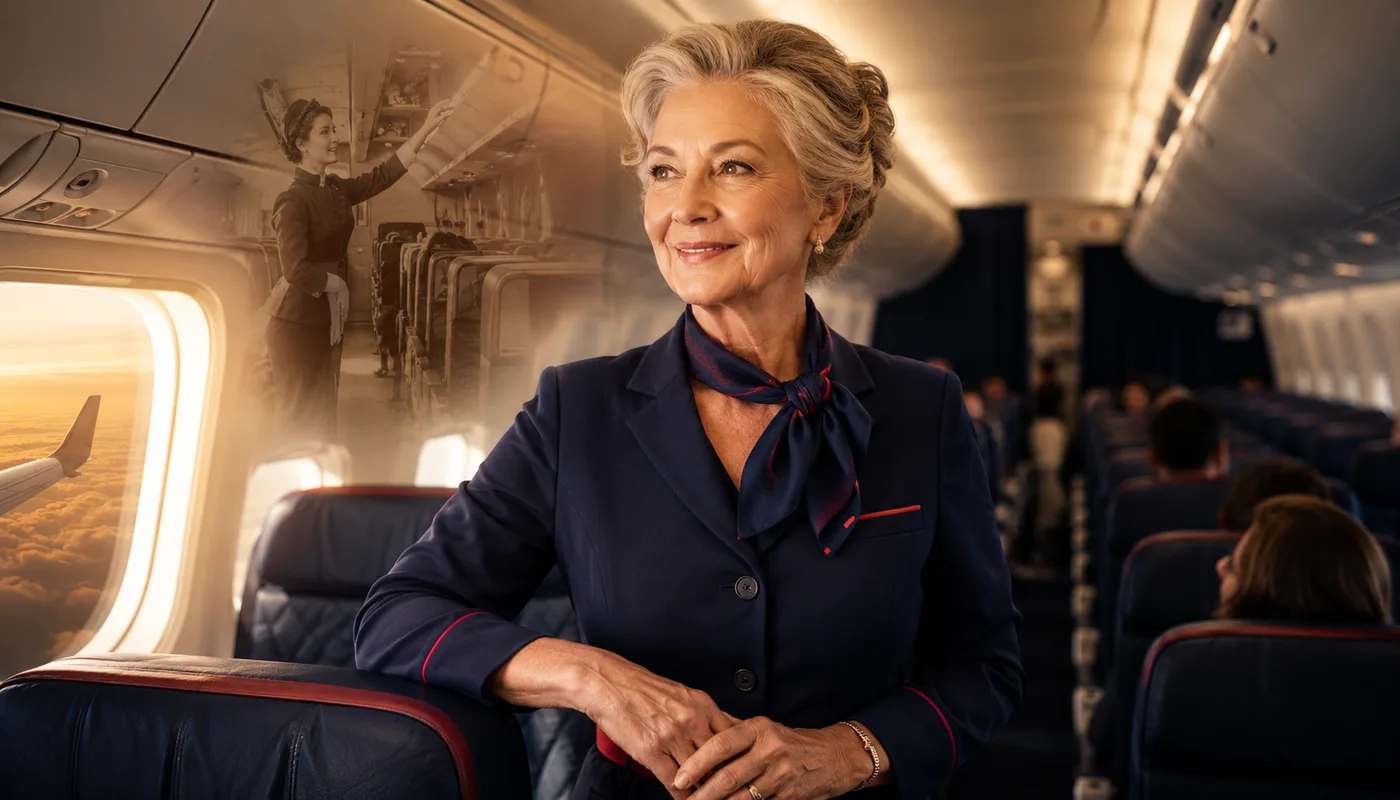
Joan Crandall’s Aviation Career: A 66‑Year Record and What It Means for the U.S. Airline Workforce
Joan Crandall’s aviation career was defined by an unbroken 66‑year tenure as a commercial flight attendant — a record in U.S. aviation that underscores both personal resilience and deep shifts in airline labor, gender norms, and workforce economics. (KVIA)
Key takeaways
- Record career duration: Joan Prince Crandall served continuously as a flight attendant from 1959 to her 2026 retirement — a 66‑year span that industry observers identify as the longest active cabin‑crew career in commercial aviation history. (KVIA)
- Industry evolution: Crandall witnessed the airline business evolve from small propeller planes like the Douglas DC‑3 to modern jetliners with hundreds of seats. (KVIA)
- Gender and labor norms changed: Early in her career, airlines enforced restrictive appearance, age, and marital status policies on female flight attendants, all but eradicated by legal and social shifts since the 1960s. (KVIA)
- Typical U.S. flight attendant career is much shorter: While Crandall’s tenure is extraordinary, most U.S. flight attendants serve about 8–12 years; the role now demands intense safety training in addition to service duties. (WTOP News)
- Economic context: The average U.S. flight attendant salary is about $70,980 per year, reflecting the professionalization of cabin crew roles in a capital‑intensive airline industry. (WTOP News)
A career that charts aviation history and workforce change
Joan Crandall’s aviation career isn’t just about longevity — it’s a living timeline of the airline industry’s transformation and the evolving economics of airline labor. When she started in 1959 at Pacific Airlines, the U.S. commercial fleet was dominated by piston‑engine propeller aircraft. Over the next six decades, the industry shifted to jetliners capable of carrying hundreds of passengers on global routes, powered by deregulation, consolidation, and technological innovation. (KVIA)
Crandall’s unique vantage shows how a personal career can mirror macroeconomic trends. Her timeline spans key airline business shifts: the rise of regulated carriers, the Airline Deregulation Act of 1978, consolidation into mega‑carriers like Delta Air Lines, and the increasing complexity of cabin operations. By the time of her retirement on May 30, 2026, she had worked through mergers from Pacific to Air West, Hughes Airwest, Republic Airways, Northwest, and finally Delta. (KVIA)
The apprenticeship era to professional safety role
At the start of Crandall’s aviation career, flight attendants were often called “stewardesses,” a title rooted in a time when airlines marketed glamour as much as transportation. She recalls early jobs that emphasized uniform style and service on small aircraft like the Douglas DC‑3, which carried about 24 passengers. (WTOP News)
Over the decades, the role expanded far beyond tray service and cabin elegance. Modern flight attendants are trained first responders in emergency evacuation, medical aid, and safety protocols — essential functions that regulators and carriers emphasize to meet strict safety standards. Despite the evolution, a constant through Crandall’s career was passenger interaction and service, now paired with rigorous safety responsibilities. (WTOP News)
The economics of the job changed in parallel. While early flight attendants often entered the role for short stints — “a job you do for about two years,” as Crandall once described the stereotype — today’s profession demands certification, recurrent training, and offers a median salary of around $70,980 per year in the United States. (WTOP News)
Breaking barriers and tracking labor norms
Crandall’s story also intersects with major labor and social reforms. In the early 1960s, many carriers imposed discriminatory restrictions on female cabin crew, including mandatory retirement at age 32 or termination upon marriage. These practices were dismantled after the Civil Rights Act of 1964 prohibited employment discrimination based on sex, race, and other characteristics, opening the path for women’s longer and more secure aviation careers. (People.com)
Her longevity thus highlights broader workforce trends in the U.S.: declining gender barriers, the professionalization of service labor, and the shifting economics of airline employment. As the airline industry matured, cabin crew roles became less about youthful image and more about safety compliance, passenger experience, and operational reliability.
What Crandall’s career signals for airline business leaders
For airline executives and workforce strategists, Crandall’s aviation career signals several enduring themes:
- Human capital matters: Even in a capital‑heavy industry defined by aircraft and routes, long‑tenured employees contribute institutional knowledge, safety culture, and brand continuity. Crandall’s service through decades of regulatory and business cycles illustrates this strategic value.
- Labor evolution mirrors business cycles: Airlines that successfully adapted cabin crew roles alongside jet technology, deregulation, and competitive pressures generally maintained service standards and operational resilience.
- Workforce planning must balance experience with renewal: Crandall’s retirement marks a shift to newer generations trained under 21st‑century safety and customer service paradigms. Strategic workforce planning now must integrate long experience with fresh skills in crisis management and digital systems.
FAQ
Who is Joan Crandall in the aviation industry?
Joan Crandall is a U.S. flight attendant who served for 66 years, making her the longest‑serving active flight attendant in commercial aviation history. Her career spanned from the propeller era to modern jets and reflected significant labor and industry changes.
What does Joan Crandall’s career illustrate about airline workforce trends?
Her career exemplifies extreme longevity, shifting gender norms, evolving flight attendant responsibilities, and long‑term human capital dynamics in the airline business.
What is the average flight attendant salary in the U.S.?
According to the U.S. Bureau of Labor Statistics, the average U.S. flight attendant salary is approximately $70,980 per year, reflecting professionalization but still shorter career spans than Crandall’s.
Sources
- CNN Newsource, “After more than 66 years in the air, the industry’s longest‑serving flight attendant prepares to retire,” 2026‑05‑30 — background on Crandall’s career.
- People, “Delta’s Longest‑Serving Flight Attendant Recalls When Female Crew Couldn't Marry, Had to Retire at 32,” 2026‑06‑03 — quotes and historical context.
- Semana, “Más de 60 años en el aire: se retira la auxiliar de vuelo con más años de servicio de la industria,” 2026‑06‑01 — industry reflection and role evolution.
- U.S. Bureau of Labor Statistics, Flight Attendants and Other Aviation Occupations — average salary and job context.