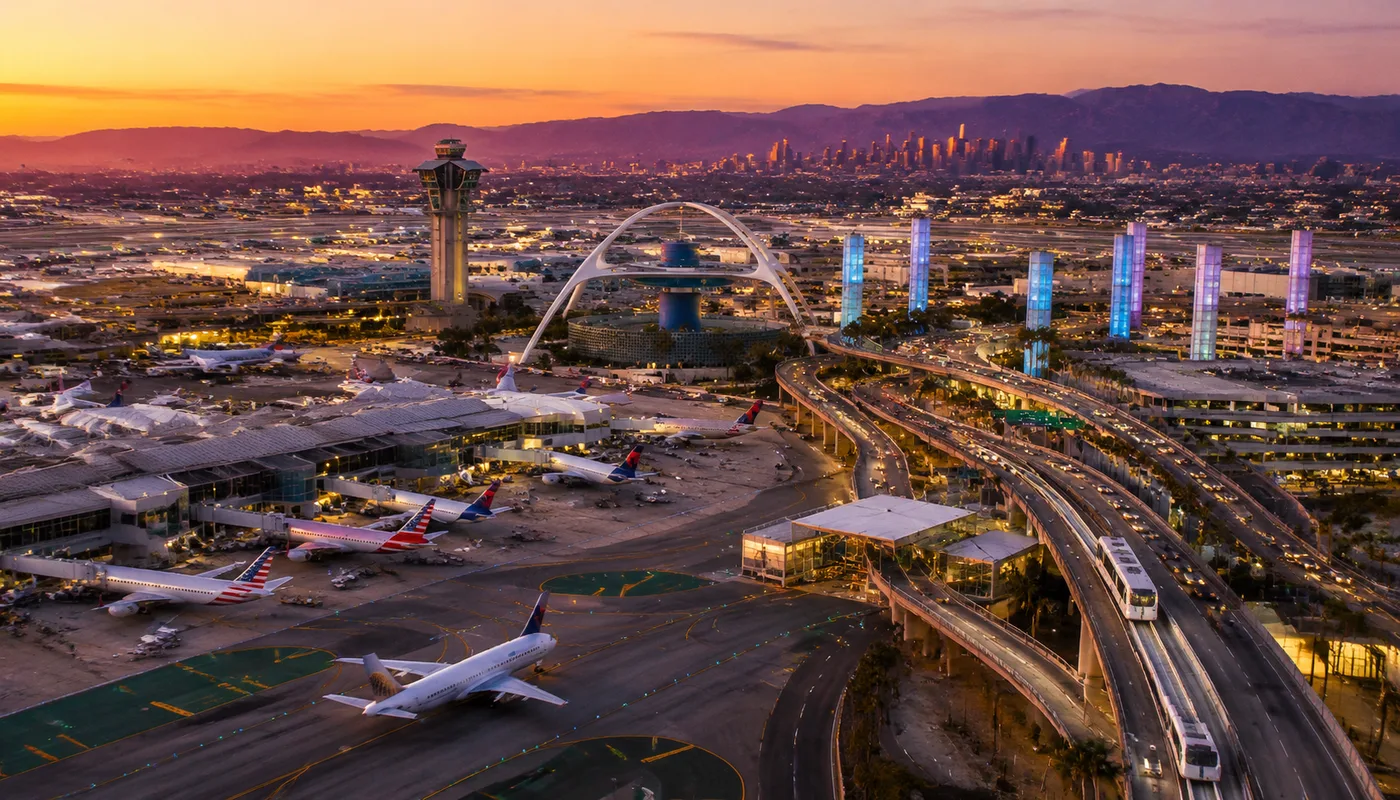
Los Angeles International Airport’s Growth Strain: Investment, Traffic Trends, and Revenue Pressures
Los Angeles International Airport traffic softened in 2025 even as multi‑billion‑dollar investments and airline route shifts signal a pivotal business moment for one of the United States’ key economic gateways.
Key takeaways
- Passenger volume softens: LAX served about 73.7 million passengers in 2025, down ~3.8% from 76.6 million in 2024 and still below peak 2019 levels. (Road Genius)
- Global connectivity persists: LAX remains one of the busiest international airports in the U.S., and carriers are adding or modifying long‑haul routes, including new service enhancements to Asia. (Cathay Pacific News)
- Heavy infrastructure spending: Major projects, including roadway improvements and the Automated People Mover (APM), are backed by multi‑billion dollar contracts, aiming to fix congestion and modernize access. (MarketScreener Canada)
- Airline economics shift routes: Elevated fuel prices have prompted carriers like American Airlines to suspend select LAX routes in late 2026. (FOX 11 Los Angeles)
- Access and connectivity upgrades: The LAX/Metro Transit Center Station opened in mid‑2025, expanding rail access and laying groundwork for further multimodal integration. (Condé Nast Traveler)
Introduction
Los Angeles International Airport (LAX) stands at a strategic economic crossroads in 2026. The airport is a global gateway for passengers and cargo, deeply woven into Southern California’s economic fabric and the broader U.S. aviation network. Yet recent trends reveal tension: annual passenger figures softened in 2025 while capital investments in infrastructure surged. LAX’s performance now reflects broader pressures on airlines and airports, from fuel cost volatility to shifting route economics, even as connectivity improvements aim to preserve market share ahead of major global events like the 2026 FIFA World Cup and 2028 Olympics. This article examines traffic trends, the business case for infrastructure spending, and how airline strategy is reshaping LAX’s near‑term economic role.
LAX traffic dynamics: recovery, decline, and comparative standing
Despite projections of unrelenting air travel growth after the pandemic, Los Angeles International Airport’s annual traffic tells a more nuanced story.
LAX traffic dipped in 2025 compared with recent years. Airport statistics indicate LAX handled approximately 73.7 million total passengers in 2025, a 3.8% drop from 76.6 million in 2024. (Road Genius) This followed a prolonged recovery from the dramatic collapse in 2020 during COVID‑19, but still leaves the airport about 16% below its 2019 pre‑pandemic peak of 88.1 million. (Road Genius)
Industry rankings reflect this shift. LAX once ranked as the second‑busiest U.S. airport by passenger count; slower growth has seen its relative position narrow as nearby airports like Ontario and Long Beach register gains. (Los Angeles Business Journal) While it remains a major international hub on the West Coast, this ebb in traffic matters for revenue streams tied to passenger volume—parking, concessions, and facility charges—that underpin airport finances.
International traffic share and carrier mix. In 2025, about 32% of LAX’s passengers were international travelers, with domestic travelers composing the remaining 68%. (Road Genius) Major carriers like Delta, United, and American dominate the airport’s traffic mix, with Delta holding the largest share. (Wikipedia) Intercontinental service enhancements—such as expanded business class offerings by global carriers—underscore that international connectivity remains a priority even amid broader dips. (Cathay Pacific News)
LAX’s aircraft operations (takeoffs and landings) similarly reflected modest fluctuations, with roughly 580,996 total movements in 2025, a slight decrease from the prior year. (Road Genius)
Massive infrastructure spend: modernization meets gridlock
LAX is investing heavily to reposition itself for future growth, but these capital commitments come amid scrutiny over cost, timing, and operational payoff.
Multi‑billion dollar modernization programs. Los Angeles World Airports (LAWA), the city authority that runs LAX, has contracted projects worth hundreds of millions to billions of dollars as part of its Airfield and Terminal Modernization Program (ATMP). For example, a joint venture led by Skanska secured an $868 million contract for expansive roadway improvements designed to ease access, reduce emissions, and support current and projected traffic volumes. (MarketScreener Canada)
These investments include reconfiguring over 6 kilometers of roadway, constructing new bridges, upgrading signals, and modern traffic systems. (MarketScreener Canada) Critics argue the timeframe and budgets may not align with actual travel growth, but LAWA officials maintain these upgrades are foundational for efficiency and safety.
Automated People Mover (APM) and access upgrades. One of LAX’s most discussed projects is its Automated People Mover, long anticipated as a solution to chronic traffic gridlock around the Central Terminal Area. As of early 2026, testing and phased launches are underway, complementing the recently opened LAX/Metro Transit Center Station, which links rail lines to airport terminals. (Condé Nast Traveler) The APM is intended to improve multimodal access ahead of peak global demand events, though delays have tested stakeholder patience.
The larger modernization reflects a strategic choice: invest now to strengthen LAX’s competitive position as other Southern California airports expand and niche carriers reshape market share. However, it comes with trade‑offs in cost, complexity, and community impact.
Airline strategy and operating economics at LAX
Traffic and infrastructure are only half the story. Airlines’ commercial decisions—especially around route networks and capacity—are reshaping LAX’s business environment.
Route suspensions tied to fuel prices. In 2026, American Airlines announced that several domestic routes from LAX to cities like Cleveland, Columbus, Pittsburgh, and Washington Dulles would be temporarily suspended during August and September, citing elevated jet fuel costs as a primary factor. (FOX 11 Los Angeles) Such adjustments highlight how macroeconomic pressures on airlines feed back into airport traffic and revenue expectations.
These route shifts are not unique to American. Across the U.S. aviation sector, carriers are optimizing networks to preserve margins amid cost inflation, challenging airports to adapt commercial strategy and revenue forecasts in real time.
New global routes underscore mixed demand signals. At the same time, carriers continue to expand global options. For instance, Cathay Pacific introduced its award‑winning new business class equipment on LAX‑Hong Kong services in 2026, anticipating strong premium demand on transpacific flows. (Cathay Pacific News) This juxtaposition—domestic route contraction and international capacity refinement—illustrates the sector’s nuanced response to economic signals.
Congestion, fees, and local friction
LAX’s financial strategy also intersects with local debates over access and fees. To fund infrastructure and manage congestion, LAWA has approved fee increases for ride‑hailing and other ground services, a move that has sparked local outcry about cost burdens for travelers. (Reddit)
From a business lens, fee adjustments generate non‑aeronautical revenue critical to offsetting capital expenditures. But they can also encumber the customer experience and influence consumer choice—especially when alternative airports or transport modes compete.
Putting it all together: strategy amid transition
Los Angeles International Airport’s current business landscape is defined by three intersecting forces:
- Traffic headwinds: Passenger volumes are softer than expected, with recovery plateaus in 2025 below pre‑pandemic peaks. (Road Genius)
- Strategic infrastructure spend: LAWA is deploying major capital to fix access, modernize terminals, and broaden connectivity ahead of major global events. (MarketScreener Canada)
- Airline commercial realignment: Carriers are withdrawing or adjusting routes based on cost pressures while investing selectively in profitable long‑haul markets. (FOX 11 Los Angeles)
These forces create a tension: airports like LAX must balance near‑term financial discipline with long‑term positioning as a global hub. For investors, airline partners, and local policymakers, maintaining this balance is critical to sustaining airport‑linked economic activity, from jobs and tourism to trade and logistics.
FAQ
Did passenger counts at Los Angeles International Airport grow in 2025?
No. LAX handled about 73.7 million passengers in 2025, down roughly 3.8% from 76.6 million in 2024 and still below pre‑COVID 2019 levels. (Road Genius)
What major infrastructure investments are underway at LAX?
LAX is funding multi‑billion dollar modernization and roadway projects, including a $868M contract for roadway improvements and the ongoing Automated People Mover rollout. (MarketScreener Canada)
Has airline service at LAX changed because of economic pressures?
Yes. American Airlines announced suspension of several domestic LAX routes in 2026 due to elevated fuel costs. (FOX 11 Los Angeles)
Sources
- Wikipedia, “Los Angeles International Airport” (overview of airport scale and traffic).
- RoadGenius, “Los Angeles International Airport Statistics 2025” (2025 passenger and operations figures).
- MarketScreener, “Skanska Signs New Contract for Modernizing Los Angeles Intl. Airport, USA, for USD 4.4 Billion” (infrastructure investment).
- FOX 11 Los Angeles, “American Airlines suspends LAX routes over fuel costs” (route strategy shifts).
- Condé Nast Traveler, “The LAX/Metro Transit Center Station Is Now Open” (connectivity).