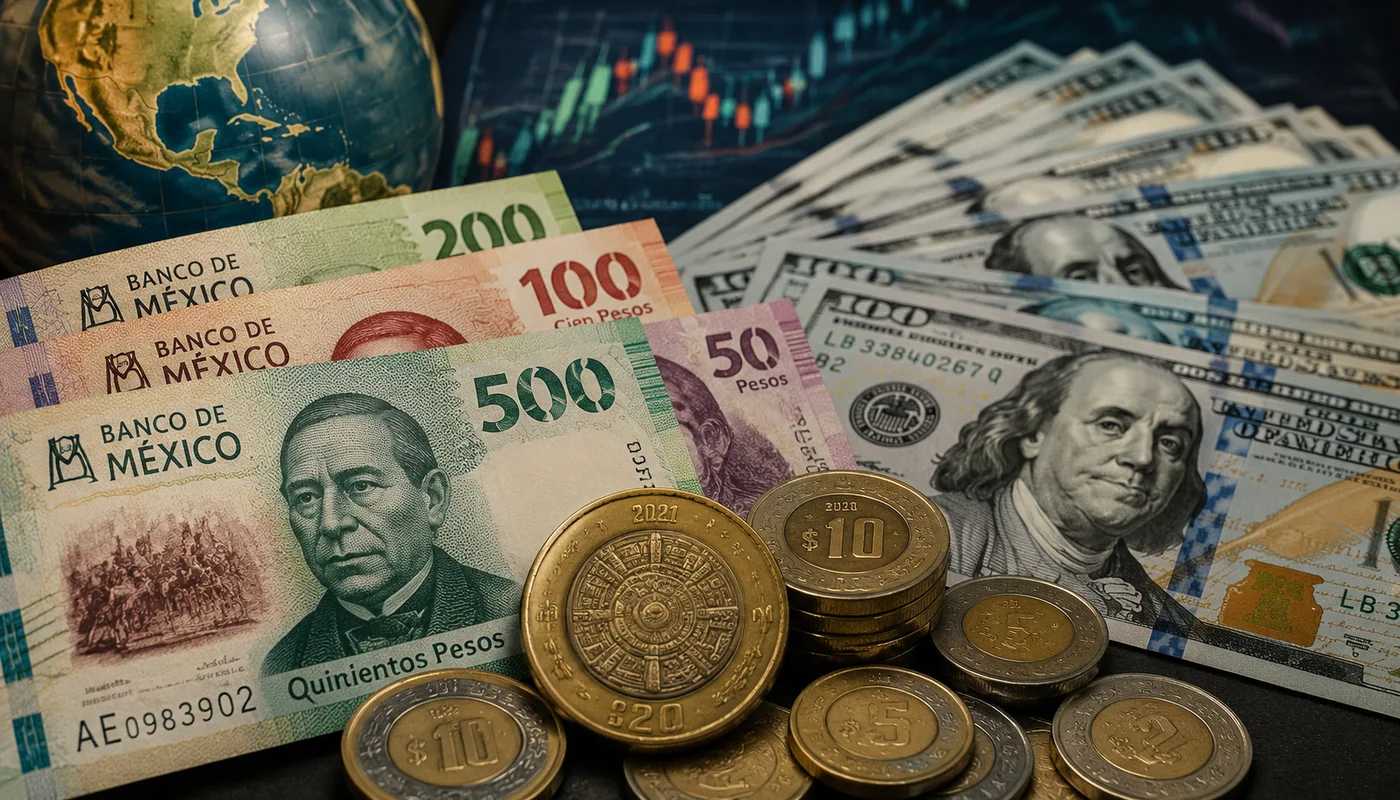
Mexican Peso in 2026: What U.S. Investors and Businesses Are Watching
The peso mexicano is navigating a 2026 inflection point — recently stronger than a year ago but now volatile amid U.S. macro signals, with direct business and remittance implications for U.S. stakeholders.
Key takeaways
- Peso strength in early 2026: The Mexican peso traded near 17.36–17.45 per U.S. dollar in January–February, its best levels since mid‑2024 as risk appetite and weak dollar conditions supported emerging market currencies. (Jornada)
- Recent volatility from U.S. data: In early June, the peso weakened to ~17.5 per dollar after stronger‑than‑expected U.S. labor data boosted the dollar. (El Economista)
- Bank forecasts flag pressure ahead: Bank of America projects USD/MXN at ~18.50 by year‑end 2026 amid broader emerging market FX pressure and slower Mexican growth. (Investing.com)
- Remittances remain a significant flow: Mexican remittances rose to US$4.9 billion in April 2026, up 3.7% year‑over‑year, underscoring the importance of exchange impacts on households. (Mexico Business News)
- Inflation cues matter: Peso moves have responded to U.S. inflation surprises, reflecting global monetary policy links. (Jornada)
Why the peso mexicano matters to U.S. business and finance
The peso mexicano is Mexico’s legal currency (MXN) and a key liquid emerging market currency. It’s also a bellwether for U.S.–Mexico economic integration via trade, remittances, and cross‑border capital flows. Exchange rate moves influence U.S. exporters’ competitiveness, import prices, investment returns from Mexican assets, and the real value of dollars sent home by Mexican workers in the U.S.
In 2025 the peso posted one of its best performances in years, buoyed by risk appetite, nearshoring trends, and favorable rate differentials that helped it appreciate against the U.S. dollar. (Disruption Banking) As 2026 unfolded, that strength began to ebb at times, revealing tension between early momentum and new macro shocks — especially U.S. labor and inflation data that lift the dollar and pressure the MXN. (El Economista)
For U.S. businesses assessing cross‑border exposure, the peso’s path offers both risk signals and opportunities — but the key now is not just level (whether 17 or 18 per dollar) but volatility drivers rooted in global monetary policy and bilateral economic data.
How exchange rates are shifting in 2026
The peso’s exchange rate has oscillated in the first half of 2026 around historic lows. In January, the peso traded near 17.36 units per dollar, its strongest since mid‑2024, driven by broad dollar weakness and positive sentiment in emerging markets. (Jornada)
By early June, however, U.S. labor market strength — particularly payroll figures beating expectations — reinforced bets on continued Federal Reserve rate support. That boosted the U.S. dollar and weakened the peso to around 17.5 per dollar, marking a notable reversal of recent gains. (El Economista)
Market commentary in Mexico highlights guarded optimism about the peso’s medium‑term range, but also caution — technical resistance points around 17.35–17.50 and potential weakening toward near‑18 levels if global dollar support persists. (El Economista)
What’s driving these shifts
- Global dollar strength: Safe‑haven flows around macro news out of the U.S. can uplift the dollar versus MXN. A strong U.S. jobs report in June 2026 is a live example. (El Economista)
- Mexico’s rate and inflation dynamic: Inflation trends in both Mexico and the U.S. shape interest rate expectations, and thus carry trades that support or pressure the peso. (Jornada)
- Emerging market sentiment: Risk appetite supports the peso in periods of broad EM currency gains, but retreating for safety can flip that. (Jornada)
- Forecasts from analysts: Institutions like Bank of America see short‑term pressure on the peso, projecting USD/MXN near 18.50 by year‑end should global FX headwinds persist. (Investing.com)
What U.S. companies should watch in 2026
Exchange rate trends won’t move in isolation — they’re tied to macro data, policy, and trade flows. For U.S. business leaders and investors, three strategic nodes matter:
1) Macroeconomic datapoints in both countries
U.S. employment, inflation, and GDP not only drive the dollar but influence cross‑border demand for U.S. goods. Likewise, Mexican inflation and output influence Banxico’s policy and, by extension, FX dynamics. U.S. inflation surprises in February 2026 briefly boosted the peso, demonstrating bidirectional sensitivity. (Jornada)
Decision rule: If U.S. inflation cools more than expected while Mexico’s remains steady, the peso could strengthen. The reverse could pressure the peso.
2) Monetary policy divergence
Interest rate differentials — sometimes called “carry” — can attract capital flows. Higher Mexican rates relative to the U.S. historically helped the peso, but narrowing interest advantages reduce this support. Bank of America’s cautious outlook for 2026 reflects this risk. (Investing.com)
Tradeoff: Higher Mexican rates may support the peso but constrain domestic borrowing and investment.
3) Remittances and consumer impact
Mexican remittances from the U.S. totaled US$4.9 billion in April 2026, a key income stream for many Mexican households. (Mexico Business News) A stronger peso means each dollar sent buys fewer pesos, potentially reducing purchasing power for recipients and damping consumption.
Planning cue: U.S. firms with Mexican consumer links should model dual scenarios — peso appreciation and depreciation — around remittance elasticity.
Myth vs. reality: “Peso strength = export boost”
A common assumption is that a weaker peso always boosts Mexican exports by making them cheaper abroad. Reality in 2026 is nuanced: Export competitiveness also hinges on global demand, supply chain proximity, and tariff regimes (e.g., USMCA). Exchange rates are only one factor. Recent peso swings have had limited direct impact on Mexico’s trade performance independent of broader economic trends. (Contextual synthesis based on overall trade reporting.)
Looking ahead: forecasts and risks
Analyst forecasts vary, but a range trade between 17.5 and ~19 pesos per dollar for the remainder of 2026 is a commonly cited band reflecting both current strength and potential headwinds. (Investing.com) Negative shocks — such as sharper U.S. rate hikes or worsening growth — could push the peso toward the weaker end, while improved risk appetite or favorable data could tighten it.
FAQ
What is the current trend in the peso mexicano vs the U.S. dollar?
As of mid‑2026 the peso mexicano trades around 17.4–17.5 per U.S. dollar after earlier strength, but recent U.S. macro data has injected volatility that could reshape near‑term trends. (Investing.com México)
How does the peso mexicano’s performance affect U.S. remittances?
A stronger peso reduces the pesos received per U.S. dollar sent, affecting purchasing power for Mexican households. A weaker peso increases local value for the same dollar amount. (Mexico Business News)
Why should U.S. businesses care about peso movements?
Peso fluctuations affect export pricing, import costs, investment returns, and consumer demand in Mexico — all central to U.S. businesses engaged in North American trade and finance.
Sources
- Investing.com, “BofA sees Mexico peso facing pressure despite oil price neutrality,” 2026‑03‑26
- La Jornada, “Peso sigue tomando fuerza … mejor nivel desde mayo de 2024,” 2026‑01‑23
- El Economista, “Peso mexicano cae con fuerza … sólidos datos laborales de Estados Unidos,” 2026‑06‑05
- Mexico Business News, “Mexico Remittances Reach US$4.9 Billion in April,” 2026‑06‑03
- La Jornada, “Peso mexicano se aprecia tras datos de inflación en EU,” 2026‑02‑13