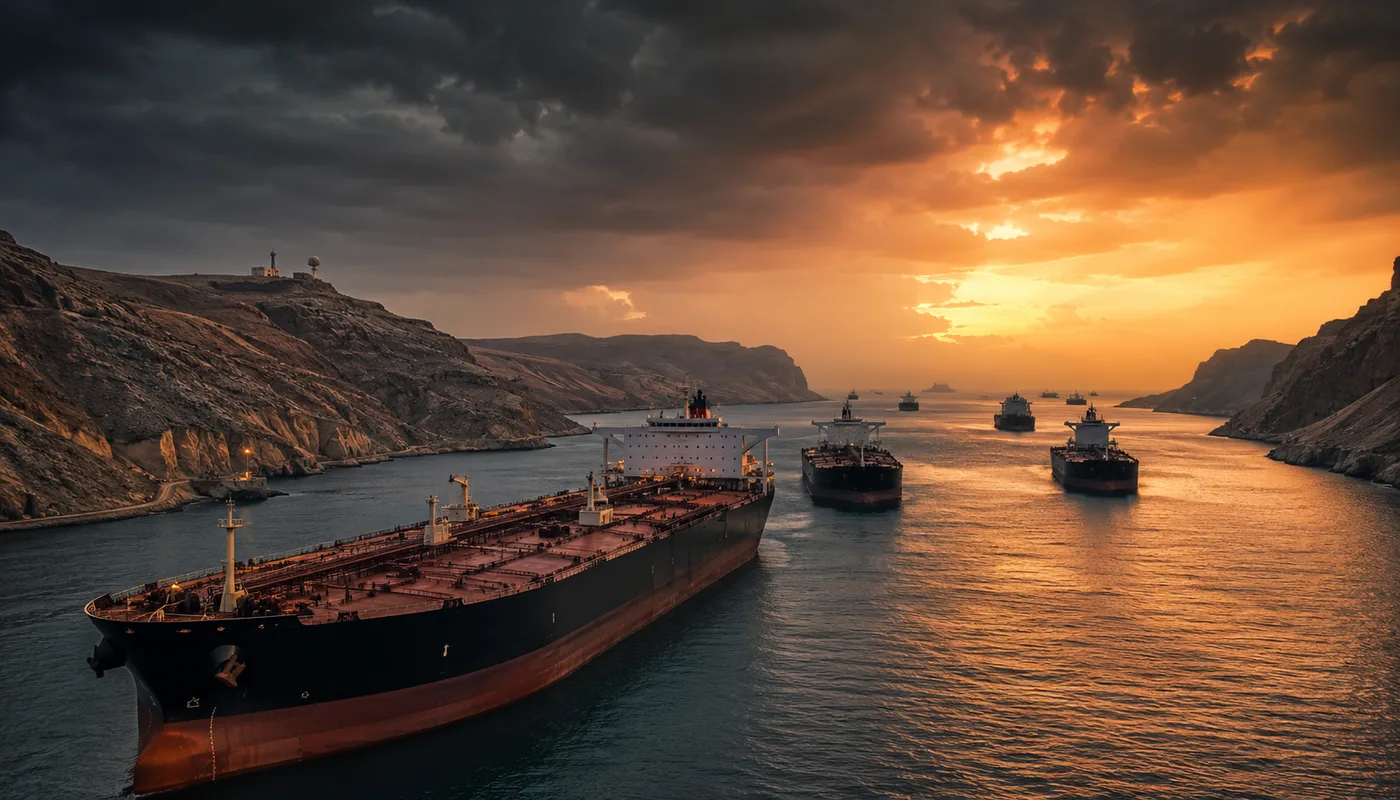
Strait of Hormuz and the Great Oil Shock: How a Narrow Waterway Is Rewriting U.S. Business & Finance
The Strait of Hormuz crisis in 2026 has constricted essential oil and energy shipping to a fraction of normal levels, creating tangible price pressures and financial risks for the United States and global markets.
Key takeaways
- Traffic collapse: Tanker traffic through the Strait of Hormuz is roughly 90–95% below pre‑crisis levels, with only a trickle of vessels transiting amid heightened risk and many ships disabling tracking systems. (Investing.com)
- Strategic chokepoint: Before the crisis, the strait handled about 20–25% of global seaborne oil trade, roughly 20 million barrels per day, making it the most critical energy shipping lane globally. (Brookings)
- Price risk & visibility: Declining supplies and opaque flows have helped lift Brent crude prices near $95–$100 per barrel, even as markets remain strangely calm amid mixed signals. (Strait of Hormuz Monitor)
- Financial service stress: War‑risk insurance markets have withdrawn or repriced coverage, forcing government backstops and exposing systemic limits in shipping risk pricing. (World Economic Forum)
- U.S. economic ripple: Even as the U.S. produces significant oil domestically, global price dynamics and disrupted energy costs are feeding inflationary pressure and creating earnings volatility across energy‑linked sectors.
The narrow waterway now shaping U.S. markets
The Strait of Hormuz is a 21‑mile‑wide maritime chokepoint linking the Persian Gulf to the Arabian Sea — but in 2026 it has become the single biggest near‑term risk factor for global energy markets. Before this year’s geopolitical escalation, about 20–25% of the world’s seaborne oil flowed through the strait every day, roughly 20 million barrels per day of crude, condensate, and refined products. (Brookings)
U.S. markets may seem insulated because the country produces and exports oil. But oil is priced globally: supply disruptions in Hormuz push Brent crude toward $100 a barrel and raise refinery feedstock costs in the United States, tightening consumer and industrial margins. (Strait of Hormuz Monitor)
This article explains how a remote waterway’s near‑closure ripples through energy pricing, insurance markets, shipping costs, and financial risk modeling — and why U.S. policymakers and business leaders should be watching closely.
Why the Strait of Hormuz matters to U.S. Business & Finance
The Strait’s importance isn’t academic — it’s a linchpin of global energy logistics.
In normal conditions, the strait accounted for roughly 20.9 million barrels per day of oil and related products, according to U.S. Energy Information Administration data cited in strategic analyses. (Analysis Atlas) That flow underpinned prices and supply reliability worldwide.
Now, traffic has collapsed by an estimated 90–95% compared to pre‑war levels, as carriers avoid the area or turn off tracking (“dark mode”) amid security risks. (Investing.com) For most of March through early June, maritime analytics dashboards show only a fraction of typical crossings and dramatically reduced throughput. (Strait of Hormuz Monitor)
Oil markets respond to both actual flows and expectations. In May and into June, Brent crude prices have hovered near $95–$100 per barrel, in part because traders are pricing in ongoing risk rather than confirmed resumed supply. (Reuters) Markets may appear calm relative to earlier spikes, but underlying inventory depletion and uncertain flows create a “blind” price regime where sentiment — not supply data — often dictates curves.
For U.S. businesses, higher crude costs affect gasoline, diesel, petrochemicals, and transportation costs. Even if U.S. shale and Gulf of Mexico production remains robust, global price linkages ensure domestic costs feel international shocks. The result can be higher inflation pressures, tighter corporate margins, and more volatile earnings for firms in energy‑related supply chains.
Shipping insurance and financial risk limits
One of the quieter but financially significant developments from the Hormuz crisis is the strain on war‑risk insurance markets.
Marine and war‑risk insurance — policies that protect hulls, cargo, and liability when ships transit dangerous waters — are now being repriced or withdrawn entirely by commercial insurers because of heightened risk in the Persian Gulf. (World Economic Forum) This isn’t a technicality: without insurance, most commercial tankers cannot legally or financially operate in high‑risk zones.
In response, governments, including the United States, have stepped in as insurers of last resort, putting sovereign balance sheets behind risk guarantees to keep strategic flows moving. (World Economic Forum)
This shift has broader implications for financial markets. Insurance is part of the infrastructure that turns unpredictable geopolitical risk into quantifiable, tradable exposures. When insurers step aside, governments become direct backers, blurring the line between market pricing and geopolitical strategy — and transferring risk to taxpayers and sovereign balance sheets.
Real traffic versus headline claims
One of the surprising features of the current crisis is how different data sources tell different stories.
Satellite and Automatic Identification System (AIS) data indicate that visible tanker traffic is dramatically reduced, in some datasets to about 6 tankers per day versus ~30 per day pre‑crisis (roughly 9% of normal), according to one live tracking dashboard. (Strait of Hormuz Monitor)
But geopolitical actors sometimes claim higher numbers of transits, and in some cases vessels disable tracking to mask routes. These divergences matter because markets trade on perceived risk, not just raw throughput. A claim that traffic is rising can dampen price spikes even if physical flows remain low.
Analysts caution that opacity in ship movement data complicates planning for traders, refiners, and risk managers. Uncertainty in both supply and risk premiums is arguably as influential on price as the underlying flow itself.
U.S. macro and sectoral impacts
From a U.S. perspective, Hormuz disruption feeds through multiple channels:
- Energy prices: Higher crude lifts gasoline, diesel, and jet fuel prices, affecting household budgets and commercial transport costs.
- Inflation: Costlier energy feeds inflation data that central banks watch closely.
- Risk assets: Energy and commodity stocks often gain as investors hedge against supply risk, while other sectors may see rising input costs.
- Supply chains: Petrochemical feedstocks and downstream products like fertilizers can become more expensive or volatile when basic energy logistics falter.
- Insurance and credit markets: Higher war‑risk premiums and sovereign backstops shift risk pricing in credit and trade finance.
The U.S. response has been a mix of naval presence, diplomatic pressure, and financial backstops — all aimed at limiting further economic spillovers. But progress is uneven, and the situation remains fluid.
What changed in 2026
The current crisis traces back to a February–March 2026 escalation in Middle East hostilities involving Iran, the U.S., and allied forces. In late February, Iran indicated it would restrict shipping through the strait in retaliation to attacks, prompting many shipowners to halt or reroute traffic. (CGTN News)
Subsequent military actions, war‑risk insurance withdrawal, and increased geopolitical uncertainty drove tanker transits to record lows. Even temporary ceasefires have produced only incremental returns in shipping, with analysts saying a full normalization will take weeks to months if it occurs at all. (World Oil)
When might things normalize?
Analysts see several scenarios for the strait’s future:
- Gradual reopening: Modest increases in traffic could emerge over weeks if risk premiums fall and insurance returns. (World Oil)
- Conditional access: New systems of controlled passage with fees or security agreements could replace free navigation. (World Oil)
- Prolonged risk premium: Even with some traffic, high war‑risk costs and geopolitical tensions could keep prices elevated.
Some financial forecasts suggest the oil market could swing back into oversupply once Hormuz reopens, driven by production increases and non‑OPEC growth. (The Economic Times) Investors and risk managers should treat such predictions with caution, as actual reopening timing is tied to unpredictable geopolitical negotiations.
What the U.S. should watch
For U.S. businesses and financial leaders, keeping an eye on these indicators is essential:
- Tanker throughput data (e.g., AIS signals, independent trackers)
- War‑risk insurance premium movements
- Brent and WTI price curves and spreads
- Strategic petroleum reserve drawdowns and releases
- Diplomatic signals from Gulf partners, Iran, and international sanctions regimes
Because a small shift in Hormuz activity can have outsized price and risk effects, businesses need real‑time risk metrics, not quarterly reports.
FAQ
What percentage of global oil normally transits the Strait of Hormuz?
About 20–25% of global seaborne oil trade and roughly 20 million barrels per day flowed through the Strait of Hormuz before 2026. (Brookings)
Why does the U.S. care about the Strait of Hormuz if it produces a lot of oil?
Oil is priced globally; disruptions in Hormuz raise global prices, affecting U.S. inflation and business costs even if the U.S. produces significant oil domestically. (Reddit)
How has the 2026 crisis changed shipping through Hormuz?
Tanker traffic is down roughly 90–95% compared with pre‑crisis levels, with most vessels either avoiding the route or disabling tracking systems. (Investing.com)
Sources
- Investing.com, Oil Market Flying Blind as Dark Tanker Traffic Surges in Hormuz, 2026‑06‑08
- Brookings Institution, From chokepoint to crisis: The Strait of Hormuz and global oil markets, 2026‑06‑08
- World Oil, Strait of Hormuz oil flows to recover slowly despite ceasefire, analysts say, 2026‑04‑09
- World Economic Forum, How war in the Middle East is turning governments into insurers of last resort, 2026‑04‑09
- Additional contextual data drawn from global energy and shipping trend reports and verified tracking datasets.