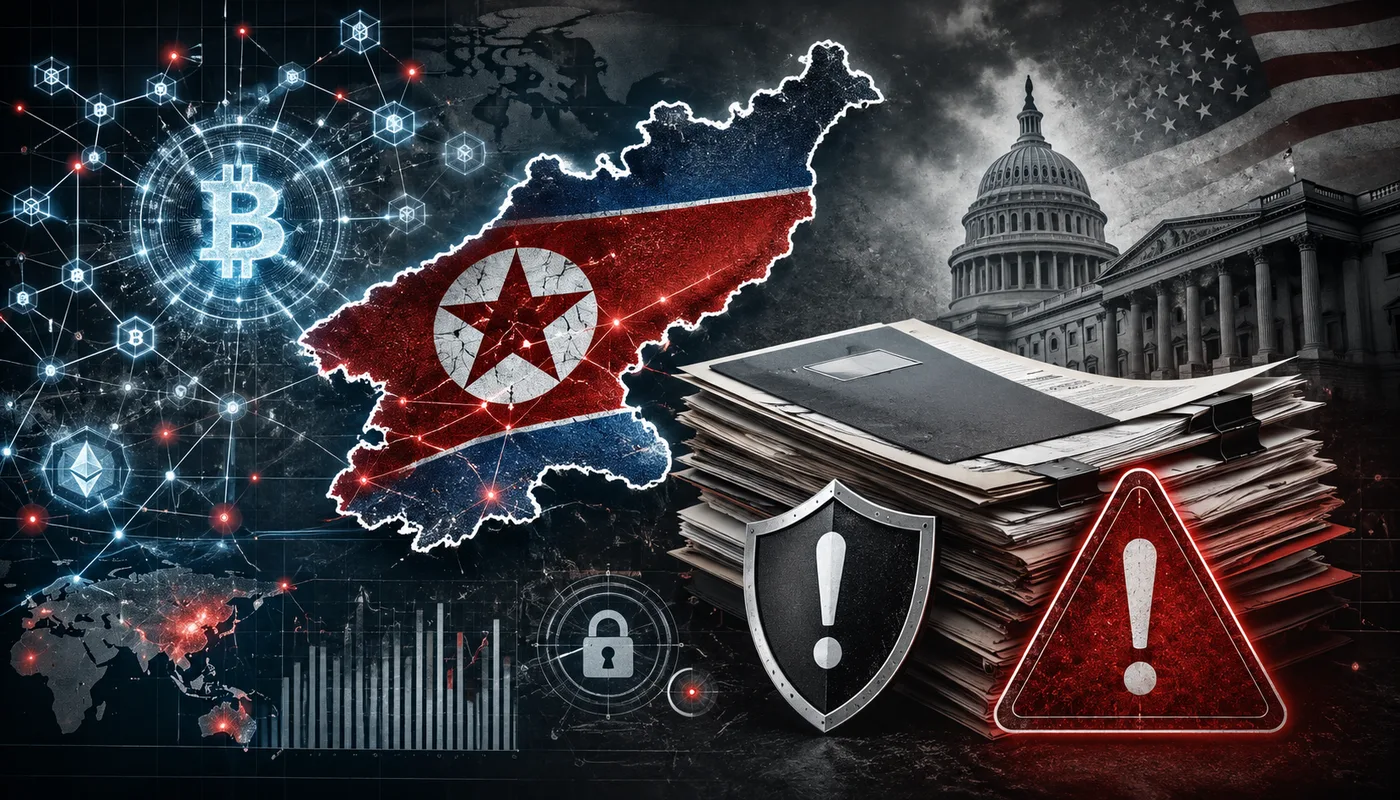
How North Korea’s Illicit Finances Are Reshaping U.S. Business & Security Policy
North Korea’s illicit financial networks, including record cyber thefts and sanctions evasion, pose a growing U.S. business and security risk.
Key takeaways
- North Korea’s state-linked cyber actors stole at least $2.02 billion in cryptocurrency in 2025, a 51% increase year-over-year, making it the largest year on record for DPRK crypto theft. (Chainalysis)
- U.S. sanctions, chiefly administered by the Office of Foreign Assets Control (OFAC), prohibit virtually all business transactions with North Korean entities unless licensed, including crypto tied to designated groups. (OFAC)
- North Korean revenue generation increasingly relies on IT worker fraud and cybercrime networks, which funneled close to $800 million in illicit earnings to the regime in 2024, according to Treasury analysis. (TRM Labs)
- U.S. businesses face sanctions exposure, compliance risk, and financial crime liability if they interact with DPRK-linked virtual assets, wallets, or fraudulent employment schemes. (TRM Labs)
- The nexus between digital finance and geopolitical strategy means North Korea’s illicit funds contribute not just to weapons programs but shape U.S. regulatory and enforcement priorities. (OFAC)
A new era of DPRK finance threatens U.S. business compliance
North Korea (officially the Democratic People’s Republic of Korea) remains one of the most isolated economies in the world. Decades of sanctions have severed trade and traditional finance links with the United States and most Western markets, forcing Pyongyang to find alternatives to support its regime and weapons programs. But unlike the Cold War-era black market, today’s North Korea increasingly operates in the digital shadows: cryptocurrency heists, fake IT worker employment, and sanctions evasion have become significant revenue engines that directly intersect with U.S. business risk and regulatory priorities.
For U.S. executives, investors, and compliance officers, this is not a remote geopolitical curiosity. The patterns of illicit finance tied to North Korea now influence sanctions enforcement, cybersecurity strategy, and regulatory compliance frameworks in ways that affect everyday operations across digital finance, hiring practices, and international risk assessment.
This article unpacks how these networks work, why they matter to U.S. businesses, and what structural trade-offs companies must navigate in 2026.
North Korea’s digital cash flow: from theft to weapons finance
North Korea’s digital heists are no longer fringe events; they are central to the regime’s strategy to circumvent economic isolation. According to blockchain analysis firm Chainalysis, DPRK-affiliated actors stole at least $2.02 billion in cryptocurrency in 2025, a record year driven by fewer but larger thefts and sophisticated laundering techniques. (Chainalysis)
These operations are attributed in part to elite hacking collectives like the Lazarus Group, which have been sanctioned by the U.S. Treasury and designated on the Specially Designated Nationals (SDN) list. (Sanctions Lawyers) Although direct attribution is often opaque, multiple high-profile breaches of crypto services—such as the $1.46 billion Bybit compromise—signal a strategic focus on financial gain rather than simple disruption. (Chainalysis)
These stolen digital assets do more than pad Pyongyang’s coffers. U.S. and UN sanctions experts contend that a substantial portion of these funds feed weapons procurement, financing ballistic missile projects and nuclear expansion programs that the international community has tried to curb. (Facebook)
How IT worker schemes entangle U.S. firms
Cryptocurrency theft grabs headlines, but an equally insidious channel is North Korea’s remote IT worker schemes. In these operations, North Korean nationals pose as remote employees under stolen or fabricated identities for Western companies. Once onboard, their wages are largely sequestered by Pyongyang, and some workers may install malware or extract data. (Wikipedia)
In 2024, U.S. authorities estimated that these schemes generated nearly $800 million in revenue for the regime. (TRM Labs) Treasury’s Office of Foreign Assets Control has responded with designations against eight people and entities linked to these networks across multiple jurisdictions, including Vietnam and Laos. (Binance)
For U.S. businesses, this translates into layered compliance challenges:
- Sanctions risk if unknowingly hiring or transacting with an employee whose earnings are rerouted to DPRK entities. (TRM Labs)
- Financial crime exposure, particularly if wages are processed via payment platforms that interact with sanctioned crypto wallets. (Binance)
- Reputational harm if a firm’s name becomes associated with sanctions violations or cyber-enabled fraud. (TRM Labs)
This dual-front strategy—digital theft and fraudulent employment—illustrates a structural adaptation by a sanctioned state that has managed to embed itself into global financial and labor markets despite intense scrutiny.
U.S. sanctions: legal ironclad, enforcement evolving
The U.S. sanctions regime against North Korea is among the most comprehensive in existence, rooted in executive orders and multiple laws that make virtually all transactions with DPRK persons and entities unlicensed and unlawful for U.S. persons and firms. (OFAC)
Key elements include:
- Prohibitions on exports, investments, and financial transactions with North Korea. (OFAC)
- Sanctions on specific cyber threat actors like Lazarus Group, which makes it illegal for U.S. entities to engage with or transact alongside their wallets. (Sanctions Lawyers)
- Ongoing enforcement actions that freeze crypto addresses, designate facilitators, and expand the network of sanctioned individuals. (Binance)
But enforcement isn’t static. Treasury and the State Department increasingly focus on digital finance vectors, collaborating with global partners to freeze crypto wallets and pursue sanctions evasion networks that span countries with lax controls. (Binance) This reflects a broader recognition that digital assets can slip around traditional controls and that private sector cooperation (e.g., exchanges complying with OFAC screenings) is essential for effective enforcement.
Trade-offs and friction: business risk vs. digital integration
For U.S. companies, the challenge is not simply avoiding bad actors; it’s navigating a world where legitimate customers and vendors may touch the same systems that DPRK adversaries exploit. Cryptocurrency platforms, remote work marketplaces, and global supply chains are all part of the financial plumbing that can be abused by state-aligned cyber actors.
Security frameworks designed for traditional AML (anti-money laundering) don’t always translate cleanly into blockchain environments. Compliance teams must juggle:
- Transaction monitoring that flags sanctioned wallets without inhibiting customer activity.
- Identity verification robust enough to deter fraudulent remote profiles while protecting user privacy.
- Cross-border AML cooperation in jurisdictions that may not fully enforce U.S. sanctions.
The friction is inherent: aggressive compliance can slow business development, and lax controls invite regulatory penalties and national security risk.
The geopolitical angle: why this matters beyond finance
North Korea’s reliance on cyber-enabled finance isn’t just a business issue; it intersects with U.S. national security and geopolitical strategy. As the regime expands its nuclear program and dialogues with the U.S. oscillate, economic pressure via sanctions and enforcement counts as leverage and deterrence. (Yonhap News)
For U.S. regulators, targeting illicit finance is both a financial crime strategy and a national defense posture, squeezing the regime’s ability to fund weapons programs and signaling consequences for evasion. For businesses, understanding this nexus is essential to managing compliance, assessing risk, and safeguarding digital and human capital.
FAQ
Can U.S. companies legally do business with North Korea?
U.S. persons and companies are prohibited from doing business with North Korean entities without specific license; virtually all trade, financial transactions, and investment are banned under U.S. sanctions law. (OFAC)
How does North Korea finance its weapons programs?
North Korea generates revenue for weapons programs through state-orchestrated cybercrime, including cryptocurrency theft estimated at over $2 billion in 2025, and fraudulent IT worker schemes. (Chainalysis)
What sanctions risk should U.S. businesses watch?
U.S. businesses risk sanctions violations, financial crime exposure, and reputational harm by engaging with North Korean-linked crypto addresses, IT fraud networks, or facilitating financial transactions tied to DPRK actors. (TRM Labs)
Sources
- U.S. Department of the Treasury — North Korea (DPRK) Sanctions (ofac.treasury.gov/sanctions-programs-and-country-information/north-korea-sanctions)
- Chainalysis — “2025 Crypto Theft Reaches $3.4 Billion” (chainalysis.com/blog/crypto-hacking-stolen-funds-2026/)
- The Korea Times — “N. Korea likely stole over $2 bil. in cryptocurrency last year” (koreatimes.co.kr)
- Voice of America — “Protecting the US from DPRK Cyber Crimes” (editorials.voa.gov)
- TRM Labs — “Beyond IT Worker Fraud: OFAC’s Latest DPRK Designations” (trmlabs.com)