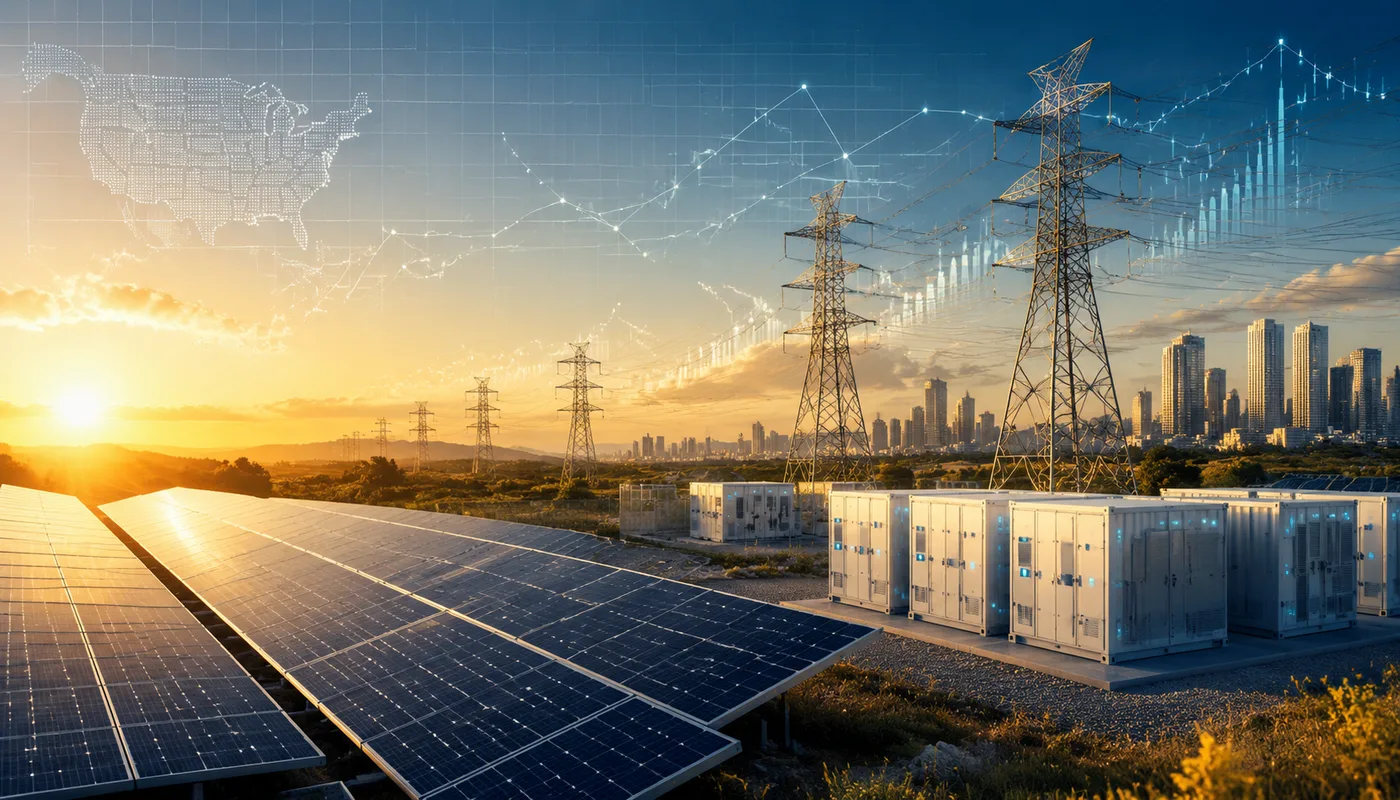
Solar energy company: the U.S. shakeout behind record demand
A solar energy company is a business that turns sunlight into sellable power, but in the 2026 U.S. market the scarce asset is not sunlight; it is grid-connected execution.
Key takeaways
Solar energy company demand is strongest where near-term power demand meets buildable projects.
- U.S. developers plan 43.4 GW of utility-scale solar in 2026, a 60% increase from 2025 if built, and solar is 51% of planned utility-scale additions, according to EIA.
- The U.S. solar industry installed 43.2 GWdc in 2025, down 14% from 2024, so demand is strong but execution is harder, according to SEIA.
- The Section 25D residential clean energy credit is not allowed for expenditures made after Dec. 31, 2025, according to IRS FAQs.
- Grid access is now a balance-sheet issue: more than 2,060 GW of generation and storage was seeking U.S. interconnection at year-end 2025, according to Berkeley Lab.
- The useful 2026 filter is the Socket-Subsidy-Shift test: can the company connect, qualify for credits, and shift solar output with storage?
A solar energy company now wins by proving grid access, tax-credit eligibility, and storage-backed demand, not cheap panels alone. The paradox is blunt: solar is winning the power-build race while the easy solar narrative is breaking; EIA and SEIA data show both momentum and friction. SEIA reports 10,000+ U.S. solar businesses and 279.2 GW of current U.S. solar capacity, while EIA says solar is the largest planned source of new utility-scale capacity in 2026 (SEIA; EIA).
The sharper angle is execution. Solar companies now compete for transformers, interconnection studies, tax-credit certainty, batteries, and power contracts. The strongest players clear three gates: Socket for grid access, Subsidy for incentive eligibility, and Shift for moving daytime output into higher-value hours.
Why is a solar energy company trending in U.S. business right now?
A solar energy company is trending because the U.S. power market needs new capacity faster than many traditional projects can arrive (EIA; Reuters). EIA says developers plan to add 86 GW of utility-scale electric generating capacity in 2026, a record if realized, with solar at 51%, battery storage at 28%, and wind at 14% of planned additions (EIA).
Reuters reported on June 4, 2026, that U.S. solar-storage builds are being pulled forward by data-center power demand and long gas-turbine waits, with major energy companies pursuing hybrid solar-battery projects for large corporate customers (Reuters). That shifts the pitch from “clean power” to “available power.”
What changed as of June 4, 2026: solar is less a climate sidebar and more a capacity procurement story. Land, grid position, batteries, and buyers now matter more than pitch decks.
Which solar energy company model is strongest in 2026?
The strongest solar energy company model in 2026 is the one with controlled grid access and contracted demand. The label hides four businesses with different risks.
| Model | 2026 advantage | Friction |
|---|---|---|
| Utility-scale developer | Solar is 51% of planned 2026 utility-scale additions, according to EIA | Interconnection, permitting, equipment timing |
| Residential installer | Local bill pressure can still create demand | Section 25D ended for post-2025 expenditures, according to IRS |
| Manufacturer | U.S. module capacity reached 65.5 GW in 2025, up from 42.5 GW at year-end 2024, according to SEIA | Factory output can trail domestic demand |
| Solar-plus-storage operator | Developers plan 24 GW of utility-scale battery storage additions in 2026, according to EIA | Battery costs, supply rules, merchant price risk |
The decision rule is simple: rank companies by bottleneck control, not headline megawatts. A project without a grid path is a spreadsheet. A factory without qualified inputs is expensive real estate.
What changed for solar company tax credits as of June 4, 2026?
Federal solar tax-credit eligibility is now a deadline and supply-chain test, not a simple incentive story (IRS Notice 2025-42; IRS). IRS Notice 2025-42 says Section 45Y and Section 48E credits terminate for applicable solar and wind facilities placed in service after Dec. 31, 2027, when construction begins after July 4, 2026 (IRS Notice 2025-42).
The sourcing test also tightened. Treasury and the IRS issued February 2026 guidance on whether qualified facilities, storage technologies, or eligible components receive “material assistance” from a prohibited foreign entity, which can affect eligibility for Sections 45Y, 48E, and 45X credits (IRS).
The myth correction is blunt: “solar has tax credits” is no longer precise enough. Construction evidence, component sourcing, ownership, and placed-in-service dates are financial variables.
What is the main risk investors and buyers should watch?
The main risk is not sunlight; it is conversion of pipeline into commissioned, cash-producing assets. Berkeley Lab says more than 2,060 GW of generation and storage capacity was seeking U.S. grid connection at year-end 2025, and most projects that apply are ultimately withdrawn (Berkeley Lab).
That queue is the industry’s lie detector. Berkeley Lab’s 2025 highlights show only 13% of capacity with interconnection requests from 2000 through 2019 had reached commercial operation by year-end 2024, while 77% had been withdrawn and 10% remained active (Berkeley Lab). SEIA also reports that utility-scale solar installations fell 16% in 2025 to 34.7 GWdc as tax-credit deadline changes and safe-harbor behavior shifted project timing (SEIA).
Solar equipment can be modular and fast. The grid is not. The sharp question is not “How many megawatts are in your pipeline?” It is “Which megawatts have interconnection, equipment, tax qualification, and a buyer?”
How should a U.S. business choose a solar energy company?
A U.S. business should choose a solar energy company by matching the supplier’s bottleneck strength to the buyer’s power problem. Retailers and data centers need different proof.
Commercial buyers should ask for interconnection status, expected commercial operation date, storage configuration, sourcing, and contract structure. Homeowners should test timing, ownership, loan terms, warranties, and state incentives after the federal Section 25D cutoff described by the IRS (IRS FAQs).
For investors, this is not a call to buy any stock. It is a call to separate announced pipeline, contracted pipeline, qualified tax-credit pipeline, and operating assets.
FAQ
FAQ answers define the solar energy company market in plain terms.
What does a solar energy company do?
A solar energy company makes, finances, installs, owns, or sells electricity from solar photovoltaic systems.
What is the biggest risk for U.S. solar companies in 2026?
The biggest 2026 risk is execution: grid access, tax-credit qualification, equipment sourcing, and financing must line up.
Is a solar energy company a good investment?
A solar energy company may benefit from power demand, but business model, balance sheet, policy exposure, and project pipeline matter more than the label.
Sources
These sources support the article's claims.
- EIA 2026 generating capacity additions, U.S. Energy Information Administration, 2026-02-20. Used for: 2026 capacity.
- SEIA Solar Market Insight 2025 Year in Review, Solar Energy Industries Association, 2026-03-10. Used for: 2025 installations.
- SEIA Solar Market Insight, Solar Energy Industries Association, unknown. Used for: U.S. solar context.
- IRS OBBB energy credit FAQs, Internal Revenue Service, 2025-08-21. Used for: Section 25D.
- IRS Notice 2025-42 beginning-construction rules, Internal Revenue Service, 2025-08-20. Used for: 45Y and 48E timing.
- IRS material-assistance energy credit guidance, Internal Revenue Service, 2026-02-12. Used for: PFE guidance.
- Berkeley Lab Queued Up interconnection data, Lawrence Berkeley National Laboratory, unknown. Used for: grid bottlenecks.
- Reuters solar-storage and gas-turbine waits, Reuters, 2026-06-04. Used for: latest solar-storage momentum.