Tugboat‑Towed Barge Hits Maryland Train Bridge, Snarls Northeast Corridor Service
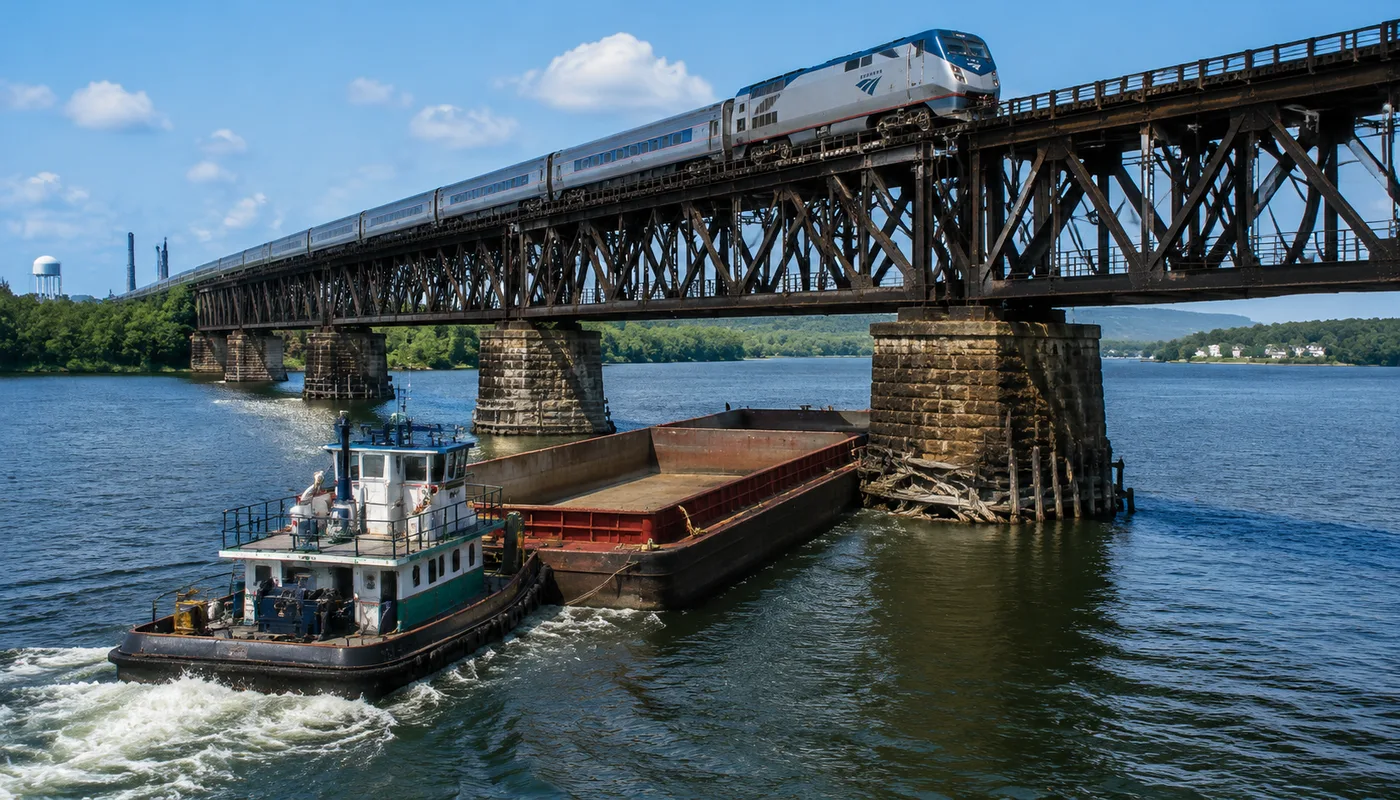
The barge a tugboat was towing struck the Susquehanna River Bridge near Havre de Grace, Maryland, on June 6, 2026, halting Amtrak service on the Northeast Corridor while officials inspected the structure.(Spokesman-Review)
Key takeaways
- Collision event: An empty barge being towed by a tugboat hit the Susquehanna River Bridge at about 2:40 p.m. ET on June 6, 2026.(Spokesman-Review)
- Service disruption: Amtrak suspended all crossings on the bridge, causing delays of up to two hours on the busy Northeast Corridor between Baltimore and Philadelphia.(Spokesman-Review)
- Minimal damage: The U.S. Coast Guard reported only minor damage to timber framing around one support pier and no injuries or damage to the tugboat itself.(Patch)
- Infrastructure context: The century‑old Susquehanna River Bridge carries heavy passenger and freight traffic and has been targeted for replacement due to age and design constraints.(Spokesman-Review)
- Ripple effects: Even a brief shutdown of this critical link can cascade across the Northeast Corridor, which moves hundreds of thousands of people daily.(Spokesman-Review)
The collision between a tugboat‑towed barge and a key rail bridge in Maryland is not just another transport mishap — it’s a stark reminder of how fragile parts of the U.S. rail backbone have become. On June 6, 2026, an empty barge being pushed by a tugboat drifted into the timber‑framed Susquehanna River Bridge, a 100‑plus‑year‑old span on the Amtrak Northeast Corridor. Trains stopped, inspectors swarmed the steel trusses, and for hours thousands of passengers waited while one of the nation’s busiest rail arteries was effectively shuttered.(Spokesman-Review)
Northeast Corridor service — the rail line stretching from Washington, D.C., through Baltimore, Philadelphia, New York, and Boston — is the busiest passenger rail route in the United States. Its dependence on century‑old structures like the Susquehanna River Bridge makes even small disruptions economically and socially costly. Amtrak’s decision to suspend trains until a structural inspection was complete underscored two competing priorities: safety first versus fluid mobility for commerce and commuters.(Spokesman-Review)
What happened when the tugboat hit the Maryland train bridge
The collision happened shortly after mid‑afternoon on June 6, 2026. A tugboat was pushing an empty barge up the Susquehanna River toward the rail span when shifting winds and currents appear to have moved the barge out of a safe alignment. At about 2:40 p.m. ET, the barge made contact with the wooden skirting around a bridge support pier.(Spokesman-Review)
Officials from the U.S. Coast Guard reported that the impact was limited to minor damage around the pier’s timber framing and did not compromise the structural integrity of the bridge’s main steel elements. The tugboat itself was unharmed, and no injuries were reported among crew or rail passengers.(Patch)
This sort of incident might sound trivial — a “bump” on wood — but modern rail safety protocols are unforgiving. Even minor hits demand thorough inspections because hidden stresses can propagate through critical load‑bearing members. Amtrak halted all train crossings until engineers could verify the bridge was safe. Service did resume by about 5 p.m., and schedules normalized by around 8 p.m..(Spokesman-Review)
How the disruption rippled across the Northeast Corridor
Stopping service on the Susquehanna River Bridge — even briefly — created ripple effects along the Northeast Corridor. Passengers heading north to New York or south to Washington found schedules slipping by up to two hours, with at least one train stuck short of the crossing for close to that long.(Spokesman-Review)
For Amtrak, delays translate directly into operational costs: crew overtime, equipment idle time, and schedule reshuffling across a tightly choreographed timetable where one late arrival can cascade into delays hours down the corridor. For freight operators and commuter lines that share tracks or depend on timely connections, these disruptions can mean missed slots, demurrage fees, and logistical headaches that cost money. While this particular incident did not make headlines for injuries or major damage, the economic impact — measured in passenger hours lost and service irregularities — remains non‑trivial.(Spokesman-Review)
Why this collision matters beyond a single afternoon
This barge strike is a microcosm of a larger U.S. infrastructure conundrum: aging bridges and rails carrying loads they were never designed to handle indefinitely. The Susquehanna River Bridge has been a bottleneck for years, a century‑old link on a corridor built for early 20th‑century traffic volumes. Amtrak has been working to replace it as part of a modernization drive that predates this year’s incident.(Spokesman-Review)
Investors, companies, and policy makers often talk about infrastructure in dollar figures — billions for new spans, revenue impacts, return on investment — but the real cost is broader: reliability of national supply chains and commuter trust in public transit. Delays and stoppages on corridors like this one affect not just train timetables but retail deliveries, labor mobility, and regional economic flows. In that light, a seemingly minor tugboat collision exposes a strategic vulnerability: too much dependence on legacy assets with too little redundancy.(Spokesman-Review)
What’s next for rail bridges and barge traffic
At this moment, the Susquehanna River Bridge isn’t closed indefinitely; service returned the same day. But incidents like this add to the pressure on federal and state leaders to accelerate infrastructure renewal. Rail corridors, especially those as busy as the Northeast Corridor, are economic arteries. Keeping them healthy isn’t just about comfort and speed — it’s about avoiding costly disruptions like this one.(Spokesman-Review)
One lesson emerging from this and past bridge strikes — from the Francis Scott Key Bridge collapse in 2024 to this barge collision — is that maritime‑rail interfaces demand robust risk analysis and mitigation. Ensuring tugboat and barge operations near critical rail and road bridges come with stricter controls, pilotage standards, and protective design elements can reduce these risks. But tighter rules often mean higher costs and slower commerce — a tradeoff that regulators and industry will need to balance thoughtfully.(Spokesman-Review)
FAQ
What happened when a tugboat hit the Maryland train bridge?
On June 6, 2026, a barge being towed by a tugboat struck the Susquehanna River Bridge near Havre de Grace, forcing Amtrak to halt service while inspectors verified safety before trains resumed.(Spokesman-Review)
Did the collision damage the bridge or injure people?
The U.S. Coast Guard reported only minor damage to timber framing around a support pier and no injuries or damage to the tugboat from the collision.(Patch)
How did the incident affect rail service?
Amtrak suspended crossings on the bridge for inspection, leading to up to two hours of delays for passengers on the Northeast Corridor before service normalized.(Spokesman-Review)
Sources
- Patch: Barge Hits Susquehanna River Bridge Pier — June 8, 2026 (Patch)
- The Spokesman‑Review: Barge hit Susquehanna Bridge on Saturday near Havre de Grace — June 7, 2026 (The Baltimore Sun/Baltimore Sun content)
- Eciks: Amtrak NEC service disruption follows bridge strike — June 8, 2026 (Railway Supply)