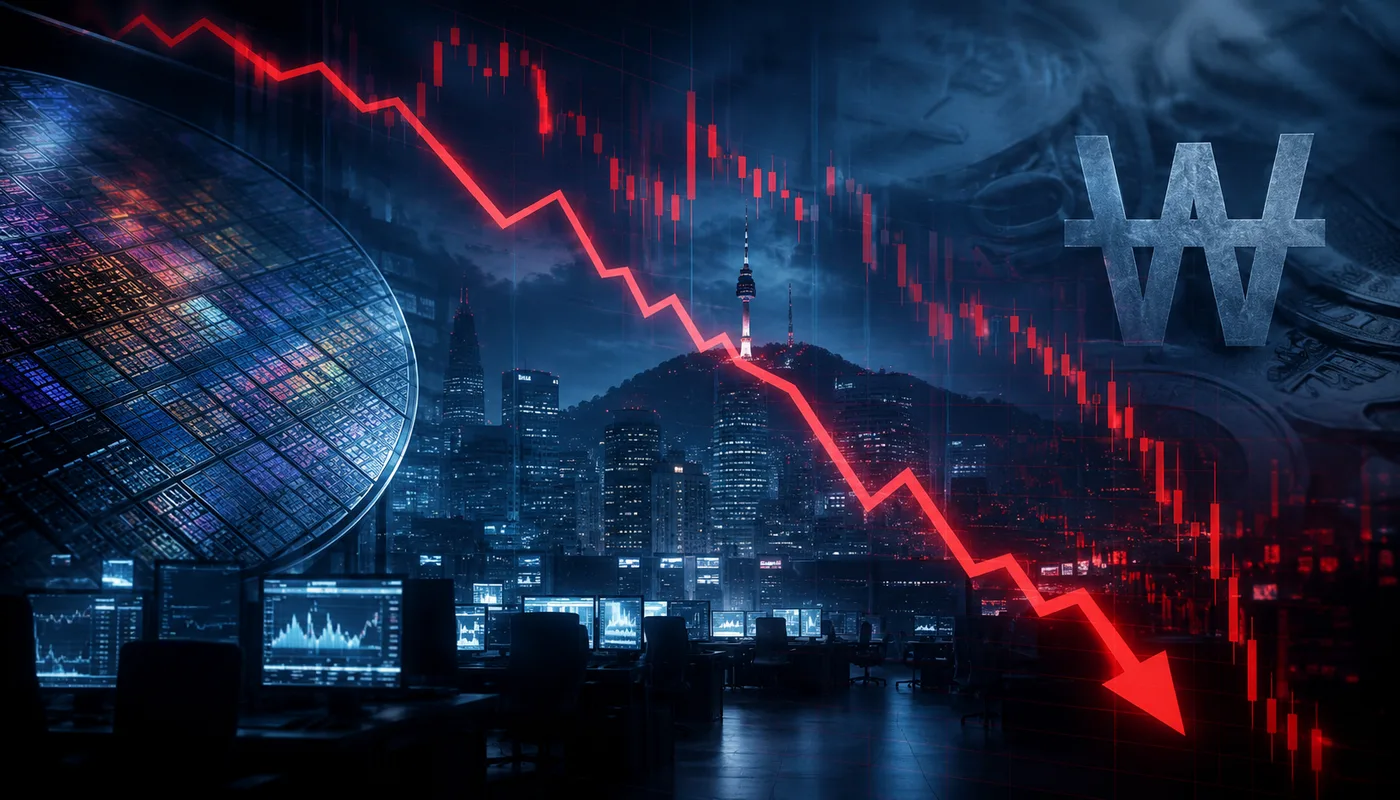
KOSPI Shock: Korea’s AI-Chip Rally Has a Concentration Problem
KOSPI is South Korea’s main stock index, and its latest crash matters because the world’s AI trade suddenly looks less diversified than advertised.
Key takeaways
KOSPI is now a concentrated proxy for the global AI hardware cycle, not just a broad Korea headline.
- KOSPI fell 8.3% to close at 7,484.41 on June 8, 2026, its biggest daily drop since March 4, Reuters reported.
- Samsung Electronics and SK Hynix made up 55% of KOSPI, so the index now carries unusually high AI-memory concentration risk, Reuters reported.
- The U.S. payroll report showed 172,000 jobs added in May 2026 and 4.3% unemployment, according to the Bureau of Labor Statistics.
- EWY, a U.S.-listed Korea ETF, had 78 holdings, 51.27% in information technology, and a 0.59% expense ratio as of June 5, 2026, according to iShares.
- The useful rule is simple: read KOSPI through chips, U.S. rates, and the vehicle used to get Korea exposure.
KOSPI is South Korea’s main stock index, and its 8.3% plunge shows how Korea became a U.S. AI-rate risk signal. Reuters reported that the benchmark closed at 7,484.41 on June 8 after circuit breakers briefly halted trading. That is not just a Seoul story. KOSPI’s surge had been built on the same artificial-intelligence hardware trade that pulled U.S. money into semiconductors. The friction is obvious: investors wanted Korean diversification, but they increasingly got Samsung Electronics and SK Hynix beta. This article explains what KOSPI measures, why it sold off, why U.S. investors searched it, and how to separate Korea opportunity from a crowded chip trade.
What is KOSPI, and what does it actually measure?
KOSPI is South Korea’s broad market-capitalization stock index for common shares listed on the Korea Exchange’s main board. The index has a base value of 100 on January 4, 1980, and it is calculated as 100 times current capitalization divided by base market capitalization, according to the IMF’s SDDS metadata for Korea’s share price index.
That formula matters. A market-cap index gives larger companies more influence. When the largest companies are banks, automakers, shipbuilders, and chipmakers, KOSPI reads like a diversified national balance sheet. When two memory-chip giants dominate returns, it reads like a semiconductor cycle with a country wrapper.
The Korea Exchange’s data portal lists “Index price” under Basic Data and carries KOSPI and KOSPI 200 summaries, making KRX the official place to verify closing figures after publication KRX Data Marketplace.
Why did KOSPI fall so hard on June 8, 2026?
KOSPI fell because a crowded AI-chip trade collided with renewed U.S. rate fears after stronger labor data. The index closed down 8.3% at 7,484.41, stood 15% below its June 2 peak of 8,801.49, and triggered circuit breakers for the third time in 2026, Reuters reported.
The catalyst came from across the Pacific. The U.S. economy added 172,000 jobs in May while unemployment stayed at 4.3%, according to the Bureau of Labor Statistics. Stronger hiring can push investors to expect tighter Federal Reserve policy for longer, which usually hurts high-valuation growth trades first.
The selloff hit the exact names that had powered the rally. Samsung Electronics fell 10.2%, and SK Hynix dropped 7.7% on June 8, Reuters reported.
What changed as of June 8, 2026: the market stopped treating Korea’s chip concentration as a feature and started pricing it as a fragility.
Why should U.S. investors care about KOSPI?
KOSPI matters to U.S. investors because it has become a live signal for global AI hardware, dollar rates, and single-country Korea exposure. On May 6, KOSPI closed above 7,000 for the first time at 7,384.56, while Samsung Electronics and SK Hynix together accounted for 44% of the index’s total value, Reuters reported.
By June 8, the concentration was sharper. Samsung and SK Hynix comprised 55% of KOSPI, meaning the benchmark increasingly moved like a bet on one or two AI-memory winners, Reuters reported. That is the myth correction: KOSPI is broad by construction, but not always broad in risk.
For U.S. portfolios, the most visible product is often EWY, the iShares MSCI South Korea ETF. iShares says the fund offers targeted single-country exposure; as of June 5, 2026, it had $21.17 billion in net assets, a $180.16 NAV, and an 83.43% year-to-date NAV total return iShares.
EWY is not identical to KOSPI. Its 78 holdings and 51.27% information-technology weight show the same concentration problem, but through a U.S.-listed ETF with its own fees, trading hours, premiums, discounts, and tax issues iShares.
What is the best decision rule for reading KOSPI now?
The cleanest decision rule is to separate Korea’s earnings engine from Korea’s index concentration before reacting. A high KOSPI can mean better profits, better governance expectations, or simply a crowded bid for a small set of chip names.
| Gate | What to check | Why it matters |
|---|---|---|
| Chips | Samsung Electronics and SK Hynix weight, memory pricing, AI-server demand | Two companies comprised 55% of KOSPI by June 8, 2026, Reuters reported. |
| U.S. rates | Payrolls, Treasury yields, Federal Reserve expectations | The May jobs report showed 172,000 payroll gains and 4.3% unemployment, according to BLS. |
| Vehicle | ETF holdings, fees, liquidity, premium or discount | EWY had a 0.59% expense ratio and a -2.76 premium/discount reading as of June 5, 2026, according to iShares. |
This framework avoids the lazy binary of “buy Korea” or “avoid Korea.” KOSPI can still reflect real earnings momentum if AI memory demand holds. It can also punish late buyers if valuation, currency, and position crowding turn together. The point is not to predict the next tick. The point is to know which risk is actually moving the tape.
FAQ
FAQ answers KOSPI’s practical meaning for U.S. readers in plain market language.
What is KOSPI?
KOSPI is South Korea’s broad market-capitalization stock index, built from common shares on the Korea Exchange’s main board.
Why is KOSPI trending in the United States?
KOSPI is trending in the United States because its June 8 plunge linked Korea’s AI-chip rally to U.S. rate expectations and semiconductor risk.
Is KOSPI the same as EWY?
KOSPI is not the same as EWY; KOSPI is a Korean stock index, while EWY is a U.S.-listed ETF offering targeted South Korea equity exposure.
What is the main risk in KOSPI right now?
The main KOSPI risk is concentration, because Samsung Electronics and SK Hynix made up 55% of the benchmark by June 8, 2026.
Sources
Sources are the official and market references used to verify definitions, dates, index moves, and U.S. investor context.
- South Korea's KOSPI craters over 8% as Fed fears spark tech rout — Reuters, 2026-06-08.
- Employment Situation Summary - May 2026 — U.S. Bureau of Labor Statistics, 2026-06-05.
- KRX Information Data System — Korea Exchange, unknown.
- DQAF View: Korea - Stock market: share price index — International Monetary Fund, unknown.
- Korea's KOSPI breaks 7,000 as AI rally catapults Samsung into $1 trillion club — Reuters, 2026-05-06.
- How a few AI chip giants warped Asia's stock picking game — Reuters, 2026-06-08.
- iShares MSCI South Korea ETF — BlackRock/iShares, unknown.